
The Dahlonega Mint was a notable branch mint in American history. It was small, regional, short-lived, and entirely tied to gold. Unlike Philadelphia, which served as the nation’s original coinage center, Dahlonega existed because gold had been discovered in the southern Appalachians and miners needed a practical way to turn raw metal into federal coinage.
From 1838 to 1861, the Dahlonega Mint produced only gold coins. Every coin it struck carried a “D” mint mark, a letter now more commonly associated with Denver. For collectors, however, an early gold coin with a “D” mint mark means something very different: Georgia gold, antebellum history, branch mint scarcity, and a facility whose coinage ended with the Civil War.
Gold in North Georgia
The story begins with the Georgia Gold Rush. In 1829, gold discoveries in north Georgia drew miners, speculators, merchants, and opportunists into the region. Dahlonega, located in Lumpkin County, became the center of that activity. The name itself is often associated with the Cherokee word for yellow or gold, a reminder that the region’s mineral wealth was tied to a much older Indigenous landscape before the federal government and settlers reshaped it.
As gold production increased, miners faced the basic problem of sending gold to Philadelphia for assay and coinage, an expensive, slow, and risky trip. Raw gold could be sold privately, but federal coinage gave it a reliable monetary form. A branch mint in Georgia would let miners deposit gold closer to where it was found and receive coins in return.
Congress answered that need in 1835 by authorizing three new branch mints: Charlotte, North Carolina; Dahlonega, Georgia; and New Orleans, Louisiana. Charlotte and Dahlonega were established for gold coinage, while New Orleans served a broader commercial role.
Opening the Dahlonega Mint
The Dahlonega Mint opened in 1838 and began striking coins that same year. It was never a large industrial powerhouse. It was a practical facility built to serve a mining region. Its purpose was to assay, refine, and coin gold from the surrounding area.
The mint’s “D” mint mark was used on every coin it produced. That detail is important because the Dahlonega Mint closed decades before the Denver Mint began striking coins. In modern collecting, an 1800s gold coin with a “D” belongs to Dahlonega, not Denver.
The first coins struck at Dahlonega were $5 gold half eagles. Over time, the mint added other gold denominations, but its identity remained consistent. It was a Southern gold mint, and its output reflected the supply, technology, and limitations of that region.
The Coins Produced at the Dahlonega Mint
The Dahlonega Mint produced four gold denominations: the gold dollar, quarter eagle, three-dollar gold piece, and half eagle.
The Half Eagle, or $5 gold coin, was the mint’s most consistent denomination. Dahlonega struck half eagles in every year of its operation, from 1838 through 1861. These coins form the backbone of Dahlonega collecting and include many of the mint’s best-known issues.
The Quarter Eagle, or $2.50 gold coin, was struck from 1839 through 1859, with one exception: no quarter eagles were produced there in 1858. These coins are smaller than half eagles but often just as desirable because of their scarcity and connection to the branch mint.
The Gold Dollar was introduced nationally in 1849, and Dahlonega struck gold dollars from 1849 through 1861. These small coins are especially popular among collectors who appreciate compact, historically rich gold issues.
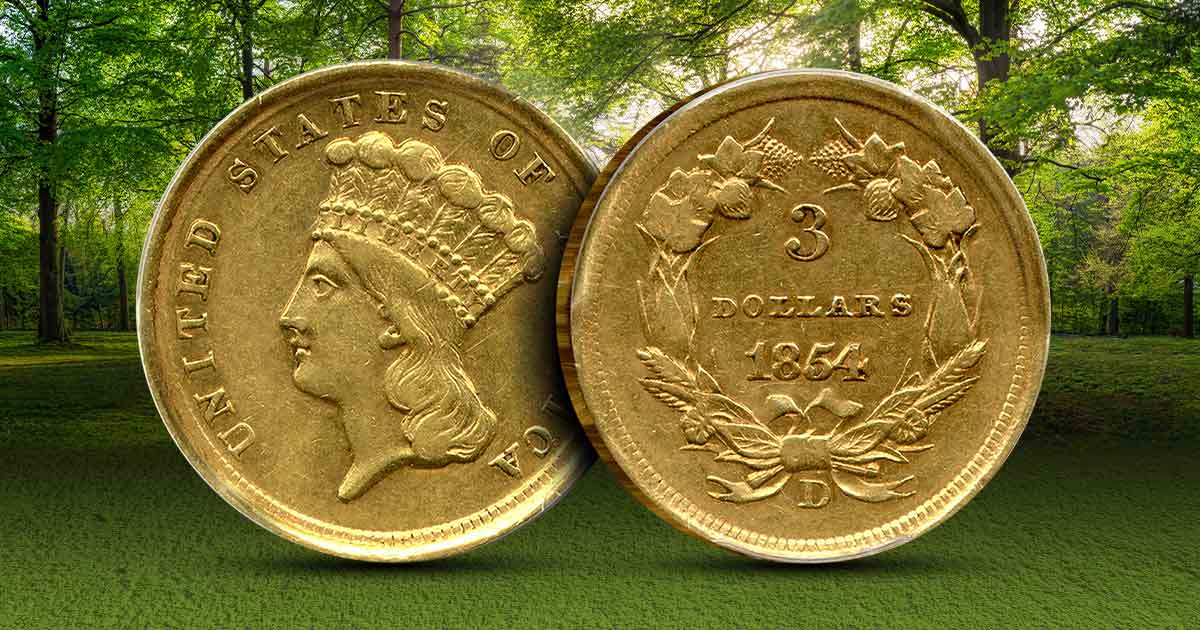
The Three-Dollar Gold Piece was produced at Dahlonega only once, in 1854. That single-year production makes the 1854-D three-dollar gold piece one of the signature coins of the mint. It represents a denomination that was unusual even in the broader U.S. series and exceptionally brief at Dahlonega.
The Character of Dahlonega Gold
Dahlonega coins are admired not only because they are scarce, but because they have personality. Many were struck under less-than-ideal conditions compared with coins from larger mints. Weak strikes, planchet irregularities, and uneven details are common. To collectors, these traits are part of the charm.
A Dahlonega coin is a product of a small branch mint working with local gold in a frontier-adjacent economy. The coins may not have the technical uniformity of Philadelphia issues, but they carry an authenticity that specialists value deeply.
The gold itself can also be distinctive. Southern branch mint gold is sometimes known for subtle color differences, influenced by the natural composition of the metal. When combined with the “D” mint mark and limited production, that character gives Dahlonega coins a strong identity.
The Civil War and the End of Coinage
The Dahlonega Mint’s coinage career ended in 1861. As the Civil War began and Georgia seceded, the facility came under Confederate control. Some 1861-D coins were struck during this turbulent transition, creating issues that are especially compelling to collectors.
After 1861, Dahlonega never again operated as a U.S. branch mint. The federal government did not reopen it after the war. Its active coinage period lasted only 24 calendar years, and in that time it produced fewer than 1.4 million gold coins with a total face value of more than $6 million.
That short operating life is central to the appeal of Dahlonega gold. The mint was born from a gold rush, served a regional need, and disappeared as a coinage facility during the national rupture of the Civil War.
What Happened to the Mint Building?
The original mint building did not survive intact. After the Civil War, the property eventually became associated with what is now the University of North Georgia. The old mint building was used by the college until a fire destroyed it in 1878. A later building, Price Memorial Hall, now stands on the site and is topped by a gold-covered steeple that honors the region’s gold history.
Dahlonega’s minting era may have ended in the 1860s, but the town’s identity remains closely tied to gold. The Dahlonega Gold Museum and local historical memory continue to preserve the story of the Georgia Gold Rush and the branch mint that followed it.
Why Dahlonega Mint Coins Matter
Dahlonega Mint coins matter because they bring together several powerful themes in American history: gold discovery, regional economics, federal expansion, Southern history, and the Civil War. They were not mass-produced in endless quantities. They were struck in a specific place for a specific purpose, and their scarcity reflects both limited production and heavy later attrition.
For collectors, the “D” mint mark identifies a coin made from Southern gold at a small Georgia branch mint that operated for less than a quarter century. Whether it appears on a gold dollar, quarter eagle, three-dollar piece, or half eagle, that mark carries one of the most interesting stories in U.S. numismatics.