


Classic Head Quarter Eagle Values
How Much Classic Head Quarter Eagles are Worth: Classic Head Quarter Eagle Values & Coin Price Chart
Year | Mint | Variety | Designation | VG-8 | F-12 | VF-20 | EF-40 | AU-50 | U-60 | MS-63 | MS-64 | MS-65 | MS-66 | MS-67 |
|---|---|---|---|---|---|---|---|---|---|---|---|---|---|---|
1800 | P | Plain 4- Stemless Wreath | Red-brown | 200 | 300 | 400 | 500 | 600 | 700 | 800 | 900 | 1000 | 1200 | 1100 |
| Year | Mint | Variety | Designation | VG-8 | F-12 | VF-20 | EF-40 | AU-50 | MS-60 | MS-63 | MS-64 | MS-65 | MS-66 |
|---|---|---|---|---|---|---|---|---|---|---|---|---|---|
| 1834 | (None) Phil | -- | -- | $865 | $957 | $1,034 | $1,268 | $1,590 | $3,788 | $9,925 | $16,450 | $57,500 | $100,000 |
| 1835 | (None) Phil | -- | -- | $865 | $957 | $1,034 | $1,323 | $1,595 | $4,175 | $12,850 | $33,500 | $65,000 | -- |
| 1836 | (None) Phil | -- | -- | $865 | $957 | $1,034 | $1,268 | $1,540 | $3,788 | $9,925 | $16,450 | $62,500 | -- |
| 1836 | (None) Phil | Script 8 | -- | $865 | $957 | $1,034 | $1,268 | $1,665 | $3,788 | $9,925 | $16,450 | $57,500 | $100,000 |
| 1837 | (None) Phil | -- | -- | $934 | $1,025 | $1,130 | $1,468 | $2,225 | $5,750 | $11,025 | $37,500 | $95,000 | -- |
| 1838 | (None) Phil | -- | -- | $865 | $957 | $1,048 | $1,323 | $2,013 | $4,273 | $13,275 | $18,725 | $62,500 | $125,000 |
| 1838 | C | -- | -- | -- | $6,300 | $7,875 | $12,125 | $15,700 | $45,000 | $85,000 | $160,000 | -- | -- |
| 1839 | (None) Phil | -- | -- | $954 | $1,098 | $1,308 | $2,700 | $4,478 | $15,475 | $65,000 | -- | -- | -- |
| 1839 | C | -- | -- | -- | $4,200 | $5,775 | $8,538 | $10,500 | $37,500 | $110,000 | -- | -- | -- |
| 1839 | D | -- | -- | $4,450 | $5,225 | $6,538 | $10,425 | $13,050 | $45,000 | $100,000 | $200,000 | -- | -- |
| 1839 | O | -- | -- | $1,625 | $1,970 | $2,530 | $4,630 | $6,275 | $17,975 | $52,500 | $100,000 | $200,000 | -- |
History of the Classic Head Quarter Eagle
The Classic Head Quarter Eagle is a United States gold coin of the $2.50 denomination that was produced from 1834 to 1839, a relatively short but significant period. This series marked a turning point in U.S. gold-coinage policy, driven largely by the Coinage Act of 1834, which revised the weight and fineness of the gold coins to discourage melting and export of U.S. gold specie.
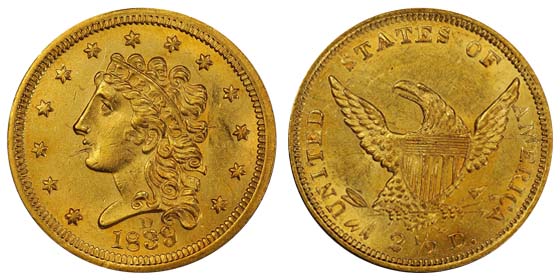
Chief Engraver William Kneass designed the new “Classic Head” profile of Liberty on the obverse, giving the coin a new appearance to reflect the revised specifications and to distinguish it from earlier issues. Officially, the design features Liberty facing left, her hair tied by a band inscribed “LIBERTY”, surrounded by thirteen stars, and below the date. On the reverse, the coin features a shield-bearing eagle with wings outstretched, clutching an olive branch and arrows; notably, the motto “E PLURIBUS UNUM” was omitted for this issue to distinguish the redesigned coins from earlier issues clearly.
Under the new specification following the Act of June 28, 1834, the quarter eagle weighed approximately 4.18 g and measured about 18.2 mm in diameter. For 1834-36, the fineness was .8992 gold, and beginning in 1837, it was adjusted to .900 gold. While initial minting was at the Philadelphia Mint, gold discoveries in the South led to branch-mint production at Charlotte (from 1838) and later at Dahlonega and New Orleans (1839).
This coin represents a policy shift, a design evolution, and the expansion of U.S. branch-minting in the early 19th century.
Rarest Coins in the Series
Within the Classic Head Quarter Eagle series, certain dates and mint mark combinations stand out because they are scarce and in demand among collectors. According to the guides, some of the rarest include:
- The 1834 issue (first year of the series) is inherently collectible because of its transitional nature and often displays proof-like surfaces in higher-grade examples.
- The 1838 C (Charlotte) and 1839 D (Dahlonega) issues are especially rare because they were struck at branch mints for the first time for this denomination. The Charlotte 1838 mintage is notably low (the lowest in the series), and it circulated heavily, making high-grade survivors very hard to find.
- Proof strikes of the series are very scarce, with fewer than ten known for some dates.
Because the bulk of the mintage and survivors come from Philadelphia, branch mint examples carry a significant premium. Moreover, high-grade ‘Uncirculated’ condition coins are far fewer than circulated ones, meaning that rarity increases sharply as the condition improves. For any collector or investor analyzing the Classic Head Quarter Eagle value, these rarities are the main factor behind higher premiums in the series.
Types of Collections
Collectors of the Classic Head Quarter Eagle may adopt different collecting strategies, each with its own advantages and challenges:
- Type Set / Basic Representative: One might include a single example of the Classic Head design in a broader U.S. gold or quarter Eagle type set. This allows exposure to the design without chasing the full date-mint-mark complexity.
- Complete Series Set: Collectors may aim to assemble all dates and mint marks of the series (1834 through 1839, including Philadelphia, Charlotte, Dahlonega, and New Orleans issues). This is ambitious because of the rarity of branch mint issues and proof examples.
- High-Grade Condition Focus: Some collectors choose fewer coins but target high grades (AU to MS) or notable eye appeal and toning. In this case, rarer dates in premium condition become the focal point.
- Branch Mint Specialist: A more advanced collector may specialize in branch-mint gold coins (such as the 1838 C or 1839 D) and pursue only those variants, resulting in a specialized collection with historical depth.
Beginner vs. Advanced Collecting
Beginner Collecting
For someone just entering the world of U.S. gold coins, the Classic Head Quarter Eagle offers a manageable place to start. The series is relatively short, historically interesting, and accessible in lower grades (Fine to Extremely Fine) compared to ultra-rare gold coins of other denominations. For beginners, the focus should be on learning how to assess condition (hair detail on Liberty, eagle wing feathers, surface marks), being aware of cleaned or polished coins, and choosing coins certified by reputable grading services.
Advanced Collecting
At the advanced level, collectors delve deeper into die varieties, proof versus business strikes, mint mark survival populations, and pedigree coins with documented auction history. They focus on high-grade, original surfaces, exceptional eye appeal, and often branch-mint rarities that often sell for large premiums because of limited supply. At this level, full series sets, or specialized subsets (e.g., only branch mint issues) become realistic goals. Advanced collectors must also navigate issues such as provenance, toning authenticity, and markets for top-tier gold coins.
Investment Potential
The Classic Head Quarter Eagle is not only a historical collectible but also a potential investment option. Several factors support its case:
- Short production span (1834-1839) and relatively low surviving uncirculated populations mean scarcity persists.
- Historical significance tied to gold coinage reform and the branch-mint expansion enhances its story and desirability among numismatists.
- The gold content floor value ensures a baseline even in weak markets, but numismatic premiums (for rarity and condition) can far exceed the metal value.
- Premiums for top-condition, branch-mint, and proof examples are substantial. As example, only a handful of proof strikes exist, making their value highly dependent on collector demand and condition.
On the other hand, prudent investors must consider risks: liquidity may be lower for very high-end pieces; subtle grade differences matter greatly; the market for U.S. gold coins can be cyclical; coin preservation (avoiding cleaning, damage, environmental deterioration) is vital. When approached with research and discipline, though, this series offers a blend of aesthetic, historical, and investment appeal.
Whether one is examining the series for its design and history or for its collectible and investment potential, the Classic Head Quarter Eagle holds a distinct place in U.S. numismatics. Its combination of reform-era importance, design evolution, branch-mint diversity, and condition-sensitive rarity makes it a compelling subject of study and acquisition for both newcomers and seasoned collectors.