


Turban Head Quarter Eagle Values
How Much Turban Head Quarter Eagles are Worth: Turban Head Quarter Eagle Values & Coin Price Chart
Year | Mint | Variety | Designation | VG-8 | F-12 | VF-20 | EF-40 | AU-50 | U-60 | MS-63 | MS-64 | MS-65 | MS-66 | MS-67 |
|---|---|---|---|---|---|---|---|---|---|---|---|---|---|---|
1800 | P | Plain 4- Stemless Wreath | Red-brown | 200 | 300 | 400 | 500 | 600 | 700 | 800 | 900 | 1000 | 1200 | 1100 |
| Year | Mint | Variety | Designation | VG-8 | F-12 | VF-20 | EF-40 | AU-50 | MS-60 | MS-63 | MS-64 | MS-65 | MS-66 |
|---|---|---|---|---|---|---|---|---|---|---|---|---|---|
| 1796 | (None) Phil | No Stars SRS: R4 100-125 Known | -- | -- | $63,800.00 | $101,500.00 | $153,750.00 | $190,750.00 | $405,000.00 | $1,750,000.00 | $2,435,000.00 | $3,070,000.00 | -- |
| 1797 | (None) Phil | Less than 30 Known SRS: R6 | -- | $34,600.00 | $38,750.00 | $46,500.00 | $60,600.00 | $86,300.00 | $258,000.00 | $396,000.00 | $550,000.00 | -- | -- |
| 1798 | (None) Phil | Less than 60 known SRS: R5 | -- | $6,875.00 | $9,350.00 | $10,745.00 | $18,250.00 | $30,700.00 | $103,700.00 | $220,000.00 | $330,000.00 | $836,000.00 | -- |
| 1804 | (None) Phil | 14 star Reverse. 150-200 Known SRS: R4 | -- | $7,920.00 | $10,175.00 | $12,175.00 | $17,700.00 | $22,400.00 | $50,500.00 | $150,200.00 | -- | -- | -- |
| 1805 | (None) Phil | 100-150 Known SRS: R4 | -- | $8,438.00 | $9,350.00 | $10,745.00 | $16,050.00 | $19,725.00 | $35,550.00 | $150,400.00 | $421,500.00 | -- | -- |
| 1806/4 | (None) Phil | Stars 8x5 Less than 100 Known SRS:R4 | -- | $8,438.00 | $9,625.00 | $11,020.00 | $16,600.00 | $21,100.00 | $56,400.00 | $145,750.00 | $220,000.00 | -- | -- |
| 1807 | (None) Phil | 250-300 Known | -- | $6,875.00 | $9,350.00 | $10,745.00 | $16,050.00 | $18,900.00 | $35,550.00 | $114,650.00 | $207,500.00 | $617,500.00 | -- |
History of the Turban Head Quarter Eagle
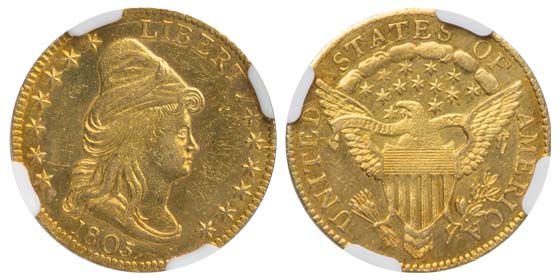
The Turban Head Quarter Eagle, also called the Capped Bust Right Quarter Eagle, was the first $2.50 gold coin produced by the United States Mint. Struck from 1796 to 1807, this coin marks the start of America’s gold coinage tradition and is historically significant in early U.S. numismatics.
Designed by Robert Scot, the U.S. Mint’s first Chief Engraver, the obverse features Liberty facing right, wearing a soft Phrygian cap, a traditional emblem of freedom dating back to ancient Rome. This cap, often mistaken for a turban, gave rise to the coin’s popular nickname. Surrounding Liberty are stars, sometimes matching the number of states then in the Union (e.g., 16 in 1796), later standardized to 13 to represent the original states.
The reverse evolved throughout its lifespan:
- 1795 Small Eagle Reverse: The first-year 1796 “No Stars” type used a Small Eagle reverse, perched on a wreath.
- 1796–1807 Heraldic Eagle Reverse: Based on the Great Seal of the United States, showing an eagle clutching arrows and an olive branch.
With a gold content of .9167 fine gold (22 karats), the Turban Head Quarter Eagle not only served as currency but also as a statement of the young nation’s financial integrity on the global stage.
Rarest Coins in the Series
All issues of the Turban Head Quarter Eagle are scarce, and certain dates and varieties are major rarities in early American numismatics.
- 1796 No Stars Quarter Eagle: The inaugural “No Stars” issue is among the rarest early U.S. gold coins. Mintage was 963, with roughly 100–125 survivors estimated today. The starless obverse is distinct within the series.
- 1796 With Stars Quarter Eagle: Struck later in the same year, this version introduced stars around Liberty’s portrait and marked an early design change.
- 1804 Quarter Eagle: A rarity with a total mintage of 3,327 across 13- and 14-star reverses; the series continued through 1807.
- 1797–1798 Transitional Varieties: These coins display subtle die variations, overdates, and alignment differences, reflecting the early Mint’s hand-engraving methods. Collectors often pursue these nuances, adding depth to specialized collections.
Because of their low mintages, early exportation, and melting for gold content, surviving examples are scarce, especially in Mint State. They most often appear at major auctions or in museum exhibits, and some have realized six- or seven-figure prices, depending on condition and provenance.
Types of Collections
Collectors approach the Turban Head Quarter Eagle in several ways depending on their experience, goals, and budget.
- Type Collections: Many collectors seek one representative example of each major design type in U.S. coinage. The Turban Head Quarter Eagle represents the earliest stage of American gold minting, making these a historic and treasured find.
- Date and Mint Variety Collections: Ambitious numismatists attempt to assemble every date and die variety from 1796 to 1807. This is a serious challenge due to extreme rarity and limited availability.
- Design Evolution Sets: Collectors sometimes build sets showcasing both reverse types (Small Eagle and Heraldic Eagle), illustrating the artistic and symbolic progression of early coinage.
- High-Grade or Prooflike Specimens: Advanced collectors focus on high-grade coins with original luster and strong strike detail, including Prooflike (PL) pieces when noted.
Each collecting path offers a unique appreciation for the artistry, history, and Turban Head Quarter Eagle value embedded in these rare gold coins.
Beginner vs. Advanced Collecting
Beginner Collecting
For beginners, the Turban Head Quarter Eagle often serves as a study piece rather than a purchase target. Learning about early minting techniques, die varieties, and the history of the U.S. Mint provides a strong foundation before acquiring such valuable coins.
Advanced Collecting
For advanced collectors, the challenge lies in locating problem-free examples with minimal wear, natural toning, and strong strike definition. Many surviving coins show surface adjustment marks (from the Mint’s manual weight correction process) or cleaning from earlier eras. Coins certified by major grading services such as PCGS or NGC are preferred for authenticity and market liquidity. Provenance, including connections to historic collections like Garrett, Eliasberg, or Bass, can influence valuation.
Investment Potential
The Turban Head Quarter Eagle value is based in its historical significance and scarcity. As one of the first American gold denominations, they attract interest from collectors, researches, and some investors.
Key factors influencing its long-term investment potential include:
- Historical importance: among the first U.S. gold denominations authorized by Congress.
- Scarcity: low survival rates due to melting and export.
- Design history: Small Eagle and Heraldic Eagle types document early national iconography.
- Gold content: bullion value is one component of overall pricing.
High-grade and rare varieties, especially the 1796 No Stars and 1804 Quarter Eagles, can realize very high prices at auction. Auction results are influenced by rarity, grade, provenance, and overall market interest, not just bullion trends.
For modern investors, these coins serve as tangible links to the birth of American coinage, combining historical depth with tangible-asset appeal.