
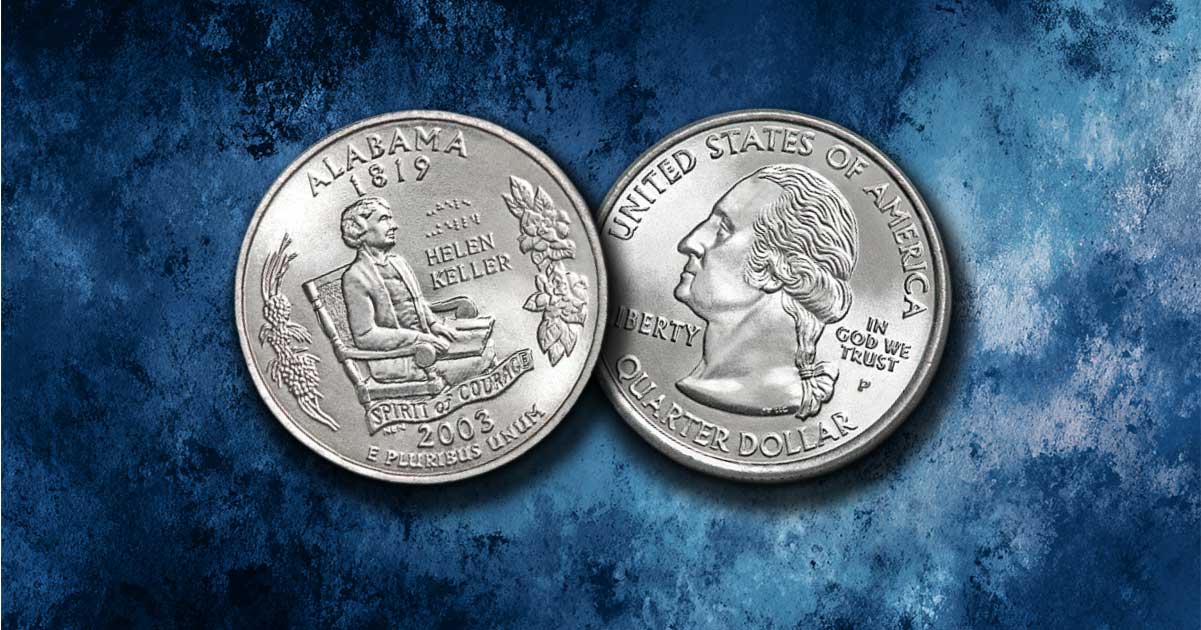
The Alabama state quarter, released in 2003 as part of the U.S. Mint’s 50 State Quarters Program, honors Helen Keller and features a portrait of the author and activist alongside a branch of longleaf pine, the state tree. The coin also carries Keller’s name in English and Braille, making it the first circulating U.S. coin to include Braille. Although Alabama quarters are not known for a single famous variety, collectors have reported a variety of mint-made errors and striking anomalies on Alabama quarters, similar to those found on other modern U.S. coins.
Off-Center Strike Errors
Off-center strikes occur when a planchet is not properly aligned beneath the dies during striking. As a result, only part of the design transfers to the coin.
Physical Diagnostics
- Blank Crescent Area: A smooth, unstruck section appears along part of the coin’s edge.
- Missing Design Elements: Portions of the date, lettering, Braille inscription, or Helen Keller portrait may be absent.
- Sharp Remaining Detail: The struck portion of the coin typically remains fully detailed.
Frequency
Off-center strikes are documented on modern U.S. quarters and may occasionally be encountered on Alabama quarters. Examples retaining the full date while showing significant displacement are generally the most desirable.
Die Cracks and Chips
Die cracks develop when a working die begins to fracture after repeated use. In more advanced cases, portions of the die may break away, creating raised cracks, breaks, or other raised features on the struck coin.
Physical Diagnostics
- Raised Lines: Die cracks appear as thin raised lines on the coin’s surface.
- Continuous Flow: Genuine cracks often travel naturally through letters and design elements.
- Raised Metal Areas: Larger die breaks may create thicker raised sections, particularly near the rim.
Frequency
Minor die cracks are known on modern U.S. quarters and may occasionally be encountered on Alabama quarters, while larger die breaks appear less commonly reported.
Filled Die Errors
Filled die errors occur when grease, debris, or compacted material fills recessed portions of a die. During striking, the filled areas prevent portions of the design from fully transferring to the coin.
Physical Diagnostics
- Weak or Missing Design Areas: Portions of the design may appear faint, smooth, or absent.
- Soft or Missing Details: Letters, Braille dots, or design elements may appear weak, incomplete, or absent.
- Smooth Affected Area: The weakened design area typically appears smooth rather than scraped or damaged.
Frequency
Filled die errors are known across modern U.S. quarter production and may occasionally occur on Alabama quarters. More dramatic examples are often of greater interest to collectors.
Machine Doubling and Die Deterioration
Some Alabama quarters display minor machine doubling or signs of die deterioration caused by normal die wear. No major doubled die variety is widely recognized for the issue by leading attribution services.
Physical Diagnostics
- Shelf-Like Doubling: Machine doubling often appears as a flat extension along lettering or design elements.
- Soft or Thickened Details: Die deterioration may cause portions of the design to appear swollen or blurry.
- Limited Separation: Unlike a true doubled die, machine doubling generally lacks clearly separated secondary images.
Frequency
Minor machine doubling and signs of die deterioration can occasionally be found on Alabama quarters, although significant doubled die varieties are not commonly documented.
Improperly Annealed Planchet
Improperly annealed planchets can develop unusual coloration when the heating and annealing process does not occur under normal conditions before striking.
Physical Diagnostics
- Dark Surface Color: The coin exhibits a uniform gray, brown, blue, or black coloration that appears to be part of the metal rather than surface contamination.
- Normal Weight: Despite the unusual appearance, the coin typically weighs within the standard range for the issue.
- Intact Design Details: Lettering and design elements remain fully struck and generally show no distortion from the color change.
Frequency
Improperly annealed planchet errors are uncommon and can sometimes be mistaken for environmental damage, toning, or post-mint discoloration. Professional authentication helps confirm whether a coin’s unusual coloration arose during minting or resulted from post-mint exposure.
Error Quarter Market Value
Alabama quarter error values depend on rarity, condition, eye appeal, and the severity of the mint error. Certified examples with dramatic visual characteristics generally command the highest premiums. Major off-center strikes, dramatic die-related errors, and unusual planchet errors can command significant premiums when properly authenticated.
How to Identify Authentic Alabama Quarter Errors
Collectors should examine Alabama quarters under magnification while paying close attention to lettering, Braille dots, rims, and surface texture. Genuine mint errors display characteristics created during production rather than damage acquired after entering circulation.
Comparing questionable coins with certified examples from PCGS and NGC is often the most reliable method of confirming authenticity.
The Alabama quarter is collected for its tribute to Helen Keller and its historic inclusion of Braille on a circulating U.S. coin. Collectors often compare potential error coins with authenticated examples to help verify unusual characteristics and confirm authenticity.