
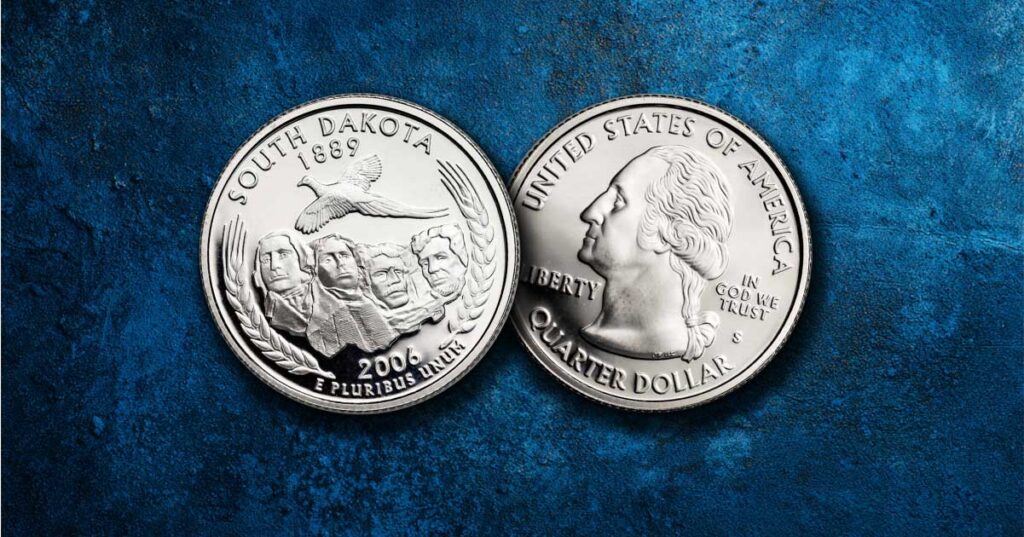
The South Dakota state quarter, released in 2006 as part of the U.S. Mint’s 50 State Quarters Program, features a Chinese ring-necked pheasant flying above Mount Rushmore, with heads of wheat bordering the design. While the South Dakota quarter is not known for a major headline-grabbing variety, a small number of documented mint-made errors and die varieties have been identified on the issue.
Missing Clad Layer Errors
Missing clad layer errors occur when one of the outer copper-nickel layers is absent before the coin is struck. Since modern quarters are made with a copper core bonded between two outer clad layers, the missing layer exposes the copper core beneath the surface.
Physical Diagnostics
- Copper-Colored Surface: One side of the coin may appear reddish, orange, or copper-brown instead of silver-gray.
- Reduced Weight: A quarter missing a clad layer should weigh less than a normal quarter.
- Visible Edge Contrast: The edge may show a clear difference between the remaining clad layer and exposed copper core.
- Normal Strike Detail: The design should still appear struck into the coin rather than worn away, stained, or chemically altered.
Frequency
Missing clad layer South Dakota quarters are scarce but documented. Certified South Dakota examples have been reported by collectors and error specialists.
Clipped Planchet Errors
Clipped planchet errors occur when a blank is improperly punched from the metal strip before striking, leaving part of the coin’s normal round shape missing.
Physical Diagnostics
- Missing Edge Section: A portion of the coin is absent due to a planchet punching error.
- Lower Weight: Because part of the planchet is missing, the coin weighs less than a standard quarter.
- Natural Design Flow: The design should appear struck normally across the remaining metal.
- No Sharp Cut Marks: Genuine clipped planchets do not look sawed, filed, or cut after minting.
- Possible Blakesley Effect: Some examples show rim weakness opposite the clip, a characteristic commonly associated with genuine clipped planchets.
Frequency
Clipped planchet South Dakota quarters are uncommon but documented. Certified examples are especially collectible when the clip is obvious and the coin retains strong design detail.
Error Quarter Market Value
South Dakota quarter error values depend on rarity, condition, eye appeal, and proper attribution. Missing clad layer errors and clipped planchet errors generally attract stronger collector interest than minor doubled die varieties. Properly attributed doubled die obverse examples can still carry premiums among state quarter variety collectors.
How to Identify Authentic South Dakota Quarter Errors
Collectors should inspect South Dakota quarters carefully under magnification, especially the rim, lettering, Mount Rushmore, the pheasant, and the wheat details. A precision digital scale is helpful when checking for possible missing clad layer errors. Coins with unusual color should be evaluated carefully, since toning, staining, environmental damage, and chemical alteration are often mistaken for missing clad layers.
For valuable South Dakota quarter errors, comparison with certified examples from PCGS, NGC, or another established numismatic reference is recommended. While most circulated South Dakota quarters are common, documented missing clad layer errors and clipped planchet errors continue to interest modern error coin collectors.