


Capped Bust Half Eagle Values
How Much Capped bust Half Eagles are Worth: Capped bust Half Eagle Values & Coin Price Chart
Year | Mint | Variety | Designation | VG-8 | F-12 | VF-20 | EF-40 | AU-50 | U-60 | MS-63 | MS-64 | MS-65 | MS-66 | MS-67 |
|---|---|---|---|---|---|---|---|---|---|---|---|---|---|---|
1800 | P | Plain 4- Stemless Wreath | Red-brown | 200 | 300 | 400 | 500 | 600 | 700 | 800 | 900 | 1000 | 1200 | 1100 |
| Year | Mint | Variety | Designation | VG-8 | F-12 | VF-20 | EF-40 | AU-50 | MS-60 | MS-63 | MS-64 | MS-65 | MS-66 |
|---|---|---|---|---|---|---|---|---|---|---|---|---|---|
| 1807 | (None) Phil | Capped Bust | -- | -- | $4,495.00 | $5,435.00 | $8,035.00 | $10,150.00 | $14,635.00 | $24,825.00 | $38,050.00 | $93,250.00 | $187,550.00 |
| 1808 | (None) Phil | -- | -- | $4,250.00 | $4,495.00 | $5,435.00 | $8,035.00 | $10,040.00 | $14,525.00 | $30,275.00 | $47,000.00 | $100,500.00 | -- |
| 1808/7 | (None) Phil | -- | -- | -- | $4,745.00 | $5,685.00 | $8,160.00 | $11,150.00 | $22,275.00 | $41,750.00 | $62,625.00 | $145,250.00 | -- |
| 1809/8 | (None) Phil | -- | -- | $4,250.00 | $4,589.00 | $5,551.00 | $8,206.00 | $10,425.00 | $15,075.00 | $30,700.00 | $88,995.00 | $100,500.00 | $194,550.00 |
| 1810 | (None) Phil | Small Date, Tall 5 | -- | -- | $3,740.00 | $5,435.00 | $8,035.00 | $10,040.00 | $14,800.00 | $32,900.00 | $69,250.00 | $175,000.00 | -- |
| 1810 | (None) Phil | Large Date, Large 5 | -- | -- | $3,740.00 | $5,435.00 | $8,035.00 | $10,040.00 | $14,525.00 | $25,650.00 | $39,425.00 | $96,000.00 | $253,300.00 |
| 1811 | (None) Phil | Small 5 | -- | -- | $4,495.00 | $5,435.00 | $8,035.00 | $10,040.00 | $15,350.00 | $26,750.00 | $43,550.00 | $111,500.00 | -- |
| 1811 | (None) Phil | Tall 5 | -- | $4,250.00 | $4,495.00 | $5,435.00 | $8,035.00 | $10,040.00 | $14,525.00 | $27,850.00 | $46,050.00 | $108,650.00 | $220,000.00 |
| 1812 | (None) Phil | -- | -- | -- | $4,495.00 | $5,435.00 | $8,035.00 | $10,040.00 | $14,525.00 | $27,850.00 | $43,550.00 | $107,000.00 | $195,250.00 |
| 1812 | (None) Phil | BD-1, Wide 5D 300-400 Known SRS: R3 | -- | -- | $4,620.00 | $5,560.00 | $7,910.00 | $10,040.00 | $14,275.00 | $25,850.00 | $44,800.00 | $114,500.00 | $200,250.00 |
| 1813 | (None) Phil | -- | -- | $4,290.00 | $5,420.00 | $6,500.00 | $9,570.00 | $11,230.00 | $18,950.00 | $30,150.00 | $54,225.00 | $144,750.00 | $219,500.00 |
| 1814/13 | (None) Phil | -- | -- | -- | $4,620.00 | $5,940.00 | $11,263.00 | $13,750.00 | $23,925.00 | $52,000.00 | $75,500.00 | $137,500.00 | -- |
| 1815 | (None) Phil | 11-13 Known | -- | -- | $93,500.00 | $137,500.00 | $253,000.00 | $291,500.00 | $448,000.00 | $705,000.00 | $871,000.00 | $1,382,500.00 | -- |
| 1818 | (None) Phil | 75-90 Known | -- | -- | $5,060.00 | $6,820.00 | $14,850.00 | $17,475.00 | $29,600.00 | $77,995.00 | $101,800.00 | $177,000.00 | $264,000.00 |
| 1819 | (None) Phil | 5D/50 15-20 Known | -- | -- | $27,500.00 | $38,500.00 | $63,600.00 | $76,600.00 | $153,500.00 | $265,500.00 | $389,250.00 | $473,000.00 | -- |
| 1820 | (None) Phil | Base 2 Less than 100 Known | -- | -- | $6,050.00 | $7,480.00 | $12,775.00 | $17,150.00 | $35,550.00 | $61,950.00 | $83,000.00 | $153,500.00 | -- |
| 1821 | (None) Phil | About 15 Known | -- | -- | $27,500.00 | $44,000.00 | $70,250.00 | $114,750.00 | $221,250.00 | $363,750.00 | $473,000.00 | $601,500.00 | $782,500.00 |
| 1823 | (None) Phil | 70-90 Known | -- | -- | $4,620.00 | $8,470.00 | $14,050.00 | $16,650.00 | $30,150.00 | $54,350.00 | $80,495.00 | $337,500.00 | $460,000.00 |
| 1824 | (None) Phil | 30-35 Known | -- | -- | $7,150.00 | $11,550.00 | $32,900.00 | $40,100.00 | $54,750.00 | $127,250.00 | $177,000.00 | $330,500.00 | -- |
| 1825/4/1 | (None) Phil | 25-20 Known | -- | -- | $9,900.00 | $14,300.00 | $33,000.00 | $45,900.00 | $96,300.00 | $166,750.00 | $203,250.00 | $307,000.00 | -- |
| 1826 | (None) Phil | 30-35 Known | -- | -- | $5,500.00 | $11,000.00 | $23,650.00 | $33,875.00 | $79,650.00 | $179,000.00 | $215,750.00 | $316,750.00 | $610,000.00 |
| 1827 | (None) Phil | About 30 Known | -- | -- | $5,500.00 | $9,900.00 | $22,000.00 | $28,600.00 | $67,250.00 | $148,500.00 | $180,250.00 | $282,000.00 | $448,000.00 |
| 1828 | (None) Phil | 12-15 Known | -- | -- | $11,000.00 | $22,000.00 | $38,500.00 | $55,000.00 | $172,500.00 | $302,500.00 | $507,500.00 | $730,000.00 | -- |
| 1829 | (None) Phil | 8-9 Known | -- | -- | -- | -- | -- | $137,500.00 | $286,000.00 | $614,000.00 | $777,000.00 | $992,500.00 | -- |
| 1830 | (None) Phil | 40-50 Known | -- | -- | $19,800.00 | $30,800.00 | $57,250.00 | $71,500.00 | $92,400.00 | $158,500.00 | $220,000.00 | $304,500.00 | $467,500.00 |
| 1831 | (None) Phil | 22-26 Known | -- | -- | $19,800.00 | $30,800.00 | $49,500.00 | $74,000.00 | $116,250.00 | $232,500.00 | $268,750.00 | $317,000.00 | $385,000.00 |
| 1832 | (None) Phil | -- | -- | -- | -- | -- | -- | -- | -- | -- | $3,750,000.00 | -- | -- |
| 1834 | (None) Phil | Plain 4, 35-40 Known | -- | $22,500.00 | $26,150.00 | $37,900.00 | $57,250.00 | $71,500.00 | $92,400.00 | $158,500.00 | $220,000.00 | $317,000.00 | $385,000.00 |
| 1834 | (None) Phil | Crosslet 4 | -- | -- | $26,150.00 | $37,900.00 | $57,250.00 | $72,600.00 | $94,600.00 | $166,750.00 | $251,750.00 | $275,000.00 | -- |
History of the Capped Bust Half Eagle
The Capped Bust Half Eagle occupies a central role in early U.S. gold coinage. Struck from 1807 to 1834, it represents the evolution of the young nation’s artistry, technology, and economic realities. The series was produced exclusively at the Philadelphia Mint, as no branch mints existed during its tenure.
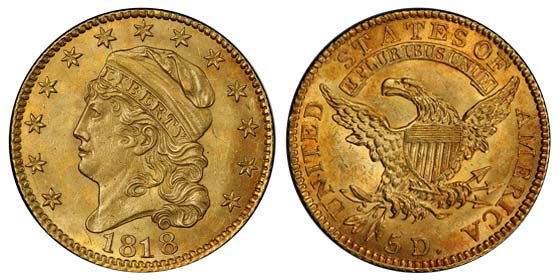
The first design, the Capped Bust Left (1807–1812), was created by John Reich. It depicted Liberty facing left, wearing a soft cap inscribed “LIBERTY”, with a reverse featuring a large eagle bearing a shield and the denomination “5 D.” Subsequent redesigns, beginning in 1813, yielded the Capped Head to Left motif, which continued through 1834. In 1829, the mint introduced a reduced-diameter version using close-collar technology.
Each piece was .9167 fine, weighed ~8.75 g, and contained about 0.258 troy ounces of gold (pre-1834 standard). These coins circulated in a complex bullion economy where gold often traded above face value, leading to large-scale melting and exportation. As a result, surviving examples, especially high-grade ones, are rare today. Every date was individually hand-punched, creating numerous varieties and notable overdates such as 1818/7 and 1819/8 that continue to intrigue specialists.
Rarest Coins in the Series
Among all early U.S. gold issues, the Capped Bust Half Eagle includes some of the most notable rarities:
- 1822 Half Eagle: One of the rarest American coins, and only three examples are known: two permanently held in the Smithsonian Institution and one in private hands.
- 1815 Half Eagle: Another legendary rarity, with a mintage of just 635 coins and only a few survivors.
- 1808 Capped Bust Left: a one-year type and especially desirable. (For half eagles, the Capped Bust Left subtype runs 1807–1812.)
- 1819/8 and 1818/7 Overdates: Many collectors value these technically complex, conditionally rare varieties. They are prized by variety specialists.
- 1821, 1825/4, 1828, and 1829 issues: Each holds significance for transitional designs and low survival rates.
Proof strikings are virtually unknown and, when encountered, are usually unique or nearly so. They often reside in major institutional collections.
Types of Collections
Collectors approach the Capped Bust Half Eagle in multiple ways, each suited to their goals and resources.
- Type Sets: Many collectors include one example of the Capped Bust design within a broader US gold type set, typically choosing the more obtainable 1807–1812 subtype.
- Design Subsets: Some capture the full design evolution by assembling three representative pieces: Capped Bust Left (1807–1812), Capped Head Large Diameter (1813–1828), and Capped Head Reduced Diameter (1829–1834).
- Date and Variety Sets: Completing a full date run is practically impossible due to the 1822 and 1815 rarities. However, subsets (e.g., 1813–1820) are popular. Advanced collectors pursue die marriages identified by Bass–Dannreuther (BD) catalog numbers.
- Grade-Based Collections: Others focus on securing well-preserved AU–MS coins across different dates, highlighting mint craftsmanship and eye appeal.
- Pedigree Collections: Some collectors build sets featuring coins from famous cabinets such as Eliasberg, Bass, Garrett, or Pogue, emphasizing provenance and historical continuity.
At the highest level, research-driven collections trace die states and plate-match known examples to catalog references, furthering scholarship in early US gold.
Beginner vs. Advanced Collecting
The Capped Bust Half Eagle appeals to collectors at all experience levels, though challenges differ dramatically.
Beginner Collecting
A sound approach for beginners is to start with a certified VF to AU example from the 1807–1812 range. These are the most accessible while retaining early US charm. Third-party certification (PCGS or NGC) is essential due to counterfeiting and surface alteration risks. Beginners should prioritize originality and color over numeric grade, as coins with untouched “old gold” toning are particularly sought after.
Advanced Collecting
Advanced collectors often devote years to studying die marriages and state progressions. Condition census collecting, i.e., tracking the finest known examples, demands knowledge of provenance chains and certification resubmissions. While coins like the 1822 and 1815 remain out of reach for most, scholars and museums continue to document their histories. Advanced collectors also appreciate the nuances of natural vs. conserved surfaces, often rejecting overly brightened pieces in favor of untouched patina.
Investment Potential
As with all early U.S. gold, the Capped Bust Half Eagle occupies a niche market where numismatic rarity far outweighs bullion value. Prices are influenced primarily by absolute rarity, condition rarity, and provenance.
The early gold market is thinly traded; some dates may not appear for years, causing sporadic price swings. Counterfeits and altered coins remain an ongoing threat, underscoring the importance of certification and expert consultation. Price volatility can occur when multiple examples of a rare date hit the market simultaneously, temporarily depressing values.
While short-term speculation is risky, high-quality early US gold enjoys strong long-term demand. The combination of artistry, rarity, and historical importance ensures that the Capped Bust Half Eagle retains its status as a cornerstone of American numismatics.