


Capped Bust Quarter Values
How Much Capped Bust Quarters are Worth: Capped Bust Quarter Values & Coin Price Chart
Year | Mint | Variety | Designation | VG-8 | F-12 | VF-20 | EF-40 | AU-50 | U-60 | MS-63 | MS-64 | MS-65 | MS-66 | MS-67 |
|---|---|---|---|---|---|---|---|---|---|---|---|---|---|---|
1800 | P | Plain 4- Stemless Wreath | Red-brown | 200 | 300 | 400 | 500 | 600 | 700 | 800 | 900 | 1000 | 1200 | 1100 |
| Year | Mint | Variety | Designation | VG-8 | F-12 | VF-20 | EF-40 | AU-50 | MS-60 | MS-63 | MS-64 | MS-65 | MS-66 |
|---|---|---|---|---|---|---|---|---|---|---|---|---|---|
| 1815 | (None) Phil | -- | -- | $378 | $533 | $805 | $2,445.00 | $2,835.00 | $4,260.00 | $6,765.00 | $13,275.00 | $32,100.00 | $72,000.00 |
| 1818 | (None) Phil | -- | -- | $226 | $322 | $578 | $1,508.00 | $2,238.00 | $4,260.00 | $6,765.00 | $8,740.00 | $32,100.00 | $55,495.00 |
| 1819/5 | (None) Phil | -- | -- | $226 | $322 | $578 | $1,508.00 | $2,238.00 | $4,260.00 | $6,765.00 | $8,740.00 | $32,100.00 | $49,000.00 |
| 1819 | (None) Phil | Small 9 | -- | $226 | $322 | $578 | $1,458.00 | $2,288.00 | $4,980.00 | $9,235.00 | $18,250.00 | $40,100.00 | $65,000.00 |
| 1819 | (None) Phil | Large 9 | -- | $226 | $322 | $578 | $1,508.00 | $2,455.00 | $5,310.00 | $12,175.00 | $22,675.00 | $47,000.00 | -- |
| 1820 | (None) Phil | Small O | -- | $226 | $322 | $578 | $1,508.00 | $2,338.00 | $4,730.00 | $10,925.00 | $16,875.00 | $37,900.00 | $86,300.00 |
| 1820 | (None) Phil | Medium O | -- | $240 | $392 | $604 | $1,821.00 | $2,559.00 | $6,053.00 | $11,143.00 | $20,063.00 | $41,940.00 | $102,430.00 |
| 1820 | (None) Phil | Large O | -- | $226 | $322 | $578 | $1,633.00 | $2,725.00 | $6,250.00 | $13,495.00 | $17,150.00 | $41,500.00 | $79,900.00 |
| 1821 | (None) Phil | -- | -- | $226 | $335 | $578 | $1,508.00 | $2,238.00 | $4,260.00 | $6,765.00 | $10,740.00 | $55,495.00 | $70,500.00 |
| 1822 | (None) Phil | -- | -- | $377 | $573 | $990 | $1,950.00 | $3,475.00 | $7,138.00 | $12,175.00 | $35,400.00 | $70,000.00 | $110,000.00 |
| 1822 | (None) Phil | 25/50C | -- | $8,825.00 | $20,200.00 | $25,175.00 | $37,750.00 | $46,175.00 | $65,000.00 | $91,250.00 | $112,000.00 | $153,500.00 | $198,000.00 |
| 1824/2 | (None) Phil | -- | -- | $907 | $1,605.00 | $2,075.00 | $4,010.00 | $6,915.00 | $32,250.00 | $74,750.00 | $156,250.00 | $250,000.00 | -- |
| 1825/4/2 | (None) Phil | Browning 1 SRS: R5 | -- | $515 | $962 | $1,303.00 | $2,976.00 | $3,960.00 | $4,840.00 | $6,776.00 | $24,598.00 | $31,460.00 | $48,400.00 |
| 1825/4/(2) | (None) Phil | Browning 2 SRS: R3 | -- | $267 | $493 | $625 | $1,410.00 | $2,350.00 | $5,950.00 | $8,580.00 | $14,180.00 | $34,300.00 | $49,500.00 |
| 1825/4/(2) | (None) Phil | Browning 23 SRS: R3 | -- | $280 | $518 | $675 | $1,535.00 | $2,225.00 | $5,950.00 | $8,580.00 | $14,180.00 | $34,300.00 | $52,000.00 |
| 1828 | (None) Phil | -- | -- | $226 | $322 | $578 | $1,508.00 | $2,238.00 | $4,260.00 | $6,765.00 | $12,370.00 | $37,050.00 | $80,200.00 |
| 1831 | (None) Phil | Small Letters | -- | $122 | $147 | $190 | $436 | $813 | $2,235.00 | $3,880.00 | $6,680.00 | $46,495.00 | $42,995.00 |
| 1831 | (None) Phil | Large Letters | -- | $122 | $147 | $190 | $436 | $813 | $2,400.00 | $4,700.00 | $9,213.00 | $31,250.00 | -- |
| 1832 | (None) Phil | -- | -- | $122 | $147 | $190 | $436 | $813 | $2,235.00 | $3,880.00 | $6,680.00 | $27,850.00 | $33,000.00 |
| 1833 | (None) Phil | -- | -- | $124 | $152 | $213 | $493 | $880 | $2,600.00 | $4,730.00 | $9,350.00 | $22,400.00 | $64,500.00 |
| 1834 | (None) Phil | -- | -- | $122 | $147 | $190 | $436 | $813 | $2,235.00 | $4,205.00 | $6,680.00 | $30,495.00 | $37,250.00 |
| 1835 | (None) Phil | -- | -- | $122 | $147 | $190 | $436 | $813 | $2,235.00 | $3,880.00 | $6,680.00 | $23,650.00 | $91,250.00 |
| 1836 | (None) Phil | -- | -- | $122 | $147 | $190 | $400 | $813 | $2,290.00 | $4,595.00 | $9,125.00 | $46,995.00 | $59,500.00 |
| 1837 | (None) Phil | -- | -- | $122 | $147 | $190 | $436 | $813 | $2,235.00 | $3,880.00 | $6,680.00 | $19,995.00 | $42,600.00 |
| 1838 | (None) Phil | Capped Bust | -- | $122 | $147 | $190 | $430 | $813 | $2,235.00 | $3,880.00 | $6,680.00 | $26,000.00 | $50,000.00 |
History of the Capped Bust Quarter
The Capped Bust Quarter, minted from 1815 to 1838, is a significant piece of early American coinage. Designed by John Reich, the new design aimed to create a more balanced and refined image of Liberty. This quarter eventually replaced the Draped Bust Quarter, after quarter production halted due to the War of 1812.
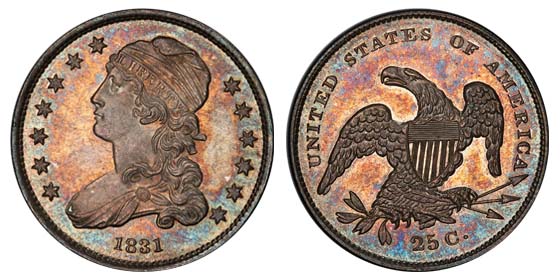
A left-facing Liberty is wearing a Phrygian cap with a ribbon inscribed “LIBERTY” on the obverse. The reverse depicts a heraldic eagle holding arrows and an olive branch, with a shield on its chest. Below is the denomination, “25C.” The series can be divided into two distinct types:
- Large Diameter (1815-1828) – Measured 27 mm with a reeded edge.
- Reduced Diameter (1831-1838) – Measured 24.3 mm, with a reeded edge for improved minting efficiency.
The Seated Liberty Quarter replaced the Capped Bust Quarter in 1838, reflecting another shift in American coinage.
Rarest Coins in the Series
- 1815: The first-year issue, struck in limited numbers because of post-war silver shortages.
- 1823/2 Overdate: A rare overdate quarter featuring a ‘3’ punched over a ‘2.’
- 1827: Original 1827 Capped Bust Quarters are extremely scarce (only a handful are known), though restrikes exist.
- 1834 Large & Small Date Varieties: A popular variety among collectors.
- Proof Issues (around 1820 to 1838): Rare early proof strikes add another level of desirability.
Types of Collections
- Full Date Collection: Collectors aim to gather examples from each year of the series (1815–1838). This includes both the Large Diameter (1815-1828) and Reduced Diameter (1831-1838) types.
- Variety Collection: A collection of overdates, re-punched numerals, and subtle minting differences.
- Proof Collection: Collectors can focus on the early proof strikes made between 1834 and 1838.
- Type Set: Some may include the Capped Bust Quarter as part of an early American coin type set collection, covering major design styles in U.S. quarters.
Beginner vs. Advanced Collecting
Beginner Collecting
Capped Bust Quarters can be challenging for beginners because they are scarce, costly, and usually appear at major auctions, reputable dealers, or estate collections. Focus on clear Liberty cap details, distinct stars, and well-defined eagle feathers. Store purchases in certified holders for protection. Learning basic grading techniques from numismatic guides helps distinguish normal wear from damage. Hold coins by the edges with clean, dry hands or cotton gloves to avoid fingerprints and surface oils. Budget-minded collectors can start by acquiring one example of each of the two main subtypes (1815-1838) before pursuing tougher dates.
Advanced Collecting
Because of its scarcity, higher prices, and many overdates and die varieties, this series generally suits experienced collectors. Quarters such as the 1823/2 overdate and the scarce 1827 issues command strong premiums. Building a complete set requires substantial capital, patience, and expertise. When studying varieties, consult authoritative references such as the Browning and Parsley catalogs and compare high-resolution photographs under consistent lighting. Grading service census data can guide valuation and indicate availability.
Investment Potential
The Capped Bust Quarter series appeals to collectors because of its historical significance, limited availability, and consistent demand. Well-preserved examples and scarce die varieties often attract competitive bidding, showing the series’ ongoing popularity among advanced collectors. As a classic early-U.S. silver type, it is a practical option for collectors who value relative price stability and long-term growth potential in their numismatic portfolios. Below is the denomination, “25C.” The series can be divided into two distinct types: