


Draped Bust Dollar Values
How Much Draped Bust Dollars are Worth: Draped Bust Dollar Values & Coin Price Chart
Year | Mint | Variety | Designation | VG-8 | F-12 | VF-20 | EF-40 | AU-50 | U-60 | MS-63 | MS-64 | MS-65 | MS-66 | MS-67 |
|---|---|---|---|---|---|---|---|---|---|---|---|---|---|---|
1800 | P | Plain 4- Stemless Wreath | Red-brown | 200 | 300 | 400 | 500 | 600 | 700 | 800 | 900 | 1000 | 1200 | 1100 |
| Year | Mint | Variety | Designation | VG-8 | F-12 | VF-20 | EF-40 | AU-50 | MS-60 | MS-63 | MS-64 | MS-65 | MS-66 |
|---|---|---|---|---|---|---|---|---|---|---|---|---|---|
| 1795 | (None) Phil | Centered Bust | -- | $3,320.00 | $4,288.00 | $5,450.00 | $10,130.00 | $15,775.00 | $58,100.00 | $145,250.00 | $215,750.00 | $421,750.00 | $793,750.00 |
| 1795 | (None) Phil | Off-Centered Bust | -- | $3,320.00 | $4,288.00 | $5,450.00 | $10,130.00 | $15,775.00 | $63,600.00 | $145,250.00 | $215,750.00 | $421,750.00 | $793,750.00 |
| 1796 | (None) Phil | Small Date, Small Letters | -- | $3,320.00 | $4,288.00 | $5,450.00 | $10,130.00 | $15,775.00 | $153,500.00 | $416,250.00 | $572,500.00 | $922,500.00 | -- |
| 1796 | (None) Phil | Small Date, Large Letters | -- | $3,320.00 | $4,288.00 | $5,450.00 | $10,493.00 | $16,820.00 | $148,000.00 | $275,000.00 | -- | -- | -- |
| 1796 | (None) Phil | Large Date, Small Letters | -- | $3,403.00 | $4,398.00 | $5,560.00 | $10,790.00 | $15,775.00 | $88,200.00 | $181,750.00 | $298,750.00 | -- | -- |
| 1797 | (None) Phil | 9X7 Stars, Large Letters | -- | $3,320.00 | $4,288.00 | $5,670.00 | $10,493.00 | $15,775.00 | $75,000.00 | $176,025.00 | $267,975.00 | -- | -- |
| 1797 | (None) Phil | 10x6 Stars | -- | $3,320.00 | $4,288.00 | $5,450.00 | $10,130.00 | $15,775.00 | $58,100.00 | $150,250.00 | $253,250.00 | $368,500.00 | -- |
| 1797 | (None) Phil | 9X7 Stars, Small Letters | -- | $3,708.00 | $6,000.00 | $10,125.00 | $27,250.00 | $78,800.00 | $140,500.00 | $240,000.00 | $377,500.00 | -- | -- |
| 1798 | (None) Phil | Small Eagle, 13 Stars | -- | $3,375.00 | $4,343.00 | $5,863.00 | $12,725.00 | $28,350.00 | $150,750.00 | $298,750.00 | -- | -- | -- |
| 1798 | (None) Phil | Small Eagle, 15 stars | -- | $3,540.00 | $4,813.00 | $6,775.00 | $14,150.00 | $34,150.00 | $148,000.00 | -- | -- | -- | -- |
| 1798 | (None) Phil | Large Eagle | -- | $1,638.00 | $2,185.00 | $2,885.00 | $4,663.00 | $6,735.00 | $25,175.00 | $56,150.00 | $108,750.00 | $213,000.00 | -- |
| 1798 | (None) Phil | Knob 9, 5 Lines | -- | $2,000.00 | $3,250.00 | $3,750.00 | $7,250.00 | $9,000.00 | $35,000.00 | $87,500.00 | -- | -- | -- |
| 1798 | (None) Phil | Pointed 9, 4 Lines | -- | $1,900.00 | $2,500.00 | $3,350.00 | $5,750.00 | $7,750.00 | $40,000.00 | $77,500.00 | $185,000.00 | $275,000.00 | -- |
| 1798 | (None) Phil | 10 Arrows | -- | $1,775.00 | $2,372.00 | $3,127.00 | $5,395.00 | $8,432.00 | $32,210.00 | $73,380.00 | $99,000.00 | $211,200.00 | -- |
| 1798 | (None) Phil | 5 Stripes | -- | $1,775.00 | $2,372.00 | $3,202.00 | $5,395.00 | $9,682.00 | $37,210.00 | $56,760.00 | $99,000.00 | $211,200.00 | -- |
| 1798 | (None) Phil | Wide Date | -- | $1,707.00 | $2,279.00 | $3,006.00 | $5,020.00 | $7,021.00 | $28,925.00 | $86,150.00 | $128,750.00 | $263,000.00 | -- |
| 1799 | (None) Phil | -- | -- | $1,638.00 | $2,185.00 | $3,429.00 | $4,663.00 | $6,735.00 | $25,175.00 | $56,150.00 | $108,750.00 | $213,000.00 | $296,000.00 |
| 1799 | (None) Phil | Irregular Date, 13 Stars | -- | $1,707.00 | $2,279.00 | $3,081.00 | $5,217.00 | $10,400.00 | $28,500.00 | $69,175.00 | $136,400.00 | -- | -- |
| 1799 | (None) Phil | Obverse Stars 8X5 | -- | $1,707.00 | $2,279.00 | $3,050.00 | $5,548.00 | $10,675.00 | $51,625.00 | $110,000.00 | $158,500.00 | -- | -- |
| 1799/8 | (None) Phil | 15 Reverse Stars | -- | $1,707.00 | $2,372.00 | $3,127.00 | $5,020.00 | $7,021.00 | $26,193.00 | $56,150.00 | $108,750.00 | $213,000.00 | $296,000.00 |
| 1799/8 | (None) Phil | 13 Reverse Stars | -- | $1,707.00 | $2,372.00 | $3,127.00 | $5,020.00 | $7,021.00 | $25,450.00 | $66,150.00 | $113,750.00 | $225,500.00 | -- |
| 1800 | (None) Phil | -- | -- | $1,665.00 | $2,227.00 | $2,940.00 | $4,773.00 | $6,900.00 | $26,000.00 | $62,750.00 | $114,250.00 | $218,500.00 | $275,000.00 |
| 1800 | (None) Phil | Dotted Date | -- | $1,737.00 | $2,324.00 | $3,067.00 | $4,963.00 | $7,953.00 | $29,750.00 | $62,750.00 | $114,250.00 | $187,000.00 | $275,000.00 |
| 1800 | (None) Phil | 12 Arrows | -- | $1,737.00 | $2,227.00 | $2,940.00 | $4,773.00 | $6,900.00 | $31,000.00 | $85,250.00 | $93,500.00 | -- | -- |
| 1800 | (None) Phil | AMERICAI | -- | $1,787.00 | $2,422.00 | $3,142.00 | $5,075.00 | $8,075.00 | $35,000.00 | $75,500.00 | $127,250.00 | $220,000.00 | -- |
| 1800 | (None) Phil | Wide Date, Low 8 | -- | $1,665.00 | $2,227.00 | $2,940.00 | $4,773.00 | $6,900.00 | $27,250.00 | $62,750.00 | $114,250.00 | $187,000.00 | -- |
| 1801 | (None) Phil | -- | -- | $1,707.00 | $2,372.00 | $2,940.00 | $5,213.00 | $7,038.00 | $29,475.00 | $95,500.00 | $168,750.00 | $338,750.00 | -- |
| 1802 | (None) Phil | -- | -- | $1,707.00 | $2,372.00 | $3,127.00 | $5,020.00 | $7,021.00 | $25,175.00 | $56,150.00 | $108,750.00 | $213,000.00 | $242,000.00 |
| 1802/1 | (None) Phil | SRS: R4 | -- | $1,707.00 | $2,372.00 | $3,127.00 | $5,020.00 | $7,021.00 | $30,175.00 | $86,150.00 | $141,250.00 | $176,000.00 | $264,000.00 |
| 1803 | (None) Phil | Small 3 | -- | $1,707.00 | $2,279.00 | $3,023.00 | $5,695.00 | $8,932.00 | $40,125.00 | $120,300.00 | $200,000.00 | -- | -- |
| 1803 | (None) Phil | Large 3 | -- | $1,707.00 | $2,279.00 | $2,885.00 | $4,855.00 | $8,550.00 | $38,050.00 | $121,250.00 | $271,000.00 | $638,750.00 | -- |
History of the Draped Bust Dollar
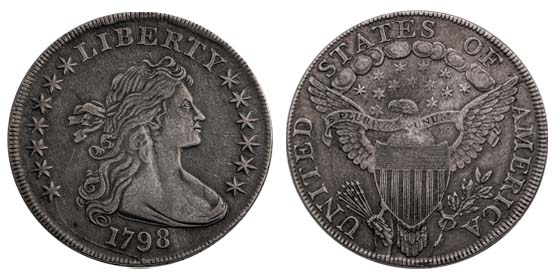
The Draped Bust Dollar was issued for circulation from 1795 through 1803 (with some pieces struck in early 1804 using 1803-dated dies) and later produced as extremely limited 1804-dated presentation coins. Crafted during the early years of the republic, it represented a concerted effort to establish a stable, respected currency for the young United States.
The design is attributed to Chief Engraver Robert Scot; some evidence suggests he based it on a portrait style linked to Gilbert Stuart, though Stuart’s involvement remains unconfirmed. The new design replaced the earlier Flowing Hair Dollar to convey a more formal aesthetic. On its obverse, Lady Liberty is portrayed with flowing drapery, while the reverse moved through two major types: the initial Small Eagle within a wreath (1795–1798, with 1798 being rare), followed by the Heraldic Eagle (1798–1803 for business strikes).
With limited mintage, a combination of design evolution, minting variations, and early-era provenance has made this silver dollar series a key subject in numismatic study and collecting.
Rarest Coins in the Series
Among the many issues in this series, certain dates and varieties stand out for their rarity and collectability.
- The 1795 issue holds pride of place as the inaugural “Draped Bust” dollar. While not the absolute rarest, high-grade examples carry huge premiums. For example, charts show the 1795 in Uncirculated (MS) condition reaching into the six-figure range.
- The 1804 Draped Bust Dollar is one of the best-known rarities in U.S. numismatics: though dated 1804, these pieces were struck decades later as diplomatic presentation specimens. Eight primary diplomatic originals (Class I) are confirmed, with additional later restrikes making the total known genuine pieces around 15.
- Varieties within the series also drive rarity: for example, sub-varieties of 1798 with different numbers of stars, or overdate issues like 1799/8, where the “8” was overstruck with a “9”. These varieties can greatly affect value.
- Condition is critical: as most survivors passed through early circulation, high-grade (AU-50 and up, or MS) coins are very scarce. This scarcity at the top end drives steep premiums in the market.
For any savvy collector or investor considering this series, understanding the interplay of date, variety, condition, and provenance is essential.
Types of Collections
Collectors approaching the Draped Bust Dollar can adopt several different strategies, each suited to different budgets, interests, and goals.
- Single Representative or Type Set: Some collectors will acquire one example of the Draped Bust type simply to represent the early silver dollar rather than chase every date or critical variety.
- Complete Date Set: Others may aim to assemble all the regular-issue dates (1795–1803) in decent condition, perhaps excluding the ultra-rare 1804 specials. This is a substantial undertaking given the scarcity of many issues in top grades.
- Variety or High-Grade Focus: A more advanced collector may target varieties (e.g., star-count differences, over-dates, mint state survivors) or invest in the best possible grade of a single key date (for example, a 1795 MS coin).
- Investment/Centerpiece Strategy: At the top end, some may seek one or two high-value specimens, such as a well-graded 1804 original, or a superb condition 1795, to serve as flagship pieces within their collection.
- Historical/Display Emphasis: Some collections may lean toward showcasing the historical evolution of U.S. coinage, including the transition from the Flowing Hair to Draped Bust design, and place the coin in a broader narrative of early American numismatics.
Beginner vs. Advanced Collecting
For beginners entering the realm of early U.S. silver dollars, the Draped Bust series offers an interesting but complex starting point.
Beginner Collecting
At this stage, one might acquire a modestly graded Draped Bust dollar (VG to XF condition) of a more common year, such as 1799 or 1800. This allows learning about grading, silver content, historical design elements, and market values without facing the high premiums of top-tier rarities. With the emphasis on learning the basics, such as verifying authenticity, grading details, provenance, and storage practices, beginners can build confidence.
Advanced Collecting
For seasoned collectors or investors, advanced collecting means chasing ultra-rare dates, top-grade specimens, varieties, proofs, and coins with documented pedigrees. It also means understanding deep market details, such as die varieties, star counts, earlier circulation conditions, toning expectations, and auction dynamics. At this level, paying a premium for condition, originality, and provenance becomes the focus. Acquisition may involve high-end auctions, certified grading, and long-term patience.
Investment Potential
The series’ investment appeal is driven by several compelling factors. First, the early date range (1795–1803) places these coins near the dawn of U.S. silver coinage, giving them strong historical relevance. Second, the limited mintage and relatively poor survival rates (especially in high grades) mean that scarcity is baked in. Third, reputable pricing databases and guides reflect consistent appreciation of key dates and high-grade examples over many years. For instance, value charts show significant increases for premium conditions in recent decades.
When evaluating the Classic Draped Bust Dollar value, one must consider that even circulated common-issue pieces are commanding thousands of dollars, while rarer, higher-grade examples run into the hundreds of thousands or millions. Moreover, with the 1804 issue reaching historic auction highs, the series demonstrates its capacity for record auction results. But prudent investors recognize that numismatic assets demand attention to condition, certification, authenticity, and long-term horizons; not all coins appreciate equally. Storage, grading fees, and market liquidity are also practical considerations. For collectors who apply research, discipline, and patience, the series offers a mix of artistry, history, and investment potential.
The Draped Bust Dollar remains a cornerstone in U.S. numismatics. Whether collected for its design, historical moment, or growth potential, it continues to draw attention from both fresh entrants and seasoned veterans alike.