


Draped Bust Half Dollar Values
How Much Draped Bust Half Dollars are Worth: Draped Bust Half Dollar Values & Coin Price Chart
Year | Mint | Variety | Designation | VG-8 | F-12 | VF-20 | EF-40 | AU-50 | U-60 | MS-63 | MS-64 | MS-65 | MS-66 | MS-67 |
|---|---|---|---|---|---|---|---|---|---|---|---|---|---|---|
1800 | P | Plain 4- Stemless Wreath | Red-brown | 200 | 300 | 400 | 500 | 600 | 700 | 800 | 900 | 1000 | 1200 | 1100 |
| Year | Mint | Variety | Designation | VG-8 | F-12 | VF-20 | EF-40 | AU-50 | MS-60 | MS-63 | MS-64 | MS-65 | MS-66 |
|---|---|---|---|---|---|---|---|---|---|---|---|---|---|
| 1796 | (None) Phil | 15 Stars | -- | $50,000 | $62,500 | $85,000 | $140,000 | $180,000 | $325,000 | $525,000 | $700,000 | -- | -- |
| 1796 | (None) Phil | 16 Stars | -- | $50,000 | $62,500 | $85,000 | $140,000 | $180,000 | $400,000 | $575,000 | $750,000 | $1,250,000 | $2,250,000 |
| 1797 | (None) Phil | -- | -- | $50,000 | $62,500 | $85,000 | $140,000 | $190,000 | $340,000 | $525,000 | $700,000 | $1,250,000 | $2,100,000 |
| 1801 | (None) Phil | -- | -- | $1,880 | $2,690 | $3,638 | $7,450 | $14,850 | $110,000 | $260,000 | $525,000 | -- | -- |
| 1802 | (None) Phil | -- | -- | $2,495 | $3,413 | $4,863 | $9,975 | $18,000 | $100,000 | -- | -- | -- | -- |
| 1803 | (None) Phil | Large 3 | -- | $585 | $760 | $1,155 | $2,695 | $4,520 | $21,500 | $110,000 | $235,000 | -- | -- |
| 1803 | (None) Phil | Small 3 | -- | $628 | $904 | $1,258 | $3,525 | $5,280 | $37,500 | $150,000 | $275,000 | -- | -- |
| 1805 | (None) Phil | -- | -- | $554 | $777 | $1,235 | $2,563 | $4,713 | $30,000 | $70,000 | -- | -- | -- |
| 1805/4 | (None) Phil | -- | -- | $1,245 | $2,020 | $2,550 | $5,313 | $8,850 | $47,500 | $110,000 | $150,000 | $250,000 | -- |
| 1806/5 | (None) Phil | Large Stars | -- | $560 | $760 | $1,105 | $2,570 | $4,575 | $14,650 | $85,000 | $105,000 | $165,000 | $300,000 |
| 1806 | (None) Phil | Knob 6, Small Stars | -- | -- | -- | -- | -- | -- | -- | -- | -- | -- | -- |
| 1806 | (None) Phil | Knob 6, No Stem | -- | $65,000 | $100,000 | $125,000 | $215,000 | -- | -- | -- | -- | -- | -- |
| 1806 | (None) Phil | Pointed 6, No Stem | -- | $439 | $667 | $905 | $1,913 | $3,200 | $11,750 | $21,500 | $50,000 | $165,000 | -- |
| 1806 | (None) Phil | Pointed 6, Stem | -- | $439 | $667 | $905 | $1,913 | $3,200 | $9,625 | $16,800 | $31,500 | $115,000 | $250,000 |
| 1806 | (None) Phil | 6 Over Inverted 6 | -- | $601 | $1,084 | $1,798 | $5,295 | $8,525 | $37,500 | $75,000 | $125,000 | -- | -- |
| 1807 | (None) Phil | -- | -- | $439 | $667 | $905 | $1,913 | $3,200 | $9,625 | $16,800 | $31,500 | $115,000 | $200,000 |
History of the Classic Draped Bust Half Dollar
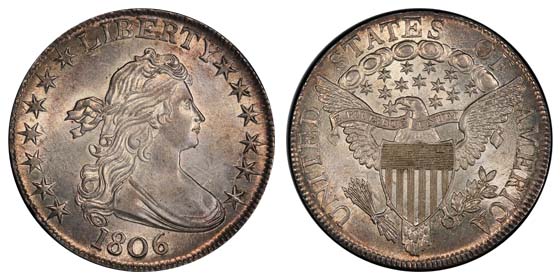
The Draped Bust Half Dollar represents an important early chapter in United States silver coinage. The series was struck initially in 1796 and 1797, then, after a hiatus from 1798-1800, production resumed and continued through 1807.
The coin’s obverse was designed by Robert Scot, the U.S. Mint’s Chief Engraver, and features Lady Liberty with flowing drapery around her shoulders. From 1796-1797, the reverse featured a small bald eagle surrounded by a wreath. After a production hiatus (~1798–1800), the reverse design was revised to use a larger heraldic eagle with shield, arrows, and olive branch, reflecting the evolving symbolism of the United States.
The coin’s artistry, limited run, and early minting context mark a step away from earlier, simpler designs.
Rarest Coins in the Series
Mintages demonstrate the scarcity of the early issues: for example, only 3,918 pieces were produced in the combined 1796-1797 period, making these among the rarest silver coins in U.S. numismatics. Within this series, certain dates and varieties are especially sought after due to their low survival rates, design significance, or only modest mintages:
- 1796 (Small Eagle Reverse): The very first year of issue and part of the ultra-limited run of less than 4,000 pieces for the two small-eagle years. This makes it extremely difficult to find, especially in higher grades.
- 1797 (Small Eagle Reverse): Slightly higher mintage than 1796, yet still exceptionally rare.
- 1806 “Knobbed 6” variety (Heraldic Eagle Reverse): One noted variety in the 1806 heraldic eagle group is the ‘Knobbed 6’ die-variety. While the overall mintage of 1806 is large, certain die variations can carry higher premiums.
- High-grade examples of Heraldic Eagle issues (1801-1807): Although the later years had larger mintages, survival in near-mint or uncirculated condition is rare, which significantly increases their value.
Types of Collections
Collectors of the Draped Bust Half Dollar typically adopt one or more of the following collecting strategies:
- Date-Set (All Regular Issues): Aiming to assemble each of the regular-issue dates from 1796 through 1807 (excluding proof or presentation issues). This involves navigating both the small-eagle and heraldic-eagle subtypes and requires increasing effort and budget as rarities appear.
- Variety/Specialty Set: A more focused collector might chase specific die varieties (e.g., the 1806 “Knobbed 6”), star-count variations, or high-grade examples. This can be narrower in scope but deeper in quality.
- High-Grade / Investment-Focus: In this path, the emphasis is on selecting the very best specimen available for a specific date or variety; high AU (Almost Uncirculated) to Mint State condition, strong eye appeal, excellent certification, and ideally, provenance.
Beginner vs. Advanced Collecting
Beginner Collecting
Because the small-eagle issues (1796-97) are extremely scarce, beginners should focus on later years (1801-07 heraldic eagle), which have higher mintages and more survivors. A beginner might start with a more common date in circulated condition (e.g., a heraldic-eagle issue from 1805 or 1807) to learn about grading, silver coin preservation, and marketplace dynamics. It is essential to focus on authenticity, surface condition, and certification.
Advanced Collecting
At a more advanced level, collectors become deeply engaged in issues like die varieties, star-counts, minute design differences (small eagle vs heraldic eagle), and pursuing high-grade specimens for rarer dates. Advanced collectors also factor provenance, auction history, and certification tiers (e.g., PCGS/MS/NGC) into their decision-making. In this realm, pursuing true “flagship” pieces such as an ultra-clean 1796 or an 1806 Knobbed 6 becomes realistic.
Investment Potential
The Draped Bust Half Dollar holds solid potential as a numismatic investment. Several factors drive this:
- Historical importance: Being among the earliest half dollars minted by the U.S. Mint, this coin carries intrinsic historical significance.
- Scarcity at condition: While the series produced some moderate mintages, survivors in high grade (especially for the rare dates and varieties) are extremely limited. This scarcity supports long-term value.
- Condition sensitivity: Value escalates sharply with finer grade; a moderately worn coin may sell for modest figures in this category, while a high-grade can sell for significantly higher prices.
- Collector demand: Serious numismatists and early-American specialists consistently seek these coins to fill type sets, date sets, or trophy pieces. The combination of demand and limited supply supports price growth over time.
When evaluating the Classic Draped Bust Half Dollar value, one must carefully consider date, subtype (small eagle vs heraldic eagle), condition, rarity of die variety, and market conditions. As always, storage, certification, and market timing remain significant factors in investment success.