


Eisenhower Dollar Values
How Much Eisenhower Dollars are Worth: Eisenhower Dollar Values & Coin Price Chart
Year | Mint | Variety | Designation | VG-8 | F-12 | VF-20 | EF-40 | AU-50 | U-60 | MS-63 | MS-64 | MS-65 | MS-66 | MS-67 |
|---|---|---|---|---|---|---|---|---|---|---|---|---|---|---|
1800 | P | Plain 4- Stemless Wreath | Red-brown | 200 | 300 | 400 | 500 | 600 | 700 | 800 | 900 | 1000 | 1200 | 1100 |
| Year | Mint | Variety | Designation | VG-8 | F-12 | VF-20 | EF-40 | AU-50 | MS-60 | MS-63 | MS-64 | MS-65 | MS-66 |
|---|---|---|---|---|---|---|---|---|---|---|---|---|---|
| 1971 | (None) Phil | -- | -- | $2 | $2 | $2 | $2 | $3 | $3.90 | $13.70 | $24.20 | $87 | $487 |
| 1971 | D | -- | -- | $2 | $2 | $2 | $2 | $3.40 | $4.80 | $15.20 | $20.80 | $29.90 | $66 |
| 1971 | S | Silver | -- | -- | -- | -- | -- | -- | -- | -- | -- | -- | -- |
| 1972 | (None) Phil | Type 1 | -- | $2 | $2 | $2 | $2 | $4.40 | $6.80 | $17.60 | $28.20 | $100 | $2,590 |
| 1972 | D | -- | -- | $2 | $2 | $2 | $2 | $3.20 | $4.40 | $14.70 | $19.40 | $25 | $100 |
| 1972 | S | -- | -- | $30 | $30 | $30 | $30 | $31 | $32 | $29.90 | $31 | $36 | $42 |
| 1973 | (None) Phil | Silver | -- | $2 | $2 | $2 | $2 | $3.90 | $5.80 | $13 | $26.20 | $53 | $523 |
| 1973 | D | -- | -- | $2 | $2 | $2 | $2 | $5.80 | $9.50 | $15.20 | $17.60 | $31 | $231 |
| 1973 | S | Silver | -- | -- | -- | -- | -- | -- | -- | -- | -- | -- | -- |
| 1974 | (None) Phil | -- | -- | $2 | $2 | $2 | $2 | $3.20 | $4.40 | $11.30 | $24.20 | $44 | $223 |
| 1974 | D | -- | -- | $2 | $2 | $2 | $2 | $3.90 | $5.70 | $12.30 | $19.40 | $28.20 | $82 |
| 1974 | S | Silver | -- | -- | -- | -- | -- | -- | -- | -- | -- | -- | -- |
| 1976 | (None) Phil | Type 1 | -- | $1 | $1 | $1.50 | $2 | $3 | $6.30 | $11 | $20.80 | $116 | $1,500 |
| 1976 | (None) Phil | Type 2 | -- | $1 | $1 | $1.50 | $2 | $2.40 | $5.40 | $8.30 | $15.80 | $27.20 | $95 |
| 1976 | D | Type 1 | -- | $1 | $1 | $1.50 | $2 | $3 | $5.40 | $8.30 | $22 | $37 | $139 |
| 1976 | D | Type 2 | -- | $1 | $1 | $1.50 | $2 | $3 | $5.40 | $8.30 | $14.90 | $24.50 | $72 |
| 1976 | S | Silver | -- | -- | -- | -- | -- | -- | -- | -- | -- | -- | -- |
| 1977 | (None) Phil | -- | -- | $2 | $2 | $2 | $2 | $3.90 | $5.70 | $12.30 | $23 | $28.90 | $68 |
| 1977 | D | -- | -- | $2 | $2 | $2 | $2 | $3.90 | $5.70 | $12.30 | $18.40 | $29.50 | $89 |
| 1978 | (None) Phil | -- | -- | $2 | $2 | $2 | $2 | $3.20 | $4.40 | $12.30 | $19.40 | $26.20 | $119 |
| 1978 | D | -- | -- | $2 | $2 | $2 | $2 | $3.90 | $5.70 | $12.30 | $19.40 | $32 | $139 |
History of the Eisenhower Dollar
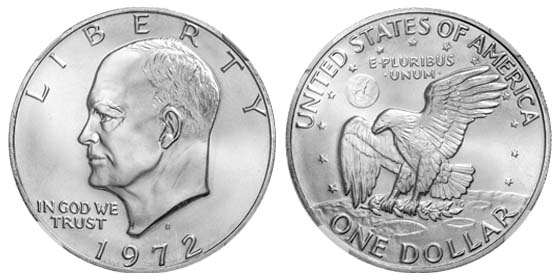
The Eisenhower Dollar was introduced in 1971 after a 36-year gap in U.S. dollar-coin production (the previous regular dollar coin series having ended in 1935). The coin was issued to commemorate the legacy of five-star General and President of the United States Dwight D. Eisenhower and the country’s accomplishments in space exploration, especially the 1969 Apollo 11 Moon landing.
Designed by Chief Engraver Frank Gasparro, the obverse features Eisenhower’s profile and the reverse depicts an eagle landing on the lunar surface, derived from the Apollo 11 mission patch. The series was minted from 1971 through 1978 at Philadelphia (no mint mark), Denver (D), and San Francisco (S) mints. There were two main compositions: the copper-nickel clad pieces intended for circulation (1971–1978) and a 40% silver-clad version (1971–1976) struck for collectors.
Despite the return of the large dollar coin, the Eisenhower Dollar saw limited circulation. Its large size and weight made it unpopular in everyday commerce, though it found some use in casinos and the vending industry in Nevada.
The Eisenhower Dollar marks a unique chapter in U.S. coinage: a tribute to leadership and space exploration, and the last large-sized dollar minted for general issue.
Rarest Coins in the Series
Within the Eisenhower Dollar series, certain dates and varieties stand out as especially scarce or desirable and sell for higher prices. According to collector guides, noteworthy examples include:
- The 1972 Philadelphia (no mint mark) “Type 2” variety is the rarest production reverse with very low mintage (estimated under 100,000 coins) and identifiable by its altered Earth design lacking islands beneath Florida.
- Silver-clad issues struck at the San Francisco (S) mint in the early years: for example, the 1974-S silver and high-grade pieces are hard to find in uncirculated grades.
- Bicentennial 1776–1976 issues in specific varieties (Type 1 vs Type 2) and mint marks that were produced in lower numbers in certain form (especially in brilliant uncirculated or proof condition).
- Generally, high-grade specimens (MS67, MS68 and above) of any date in either clad or silver-clad composition are quite scarce, especially with full original luster and minimal bag marks. Collector-valued condition makes a large difference in the Eisenhower Dollar market.
Understanding the interplay of date, mint mark, variety (reverse type, composition), and condition is essential when determining an Eisenhower Dollar’s rarity and assessing the “Eisenhower Dollar value.”
Types of Collections
Collectors approach the Eisenhower Dollar series in various ways, depending on their interest, budget, and collecting goals:
- Basic Type / Representative Set: A collector might acquire a single example of the Eisenhower Dollar series (perhaps a common date in circulated grade) simply to represent the return of the large dollar coin and the Eisenhower/space theme.
- Complete Date & Mint Mark Set: More ambitiously, a collector may aim to assemble one of each date and mint mark from 1971 to 1978 (including Philadelphia, Denver, and San Francisco issues) in a single composition (typically clad).
- Composition / Finish Specialization: Some collectors focus on the silver-clad issues (1971-76 S-mint silver) or proof issues and their varieties. Others may seek the clad business strikes in uncirculated grades or with exceptional eye appeal.
- Investment/Trophy Strategy: At the top end, collectors may target only those pieces expected to appreciate; for example, a 1972 Type 2 in MS67 or better, or a rare silver-clad proof with cameo contrast.
Each approach comes with trade-offs: breadth vs depth, accessibility vs rarity, cost vs condition. The Eisenhower Dollar series offers opportunities for both beginners and advanced specialists.
Beginner vs. Advanced Collecting
Beginner Collecting
For someone new to modern U.S. coin collecting, the Eisenhower Dollar can be an excellent entry point. Many dates exist in large mintages and are affordable in circulated grades. A beginner might start by acquiring a circulated business strike from a common date, get comfortable with coin handling, grading basics, mint marks, and photo referencing. From there, moving into uncirculated or silver-clad issues is a natural progression. Collector guides indicate that common clad business strikes may sell for modest premiums over face value.
Advanced Collecting
On the advanced side, the collector focuses on condition, variety, and rarity. Key tasks include identifying subtle reverse types (Type 1 vs Type 2 vs Type 3 for 1972), verifying silver-clad vs clad composition, confirming proof vs business strike, and securing certified high-grade examples. Advanced collectors also follow auction results, pedigree coins, and grading trends. Condition sensitivity is high: a one-grade difference (MS65 vs MS66) often translates into a large price gap. When assessing advanced pieces, dealers frequently refer to pricing guides discussing Eisenhower Dollar value in depth.
Investment Potential
While many Eisenhower Dollars remain modestly priced, the series offers investment potential when one focuses on rarities, condition, and composition. Several factors support this:
- Historical context: The Eisenhower Dollar represents the return of the large-size dollar, commemorates President Eisenhower, and celebrates the Apollo 11 lunar landing, giving it a strong thematic appeal.
- Variety and condition scarcity: Although many coins were struck, standout varieties (1972 Type 2, rare silver issues, high-grade business strikes) are scarce. Collector demand often pushes prices higher.
- Accessible entry with upside: Common dates in circulated grades are inexpensive, providing an easy entry point. Rarer high-grade pieces may appreciate more, especially as grading populations for modern-era coins shrink.
- Price guide data: Published retail price guides show that while many Eisenhower Dollars trade for modest premiums now, top-grade examples consistently trade at strong levels.
When evaluating an Eisenhower Dollar’s investment merit, one must look at date, mint mark, variety, composition (clad vs silver-clad), grade, and certification. While most coins may not deliver dramatic returns, the handful of rarer specimens do reflect the principle of “quality over quantity.”