


Liberty Head Gold Dollar Values
How Much Liberty Head Gold Dollar are Worth: Liberty Head Gold Dollar Values & Coin Price Chart
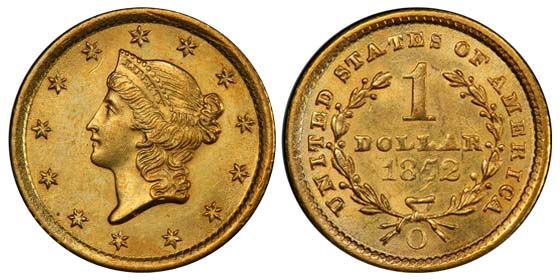
Year | Mint | Variety | Designation | VG-8 | F-12 | VF-20 | EF-40 | AU-50 | U-60 | MS-63 | MS-64 | MS-65 | MS-66 | MS-67 |
|---|---|---|---|---|---|---|---|---|---|---|---|---|---|---|
1800 | P | Plain 4- Stemless Wreath | Red-brown | 200 | 300 | 400 | 500 | 600 | 700 | 800 | 900 | 1000 | 1200 | 1100 |
| Year | Mint | Variety | Designation | VG-8 | F-12 | VF-20 | EF-40 | AU-50 | MS-60 | MS-63 | MS-64 | MS-65 | MS-66 |
|---|---|---|---|---|---|---|---|---|---|---|---|---|---|
| 1849 | (None) Phil | No L | -- | $312 | $324 | $350 | $431 | $509 | $1,034.00 | $1,820.00 | $3,085.00 | $6,075.00 | $13,000.00 |
| 1849 | (None) Phil | Open Wreath | -- | $312 | $324 | $356 | $401 | $447 | $620 | $1,440.00 | $2,205.00 | $4,605.00 | $15,850.00 |
| 1849 | D | -- | -- | -- | $2,035.00 | $2,460.00 | $3,470.00 | $4,148.00 | $6,750.00 | $19,075.00 | $41,500.00 | $89,000.00 | -- |
| 1849 | O | -- | -- | $312 | $324 | $342 | $483 | $573 | $1,365.00 | $3,229.00 | $6,100.00 | $14,800.00 | $38,750.00 |
| 1850 | (None) Phil | -- | -- | $301 | $317 | $336 | $381 | $409 | $531 | $673 | $1,535.00 | $5,925.00 | $12,400.00 |
| 1850 | C | -- | -- | -- | $1,328.00 | $1,640.00 | $2,710.00 | $4,245.00 | $7,720.00 | $34,600.00 | -- | -- | -- |
| 1850 | D | -- | -- | -- | $1,265.00 | $1,895.00 | $3,245.00 | $4,275.00 | $12,175.00 | $42,600.00 | $66,400.00 | -- | -- |
| 1850 | O | -- | -- | -- | $729 | $888 | $1,278.00 | $1,590.00 | $3,688.00 | $9,550.00 | $23,950.00 | -- | -- |
| 1851 | (None) Phil | -- | -- | $287 | $303 | $321 | $363 | $391 | $488 | $617 | $1,072.00 | $2,200.00 | $4,308.00 |
| 1851 | C | -- | -- | -- | $1,375.00 | $1,573.00 | $2,185.00 | $2,850.00 | $4,260.00 | $6,775.00 | $18,325.00 | $38,995.00 | $37,625.00 |
| 1851 | D | -- | -- | -- | $1,100.00 | $1,430.00 | $2,725.00 | $3,665.00 | $6,030.00 | $19,500.00 | $49,250.00 | $91,250.00 | -- |
| 1851 | O | -- | -- | $311 | $337 | $371 | $458 | $490 | $870 | $1,770.00 | $4,190.00 | $5,860.00 | $24,750.00 |
| 1852 | (None) Phil | -- | -- | $287 | $303 | $321 | $363 | $391 | $488 | $617 | $938 | $2,200.00 | $5,325.00 |
| 1852 | C | -- | -- | -- | $825 | $1,245.00 | $1,965.00 | $2,775.00 | $5,200.00 | $15,300.00 | $25,600.00 | $53,550.00 | $80,250.00 |
| 1852 | D | -- | -- | -- | $1,155.00 | $1,715.00 | $2,545.00 | $3,790.00 | $8,990.00 | $36,650.00 | -- | -- | -- |
| 1852 | O | -- | -- | $312 | $324 | $399 | $521 | $550 | $1,303.00 | $4,495.00 | $10,180.00 | $35,400.00 | $55,875.00 |
| 1853 | (None) Phil | -- | -- | $287 | $303 | $321 | $363 | $391 | $488 | $617 | $938 | $1,703.00 | $4,308.00 |
| 1853 | C | -- | -- | -- | $2,365.00 | $2,368.00 | $3,790.00 | $4,468.00 | $6,580.00 | $21,520.00 | $33,200.00 | $48,400.00 | -- |
| 1853 | D | -- | -- | -- | $1,265.00 | $1,540.00 | $2,975.00 | $3,900.00 | $8,740.00 | $23,375.00 | $32,500.00 | $55,600.00 | $128,750.00 |
| 1853 | O | -- | -- | $312 | $324 | $346 | $411 | $462 | $704 | $1,695.00 | $2,338.00 | $14,495.00 | $32,995.00 |
| 1854 | (None) Phil | -- | -- | $287 | $303 | $321 | $363 | $595 | $488 | $3,939.00 | $938 | $2,200.00 | $4,308.00 |
| 1854 | D | -- | -- | -- | $3,520.00 | $4,400.00 | $6,000.00 | $7,300.00 | $11,750.00 | $47,300.00 | $90,200.00 | -- | -- |
| 1854 | S | -- | -- | -- | $440 | $550 | $1,163.00 | $1,715.00 | $4,025.00 | $9,270.00 | $17,900.00 | $44,250.00 | -- |
History of the Liberty Head Gold Eagle
The Liberty Head Gold Eagle, minted from 1838 to 1907, stands as a notable and long-lived gold coin in American history. Designed by Christian Gobrecht, the third Chief Engraver of the U.S. Mint, this $10 denomination played a crucial role in American commerce for nearly seven decades. Struck through major periods of U.S. development, including the California Gold Rush, the Civil War, and the Industrial Revolution, the coin symbolizes the nation’s economic resilience and artistic refinement.
The obverse features Lady Liberty facing left, adorned with a coronet inscribed “LIBERTY” and encircled by thirteen stars symbolizing the original colonies. The reverse displays a heraldic eagle clutching arrows and an olive branch, representing the balance of military readiness and peace. Two main design varieties exist:
- 1838–1866: No Motto: The earliest issues omitted the phrase “IN GOD WE TRUST”.
- 1866–1907: With Motto: Added following the Civil War to reflect a more religious and unified national identity.
The Liberty Head Gold Eagle was minted during a period of change in the U.S. Mint: while earlier issues reflected somewhat smaller minting techniques, by the late 19th century, the Mint had fully embraced mechanized, high-volume production. The series thus occupies a space both as a historical artifact and a numismatic milestone.
Rarest Coins in the Series
The long minting history of this coin produced numerous rare and highly desirable issues that continue to define Liberty Head Gold Eaglevalue in the marketplace. Some standouts include:
- 1838 Philadelphia Issue: With a relatively modest mintage and being the first year of the Liberty Head design, the 1838 Philadelphia variety is especially sought after.
- 1854-S Liberty Head Gold Eagle: The first $10 gold coin struck at the San Francisco Mint. While exact survival figures are uncertain, the 1854-S is among the scarcer San Francisco-mint issues and often sells at a premium.
- 1870-CC Liberty Head Gold Eagle: Struck at the legendary Carson City Mint during its first year of operation, with only 5,908 coins minted and far fewer surviving.
- 1865-S and 1875 Philadelphia Issues: Both noted for low mintages and scarcity in higher grades.
Collectors also seek coins exhibiting die varieties such as overdates, repunched mint marks, and weak strikes, remnants of the less consistent production conditions of the 19th century. Coins struck at Southern branch mints like Charlotte (C) and Dahlonega (D) are particularly rare due to their limited runs and historical significance.
Types of Collections
The Liberty Head Gold Eagle appeals to collectors of all levels due to its diverse production history and range of attainable examples. Common approaches include:
- Date and Mint Mark Sets: Collectors pursue one example from each year and mint, often spanning Philadelphia, New Orleans (O), San Francisco (S), Charlotte (C), Dahlonega (D), and Carson City (CC).
- Type Sets: Featuring one coin from each design variety: the No Motto and With Motto types.
- Specialty Collections: Focused on errors, die varieties, or hoard provenance, including coins recovered from historic shipwrecks or old bank reserves.
Because of its long mintage and widespread circulation, the Liberty Head Gold Eagle offers a versatile range from affordable circulated pieces to very scarce numismatic rarities.
Beginner vs. Advanced Collecting
Beginner Collecting
For beginners, later-date examples (1890s–1907) of the Liberty Head Gold Eagle often represent the more accessible portion of the market. While they may have a premium above bullion value, they generally cost markedly less than the ultra-rare early or branch-mint issues, offering a historical coin at a more manageable price point.
Advanced Collecting
Advanced collectors, however, pursue scarcer issues, particularly those from Charlotte, Dahlonega, and Carson City, where mintages were often below 10,000 pieces. Authentication by third-party grading services is essential, as counterfeits and altered coins exist. Specialists also assess strike quality, surface preservation, and originality of luster, all of which play a major role in determining the Liberty Head Gold Eagle value in today’s market.
Investment Potential
Beyond its historical significance and design, the Liberty Head Gold Eagle represents a compelling investment vehicle. Being a pre-1933 U.S. gold coin, the Liberty Head Gold Eagle has both intrinsic gold value and numismatic appeal. That said, the degree of premium depends heavily on date, mint mark, grade, and rarity.
While high-grade or branch-mint examples often command significant premiums and tend to hold up better against bullion swings, many common dates in lower grade may still closely track bullion value. Furthermore, coins with verified provenance or inclusion in notable collections can realize substantial premiums at auction.
The coin’s enduring appeal lies in its balance between accessibility and exclusivity: common dates offer affordability and historical interest, while rare issues provide greater appreciation potential. For those seeking a tangible connection to America’s 19th-century legacy, few coins rival the cultural and financial numismatic significance of the Liberty Head Gold Eagle.