


Sacagawea Dollar Values
How Much Sacagawea Dollars are Worth: Sacagawea Dollar Values & Coin Price Chart
Year | Mint | Variety | Designation | VG-8 | F-12 | VF-20 | EF-40 | AU-50 | U-60 | MS-63 | MS-64 | MS-65 | MS-66 | MS-67 |
|---|---|---|---|---|---|---|---|---|---|---|---|---|---|---|
1800 | P | Plain 4- Stemless Wreath | Red-brown | 200 | 300 | 400 | 500 | 600 | 700 | 800 | 900 | 1000 | 1200 | 1100 |
| Year | Mint | Variety | Designation | VG-8 | F-12 | VF-20 | EF-40 | AU-50 | MS-60 | MS-63 | MS-64 | MS-65 | MS-66 |
|---|---|---|---|---|---|---|---|---|---|---|---|---|---|
| 2000 | P | -- | -- | $1 | $1 | $1 | $1 | $1.50 | $1.90 | $4.20 | $4.70 | $5.30 | $5.80 |
| 2000 | D | -- | -- | $1 | $1 | $1 | $1 | $1 | $2.60 | $4.20 | $4.70 | $5.30 | $9.80 |
| 2001 | P | -- | -- | $1 | $1 | $1 | $1 | $1.90 | $2.80 | $4.20 | $4.70 | $5.30 | $5.80 |
| 2001 | D | -- | -- | $1 | $1 | $1 | $1 | $1.90 | $2.80 | $4.20 | $4.70 | $5.30 | $8.70 |
| 2002 | P | -- | -- | $1 | $1 | $1 | $1 | $2.10 | $3.20 | $4.20 | $4.70 | $5.30 | $6.50 |
| 2002 | D | -- | -- | $1 | $1 | $1 | $1 | $1.90 | $2.80 | $4.20 | $4.70 | $5.30 | $10.40 |
| 2003 | P | -- | -- | $2 | $2 | $2 | $2 | $2.40 | $2.90 | $4.20 | $4.70 | $5.30 | $8.50 |
| 2003 | D | -- | -- | $2 | $2 | $2 | $2 | $2.40 | $2.90 | $4.20 | $4.70 | $4.80 | $10.40 |
| 2004 | P | -- | -- | $1 | $1 | $1 | $1 | $1.90 | $2.80 | $4.20 | $4.70 | $5.80 | $8 |
| 2004 | D | -- | -- | $1 | $1 | $1 | $1 | $2.40 | $3.90 | $4.20 | $4.70 | $5.30 | $11 |
| 2005 | P | -- | -- | $1 | $1 | $1 | $1 | $1 | $2.60 | $4.20 | $4.20 | $5.80 | $12 |
| 2005 | D | -- | -- | $1 | $1 | $1 | $1 | $1.90 | $2.80 | $4.20 | $4.20 | $5.80 | $11 |
| 2006 | P | -- | -- | $1 | $1 | $1 | $1 | $1.90 | $2.80 | $4.20 | $4.70 | $5.30 | $6.50 |
| 2006 | D | -- | -- | $1 | $1 | $1 | $1 | $2.80 | $4.60 | $4.70 | $4.70 | $6.50 | $16.10 |
| 2007 | P | -- | -- | $1 | $1 | $1 | $1 | $1 | $2.60 | $4.20 | $4.70 | $5.30 | $6.50 |
| 2007 | D | -- | -- | $1 | $1 | $1 | $1 | $1.90 | $2.80 | $4.20 | $4.70 | $5.30 | $9 |
| 2008 | P | -- | -- | -- | -- | -- | -- | -- | $3.70 | $4.30 | $4.80 | $5.40 | $9 |
| 2008 | D | -- | -- | -- | -- | -- | -- | -- | $4 | $4.30 | $5.30 | $5.90 | $9 |
History of the Sacagawea Dollar
The Sacagawea Dollar, first issued in 2000, was designed to reintroduce dollar coins into circulation and celebrate one of America’s most recognized historical figures. Featuring Sacagawea, the Shoshone interpreter and guide who played a pivotal role in the Lewis and Clark Expedition, this golden-hued coin represented a new era in U.S. coinage, one blending innovation, history, and symbolism.
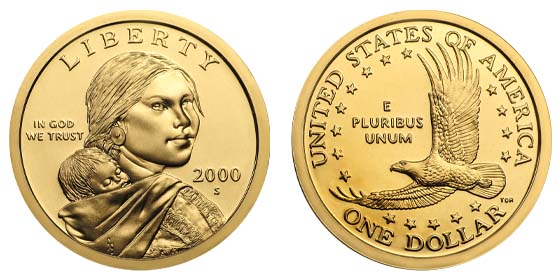
Designed by Glenna Goodacre, the obverse depicts Sacagawea carrying her infant son, Jean Baptiste, on her back, her gaze calm yet purposeful, symbolizing strength and guidance. The reverse, designed by Thomas D. Rogers, features a soaring eagle encircled by 17 stars, representing the number of U.S. states in 1804, the year Sacagawea joined Lewis and Clark in their expedition.
The Sacagawea Dollar replaced the Susan B. Anthony Dollar, which was often confused with the quarter due to its similar size and color. To address this issue, the U.S. Mint adopted a manganese-brass alloy, giving the coin a distinctive golden tone and unique tactile feel. The mint also promoted the coin heavily, even partnering with General Mills to include 2000-dated coins in boxes of Cheerios, about 5,500 of which featured a prototype reverse with enhanced tail feathers, now known as the “Cheerios Dollar.”
Although the coin was intended for everyday transactions, public adoption was limited. Nevertheless, its artistry, cultural significance, and special editions have made it a key part of modern numismatics, especially among those intrigued by Native American heritage and early 21st-century U.S. Mint experimentation.
Rarest Coins in the Series
Despite its widespread mintage, certain Sacagawea Dollars have achieved notable recognition due to their rarity or unique variations. Chief among them is the 2000-P “Cheerios” Dollar, distributed through a promotional campaign in boxes of Cheerios cereal. These coins differ subtly but importantly from the standard issue: the eagle on the reverse has enhanced tail feather detail, a design prototype that never made it to mass production.
Fewer than 5,500 Cheerios Dollars are believed to exist, making them some of the most sought-after modern coins in U.S. history. Other rare and notable pieces include:
- 2000-W Burnished Proof Sacagawea Dollar: A small group of experimental pattern coins struck at the West Point Mint, with only about five confirmed examples.
- 2007 Sacagawea Dollar Mule Error: A coin mistakenly struck with a Washington Quarter obverse and a Sacagawea reverse, one of the most well-known modern U.S. Mint errors with roughly 19 known examples.
- 2009 Native American Series Transition Coin: Marked the beginning of annually changing reverses celebrating Native American achievements, such as agriculture, trade, and military service.
These coins, particularly in pristine or certified conditions, have become important highlights in any modern U.S. coin collection and have helped establish the Sacagawea Dollar value in the upper echelons of contemporary numismatics.
Types of Collections
Collectors approach the Sacagawea Dollar in several ways:
- Date and Mintmark Sets: A complete timeline of annual issues from Philadelphia (P), Denver (D), and San Francisco (S) mints.
- Special Editions and Varieties: Including proof coins, special Mint finishes, and experimental strikes like the 2000-W Proof.
- Transition Sets: Combining Sacagawea Dollars with Native American Dollars (issued from 2009 onward) to showcase the evolution of the series.
- Error and Promotional Coins: Featuring mules, missing-edge inscriptions, and promotional releases like the Cheerios variety.
This versatility allows collectors of all experience levels to build a unique and historically meaningful set tailored to their interests and budget.
Beginner vs. Advanced Collecting
Beginner Collecting
For beginners, the Sacagawea Dollar offers a welcoming entry point into coin collecting. Most coins from circulation or uncirculated rolls are affordable and easy to find, providing an accessible way to explore modern U.S. minting history. Collectors can start with basic date sets or proof editions, available from the U.S. Mint and reputable dealers.
Advanced Collecting
Advanced collectors, however, focus on rare varieties and high-grade specimens. The 2000-P Cheerios Dollar, 2000-W Burnished Proof, and Mule Error coins are top-tier targets, commanding thousands of dollars at auction. Collectors also seek high-quality proof coins from San Francisco and varieties with unusual toning or minting errors that enhance aesthetic and monetary appeal. Proper authentication through grading services such as PCGS or NGC is essential for verifying authenticity and preserving long-term value.
Investment Potential
While most Sacagawea Dollars trade close to their face value, the series offers notable collector interest through its rarities and numismatic appeal. The Cheerios Dollar, for instance, has sold for over $5,000, while Mule Errors have fetched six-figure sums. These standout coins demonstrate that while the average issue is common, select pieces possess notable Sacagawea Dollar value.
Furthermore, the coin’s ongoing cultural resonance, particularly through the Native American Dollar continuation, keeps collector interest alive. As more collectors appreciate the artistry and historical symbolism behind this series, collector interest has remained strong over time.
The coin’s golden appearance, strong historical roots, and limited special issues ensure it remains a staple for both modern coin enthusiasts and collectors seeking variety within their collections.