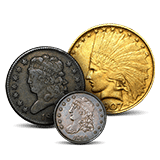

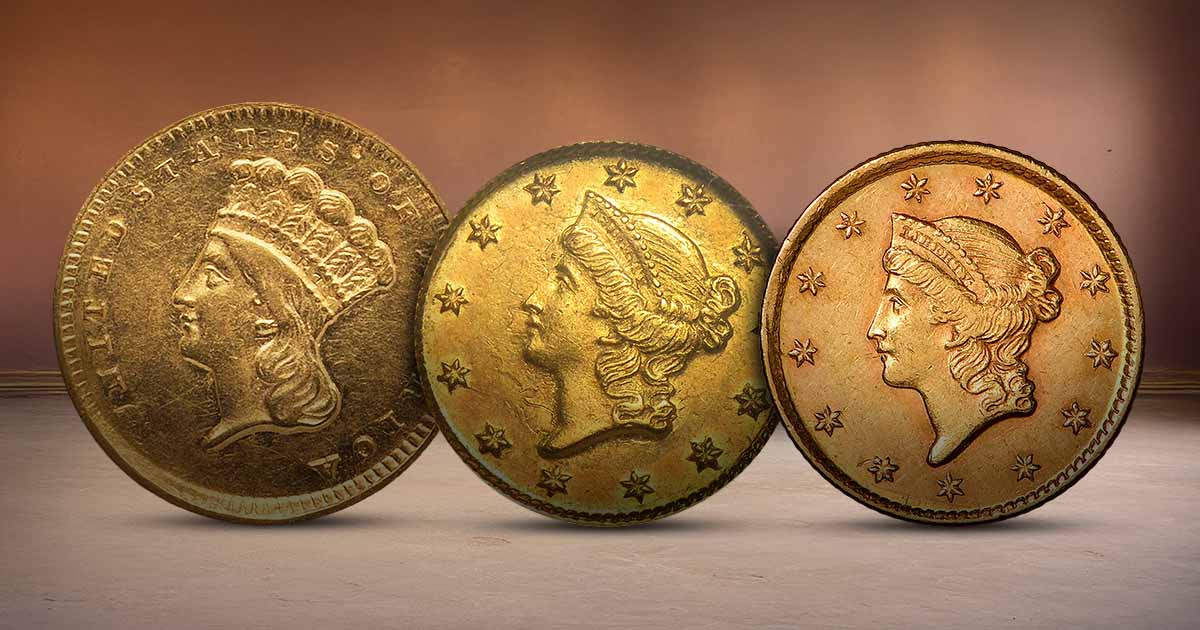
The United States Mint struck gold dollars from 1849 until 1889 following the Coinage Act of 1849, the flood of California gold, and a public need for high-denomination currency. Three principal design types emerged in that time: the Type 1 Liberty Head, the Type 2 Small Indian Princess, and the Type 3 Large Indian Princess. The rarest of these gold dollars is the 1849-C Liberty Head Open Wreath issue.
Five U.S. Mint branches struck gold dollars, including Philadelphia, Charlotte, and Dahlonega in the southern gold fields, New Orleans during the 1850s, and San Francisco. For the purposes of this Answer, let’s focus on a single rarity before discussing the nine runners-up, confining the scope to business strikes.
The Rarest Gold Dollar Coin
1849-C Liberty Head Open Wreath
- Design: Type 1 Liberty Head
- Estimated survivors: 4–5 in all grades
- Market range: Issues in lower grades like Extra Fine have recently sold for more than $250,000, with Mint State examples passing $1,500,000.
Why Is It the Rarest Gold Dollar?
The 1849 Open Wreath, the first year’s issue, employs an early reverse die featuring an open wreath. A single reverse die carried the open wreath design before the Mint engravers closed the wreath. With so few examples, the coin seldom enters public auctions. When it does, collectors tend to bid aggressively.
Population reports from PCGS and NGC supply useful data, but resubmissions and crossover grading can inflate totals. All totals cited here reflect combined populations retrieved in May 2025.
Nine Of the Rarest Gold Dollars
1861-D Indian Princess Head Type 3
- Mint: Dahlonega under Confederate authority
- Survivors: ≈75
- Diagnostics: Weak strike, and frequent clash marks
- Value spectrum: XF-45 $35,000 – MS-64+ $180,000
1855-D Indian Princess Head Type 2
- Mintage: 1,811
- Survivors: ≈80
- Value spectrum: XF-40 $29,600 – MS-64 $191,700
1875 Philadelphia Liberty Head Type 3
- Mintage: 400
- Survivors: ≈150, with fewer than 40 in Mint State
- Value spectrum: XF-45 $8,000 – MS-66 $70,000
1856-D Indian Princess Head Type 2
- Mintage: 1,811
- Survivors: ≈80
- Value spectrum: XF-40 $29,600 – MS-64 $191,700
1875 Philadelphia Liberty Head Type 3
- Mintage: 400
- Survivors: ≈150, with fewer than 40 in Mint State
- Value spectrum: XF-45 $8,000 – MS-66 $70,000
1856-D Indian Princess Head Type 2
- Mintage: 1,460
- Survivors: 90
- Value spectrum: XF-45 $10,000 – AU-58 $140,000
1863 Liberty Head Type 3 (Philadelphia)
- Mintage: 6,200
- Survivors: Less than 120
- Value spectrum: XF-45 $3,500 – MS-68 $190,000
1854-D Liberty Head Type 1
- Mintage: 2,935
- Survivors: About 150
- Value spectrum: XF-45 $4,500 – MS-64 $64,000
1860-D Indian Princess Head Type 3
- Mintage: 1,566
- Survivors: <170
- Value spectrum: XF-40 $7,800 – MS-66 $84,900
1850-D Liberty Head Type 1
- Mintage: 8,382
- Survivors: ≈200 with fewer than 40 in Mint State condition
- Value spectrum: XF-40 $4,200 – MS-64 $66,400
1852-D Liberty Head Type 1
- Mintage: 6,360
- Survivors: ≈210
- Value spectrum: XF-40 $2,500 – MS-63 $36,650
Authentication and Certification
Third-party grading remains the foundation of market confidence. Submit suspect coins to authoritative grading organizations like PCGS or NGC. Use these diagnostic cues before shipping.
- 1849-C Open Wreath: Reverse branches terminate without overlapping; denomination numeral sits slightly higher.
- 1861-D: Doubled outline on many letters; clash marks between Liberty and wreath.
- 1856-D: Blob shape in the U of UNITED; granular fields from worn dies.
Some Type 1 Liberty Heads have exhibited tooled reverse wreaths to mimic the open wreath pattern. Check interior surfaces under magnification.
Among all business strike gold dollars, the 1849-C Open Wreath is the because of its minute survival count, auction leadership, and symbolic position as a first-year issue. The other nine issues weave a narrative of Southern gold production, Civil War turmoil, and design changes that fascinate numismatists. Mastering their rarity metrics, auction cadence, and authentication markers empowers collectors to navigate a challenging yet rewarding corner of U.S. Mint coinage.