
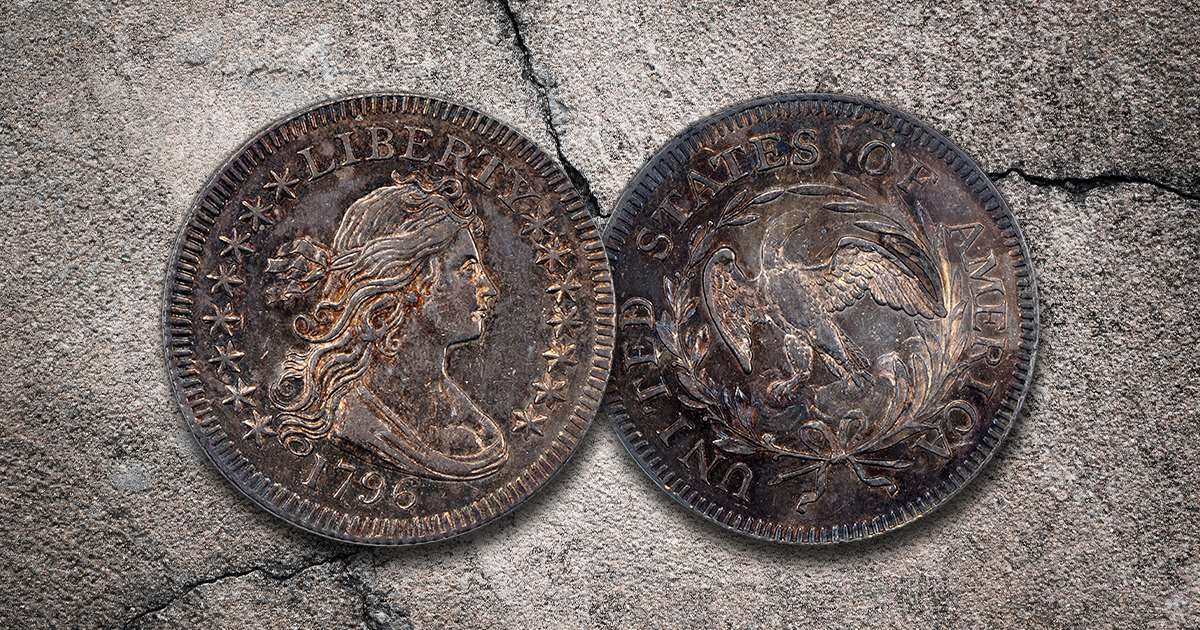
The most expensive quarter dollar is the 1796 Draped Bust Quarter. Its rarity and historical significance have driven prices as high as $1.74 million at auction.
The First Quarter Dollar
The quarter dollar was authorized by the Coinage Act of 1792, but the first quarters were not minted until 1796, reflecting early production challenges and changing priorities at the newly established U.S. Mint. The quarter was a later addition compared to other denominations like the half cent and silver dollar, which debuted earlier. The 1796 quarter is also notable for lacking a denomination inscription, since, at the time, coin designs and conventions were still evolving.
Design
Obverse Design
The obverse features Liberty facing right, her hair tied with a ribbon and draped in classical robes. Fifteen stars surround her, representing the states of the Union at the time.
Reverse Design
The reverse shows a small eagle perched on a cloud, encircled by a laurel and palm wreath. This reverse design was used only in 1796, making it a one-year subtype. Two main die varieties exist, cataloged as Browning-1 and Browning-2. The difference lies in the placement of the “6” in the date; it is low in B-1 and higher in B-2. Both varieties share the same reverse die and often exhibit weak strikes at the eagle’s head because of die opposition with Liberty’s shoulder.
Mintage, Survival Rates, and Die Varieties
The 1796 Draped Bust Quarter had a total mintage of 6,146 coins, all produced at the Philadelphia Mint. This low mintage was due to limited demand for the denomination and the Mint’s early production constraints. No quarters were minted again until 1804, making the 1796 issue a standalone rarity. Experts estimate that approximately 650 1796 quarters survive today, with only a small number in mint state condition. Among these, high-grade examples are extremely scarce. Population reports from grading services like PCGS confirm that coins graded MS-64 and above are rare, which contributes to their high market value. There are two recognized dies for this coin, known as Browning-1 and Browning-2. The Browning-1 variety is scarcer and features a lower “6” in the date, while Browning-2 is more common with a higher “6.”
Auction Prices and Market Performance
The 1796 Draped Bust Quarter has demonstrated consistent price growth over several decades. High-grade examples have set auction records that underscore the coin’s rarity and desirability among collectors. Notable sales include the Simpson specimen, graded MS-66 by PCGS, which sold for $1.74 million in 2022 at Heritage Auctions. The Newman specimen, graded MS-67+★ by NGC, fetched $1.53 million in 2013. The Eliasberg specimen, graded Specimen-66 by PCGS, sold for $881,250 in 2014.
Other High-Value Quarters
While the 1796 Draped Bust Quarter is the most expensive quarter dollar ever sold, several other quarters have reached significant auction prices.
- The 1901-S Barber Quarter, with a mintage of 72,664, sold for $550,000.
- The 1827/3 Capped Bust Quarter, a proof-only overdate rarity, has fetched prices near $700,000.
- The 1873-CC No Arrows Seated Liberty Quarter, a Carson City rarity with only five known examples, has sold for $460,000.
- The 1932-D Washington Quarter, a key date in its series, has achieved prices between $60,000- $143,000 in high grades like MS-66.
In addition, modern quarters such as the 2004-D Wisconsin Extra Leaf and the 2021 Washington Crossing Delaware quarter struck on a $5 gold planchet have attracted interest due to their errors and unique features. Collector interest also varies by series. Barber, Seated Liberty, and Washington quarters each have distinct collector bases, influencing demand and pricing.
The 1796 Draped Bust Quarter stands as the most expensive quarter dollar ever sold, and for good reason. Its combination of rarity, historical significance, unique design, and condition scarcity makes it a highly prized piece in American numismatics. While other quarters have achieved high prices, none match the 1796 quarter’s blend of monetary worth and cultural importance.