
Celebrating Arkansas’ Admission to the Union
Arkansas Centennial Half Dollars (1935-1939)
The people and legislators of the State of Arkansas planned a celebration in Little Rock, Arkansas, in 1936 to mark the centennial of Arkansas’ Admission to the Union. The legislation that they proposed passed Congress and was signed into law by President Franklin D. Roosevelt. The Arkansas Centennial Silver Half Dollar was reissued annually through 1939. Additionally, a 1936 version was issued with a different obverse, showing a portrait of U.S. Senator Joseph Taylor Robinson, who represented the state of Arkansas.
The Arkansas Centennial Commission was formed to plan the statewide celebrations, select a designer, and distribute the coins. The Commission sought a local artist to create the coin’s original designs, so they held a competition. Arkansas sculptor and artist Edward Everett Burr won the design competition.
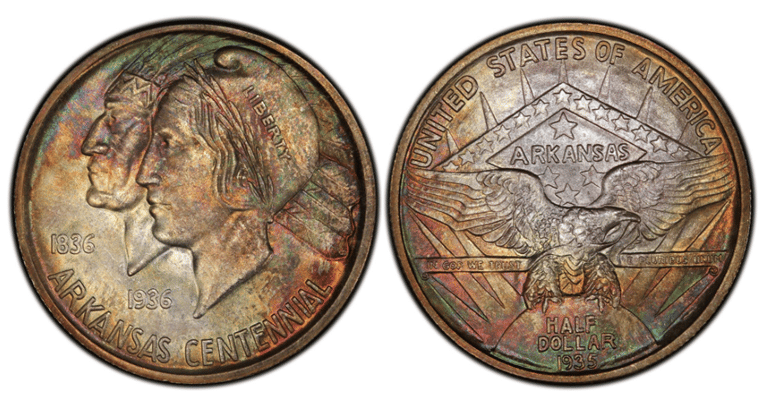
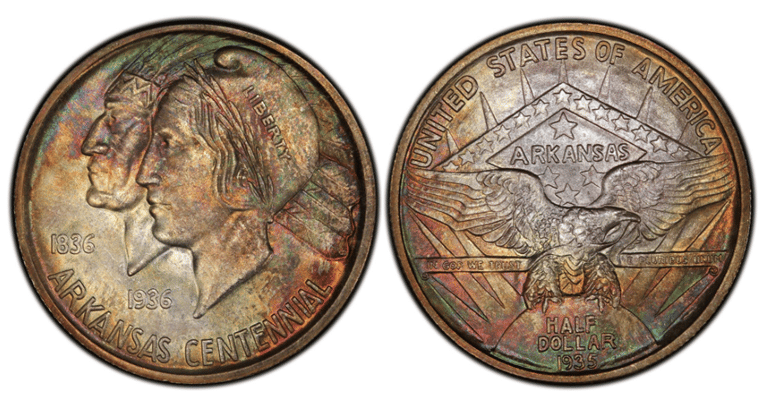
Emily Bates sculpted the obverse, and Edward E. Burr designed the obverse and the reverse. The 1935-1939 obverse design features the busts of a Quapaw Indian and Lady Liberty. The conjoined busts faced left, and the words “ARKANSAS CENTENNIAL” are below the busts at the bottom periphery. There were also two dates in front of the faces, “1836” and “1936″.
The reverse depicts an eagle with wings spread, perched on a rising sun. A diamond shape is behind the eagle with 13 five-pointed stars contained within, and inside the diamond, the name “ARKANSAS” and four additional stars, which were adapted from the state flag. Across the top periphery are the legends “UNITED STATES OF AMERICA” and “HALF DOLLAR” across the bottom periphery on the sun. The reverse includes the year of issue (1935–1939) on the sun. Behind the eagle is a ribbon that extends the width of the coin with the mottoes “IN GOD WE TRUST” and “E PLURIBUS UNUM” on it.
The legislation proposed a maximum of 500,000 coins to be authorized. Although 1936 was the actual centennial year, the coins were struck at the Philadelphia, Denver, and San Francisco Mints in 1935. In 1935, Philadelphia struck 13,012 coins, Denver struck 5,505 coins, and San Francisco struck 5,506 coins. During the centennial year, 1936, 9,660 coins were struck at the Denver Mint, and 9,662 were struck at the San Francisco Mint.
In 1937, the Commission turned to New York City coin dealer, Stack’s, to handle the sales and distributions of the coins. Stack’s distributed the 3-coin set in a small black leatherette wooden box with their name in gold, priced at $6.75. There were 5,505 coins struck in Philadelphia and Denver that year, and 5,506 coins were struck in San Francisco.
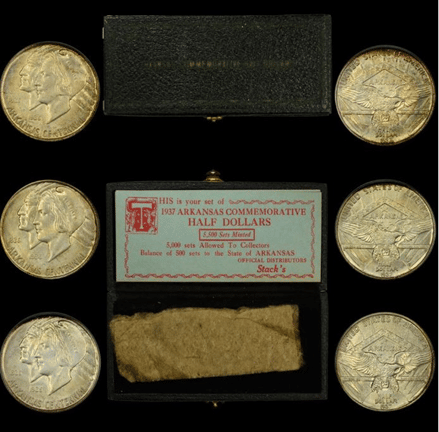
In 1938 and 1939, Stack’s still distributed the 3-coin sets, but in plain wooden boxes. The 1938 mintages dropped to 3,156 each for Philadelphia and San Francisco, and 3,155 coins for Denver. In 1939, 2,104 coins were each struck in Philadelphia and Denver, and 2,105 were struck in San Francisco. Of the 500,000 coins authorized, only 85,302 were struck and distributed on behalf of the Commission.
1936 Robinson-Arkansas Centennial Half Dollar Design Variation
A second design for the Arkansas Centennial coin was authorized by the Act of June 26, 1936, and there was strong support for changing the obverse design to be replaced by then-living US Senator Joseph T. Robinson.
While other commemorative coins had a variety of dates or stars or a 2X2 to identify the variety, the Arkansas new issue was called the “Robinson-Arkansas” to distinguish it from the separate Arkansas Centennial Half Dollar issues. The reverse of the coin remained the same, but Henry Kreis, who designed the 1935 Connecticut Tercentenary Half Dollar and the 1936 Bridgeport Connecticut Centennial Half Dollar, was selected to redesign the obverse of the coin and provide a likeness of Senator Robinson. The approved coin legislation would be a “one-year” and “one Mint” (Philadelphia) issue only.
On the obverse, a bust of Senator Robinson facing right. Above the portrait in the periphery is “ARKANSAS CENTENNIAL 1836 – 1936”, and behind his head is “LIBERTY”. His name, “JOSEPH T. ROBINSON” appears in two lines in front of his face. The Edward Everett Burr reverse design remained unchanged.
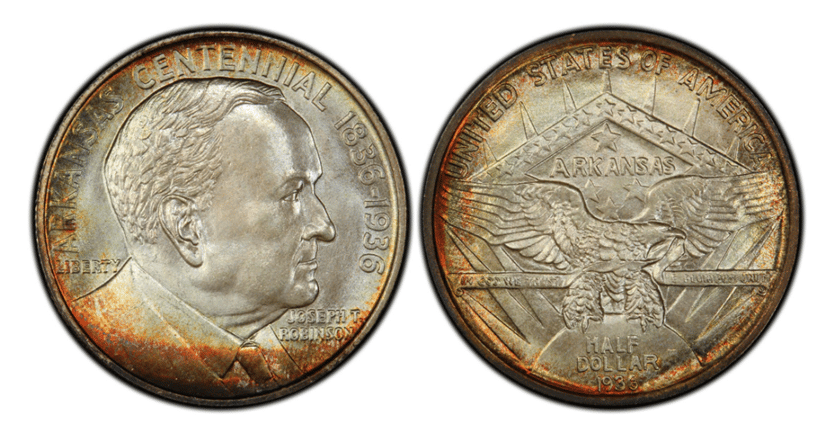
The Philadelphia Mint struck 25,265 coins, which were managed by the Robinson-Arkansas Centennial Commission. Stack’s offered to help distribute these coins and created a small folder that could hold up to 5 coins.
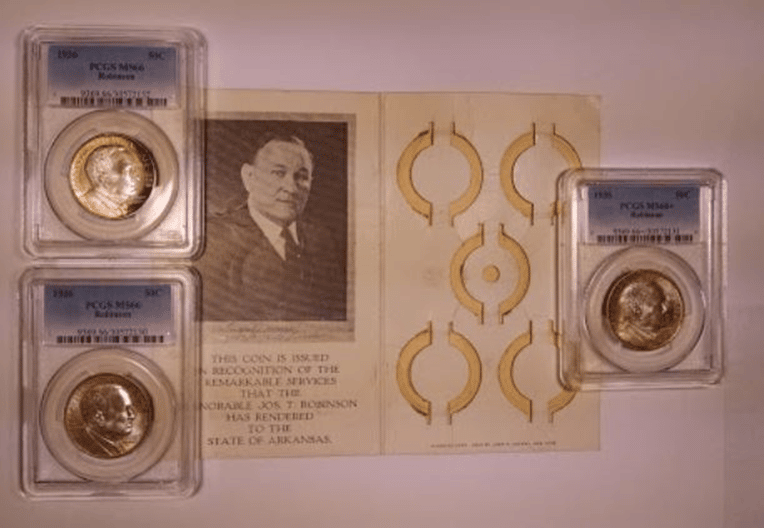
Although 50,000 coins were authorized by that special legislation, slightly more than half of that number were struck and distributed by Stacks. The profits from the sale of these special Robinson coins also supported the Arkansas Centennial celebrations. Sales were buoyed by Robinson’s popularity across the state of Arkansas.
Add every version of this half dollar to your collection and explore other U.S. classic silver commemorative coins.