
French New World Coinage, 1717 to 1720: Canada, Louisiana, and the Colonial Need for Small Change
France did not consistently produce coinage marked for exclusive use in Canada, Louisiana, or the French West Indies, but it did authorize issues meant to circulate broadly across its New World possessions. Soon after Louis XV became king, officials confronted a familiar colonial problem. Everyday trade needed reliable small coins, but supplies were uneven and dominated by older or foreign pieces. The story starts with a Perpignan issue of 1717 that was planned but largely abandoned. It then turns to 1720 coinage struck in greater numbers, although surviving pieces are scarce and recorded circulation was uneven.
The Failed Perpignan Experiment of 1717
A royal edict dated March 9, 1717, called for copper coins of 6 deniers and 12 deniers to be struck at the mint at Perpignan in southwestern France. These coins were intended to be legal tender in Canada, and the authorization was substantial: 3,000,000 pieces of 6 deniers and 1,500,000 pieces of 12 deniers.
The plan quickly ran into a problem that could not be solved by decree. The copper available was of poor quality, and contemporary descriptions and later references emphasize that the alloy issues were serious enough that production was stopped. Surviving examples are often described as showing manufacturing flaws such as flan problems, including cracking and surface roughness, consistent with a project that never reached stable, large-scale output.
This first attempt also stands out for its design. The 1717-Q coins have a different character than the later 1720 pieces, including reverses that carry only text rather than the more recognizable heraldic devices seen on later issues.
Although the project failed to supply coins in volume, the surviving pieces document the intended colonial design and the difficulty of producing it.
The 1720 Issues and Their Design Language
A second effort followed, and coinage dated 1720 is generally treated as the point where the program became far more tangible. Instead of being confined to a single mint, the 1720-dated series was struck more broadly, and references consistently identify multiple denominations associated with New World circulation needs.
The copper denominations commonly discussed for 1720 include a liard valued at 3 deniers, a 6 deniers piece, and a 12 deniers coin that functioned as a sol in accounting terms. The series also includes a silver twenty-sol piece, providing a step from copper to silver denominations.
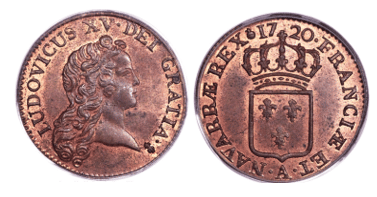
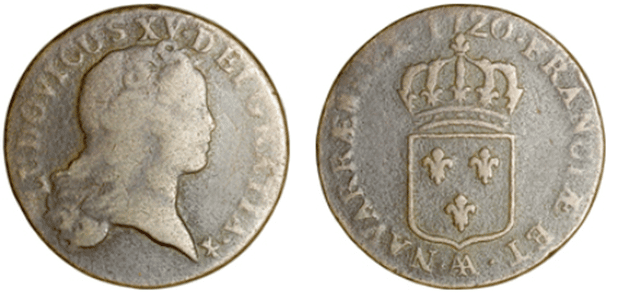
Design elements link these coins visually. The copper pieces feature a portrait bust of Louis XV facing right on the obverse, typically accompanied by Latin titles that present him as king by the grace of God. A standard reverse theme for the copper issues is the royal shield with three fleurs-de-lis surmounted by a crown, an instantly recognizable Bourbon emblem.
Denomination is handled differently across the group. The 1717 Perpignan coins spell out the value in text on the reverse, while some 1720-related copper pieces rely more on size and type conventions, which is why collectors often discuss the copper denominations together as a matched group.
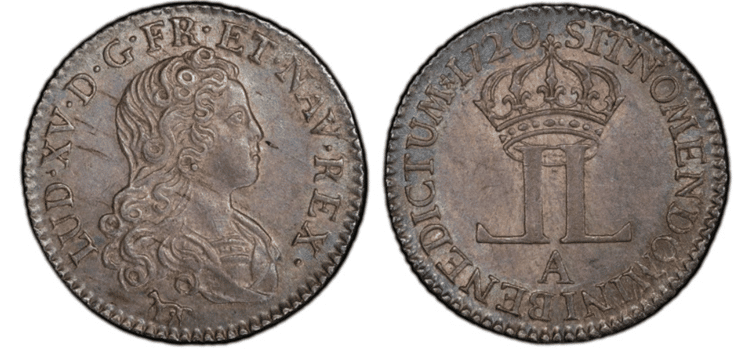
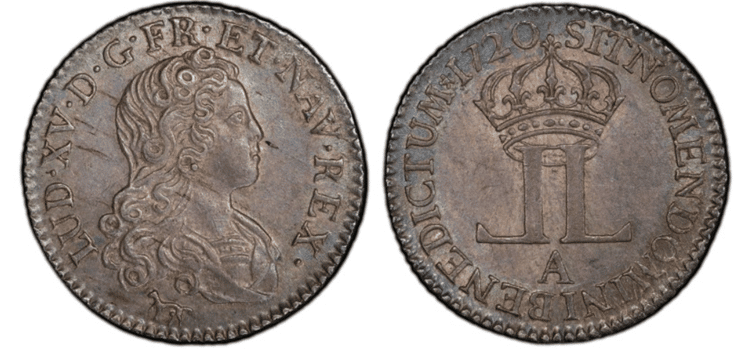
The silver 20 sols stands apart in appearance. While it shares the Louis XV portrait on the obverse, an overview of the series notes a different reverse arrangement, including opposed letters “L” beneath a crown, separating it from the fleur-de-lis shield used on the copper pieces.
The 1720 issues appeared during a period of severe financial turbulence. John Law’s Mississippi Company and the broader Mississippi Bubble peaked and then collapsed in 1720, contributing to severe dislocation in French finance and confidence.
Against that backdrop, 1720-dated coinage associated with colonial needs sits at the intersection of practical small-change policy and a time when France’s economy was under heavy strain.