
Honoring the 75th Anniversary of the Battle of Gettysburg
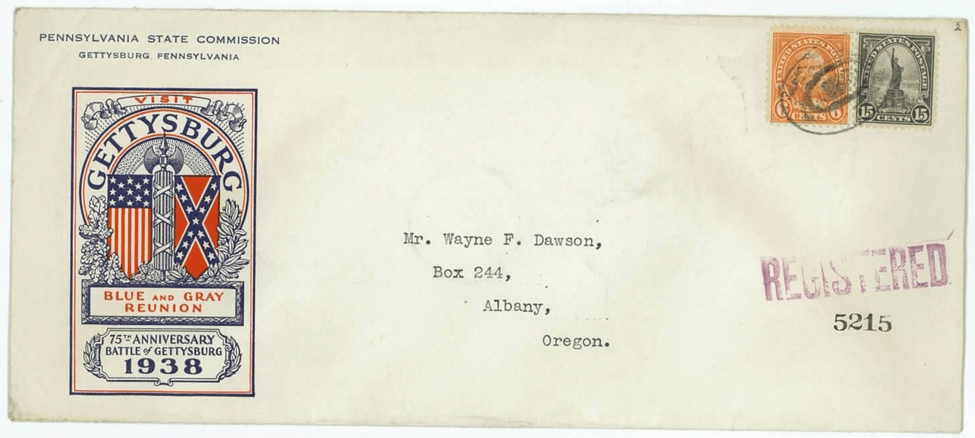
The American Civil War ended in 1865, and by the 1930s, surviving veterans were aging. To ease remaining tensions, veterans’ reunions marked anniversaries of key battles. By 1938, the 75th anniversary of the Battle of Gettysburg was approaching. Although the number of surviving participants was declining, organizers planned a national commemoration and the minting of the 1936 Battle of Gettysburg Half Dollar. Gettysburg was a critical turning point for the Union after two and a half years of setbacks.
The Battle of Gettysburg was fought over three days: July 1–3, 1863. It produced the highest number of casualties of any battle in the four-year conflict, with about 23,000–28,000 Confederate casualties and 23,049 Union casualties.
The Pennsylvania State Commission was appointed to sponsor a commemorative coin in Congress and manage its sales and distribution. The legislation was passed in 1936. As with the Delaware Tercentenary Commemorative Coin, the date can be confusing: the coin is dated 1936 to match the authorizing legislation, but it was struck in 1937 for the 75th anniversary, which occurred in 1938. President Franklin Roosevelt signed the legislation into law.
Design Details
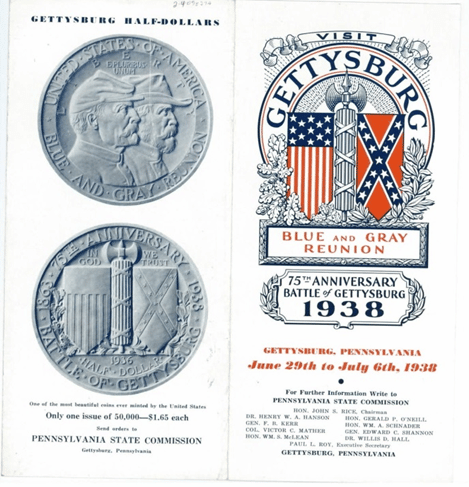
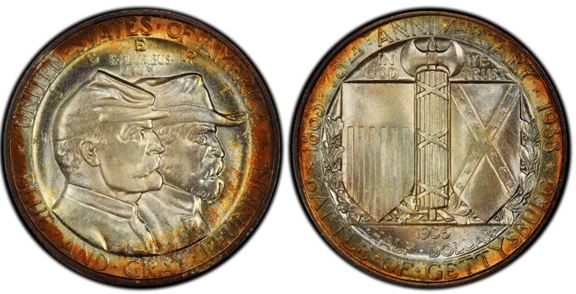
The Pennsylvania State Commission selected Frank Vittor, a Pittsburgh sculptor, to design the coin and secure its approval. The obverse depicts two soldiers, one Union and one Confederate, in profile, facing right. Above them appear “LIBERTY” and “E PLURIBUS UNUM.” Around the periphery are “UNITED STATES OF AMERICA” and “BLUE AND GRAY REUNION.”
The reverse shows two military shields, one Union and one Confederate, separated by a double-headed ax within a fasces. Oak and laurel wreaths appear behind the shields. Above are the words “IN GOD WE TRUST,” and below are “1936” and “HALF DOLLAR.” Around the periphery are the words and dates “1863 – 75th Anniversary – 1938 – BATTLE OF GETTYSBURG.”
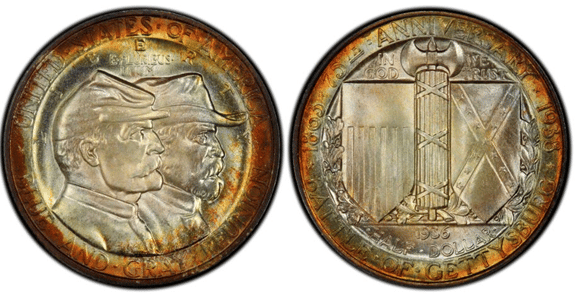
The coin is often critiqued for resembling a medal due to its prominent outer ring and dense inscriptions on both sides. Medals can be struck for commemorative purposes and to honor or award an individual or a group of people, among other things, but the main reason this coin isn’t a medal is that it has a denomination.
Mintage Details
Although the authorized mintage was 50,000 coins, all struck at the Philadelphia Mint, slightly more than half (26,928) were sold and distributed by the Pennsylvania State Commission. The offering price was $1.65, which was on the higher end for these 1936 issues.
The coins were distributed in Pennsylvania State Commission–imprinted envelopes and simple, white, unprinted three-coin holders. Today, collectors value this issue for its historical context, distinctive design elements, and limited distribution. Experience the thrill of adding rare coinage to your collection today, and view the entire collection of our U.S. silver modern commemorative coins