
The Battle of Lexington and Concord
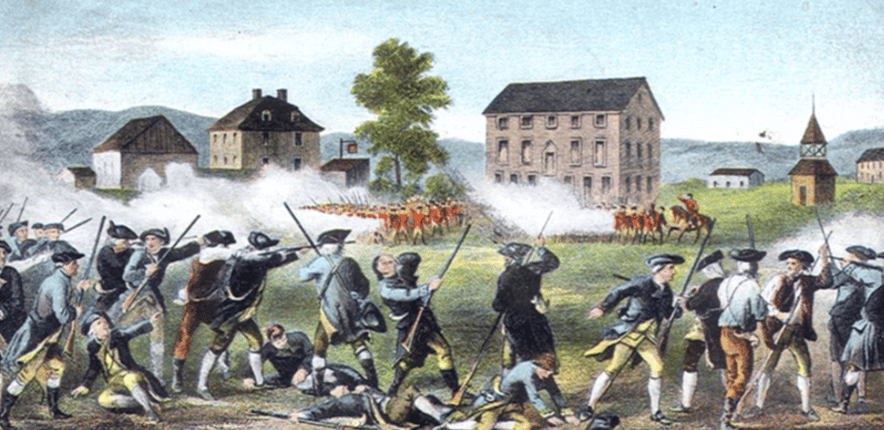
The American Colonies were heavily taxed and regulated by King George III of England, and many colonists sought greater self-governance. The seeds of rebellion had been sown by the King’s actions, and throughout the 1760s the movement grew steadily stronger. By 1775, the Colonies had grown increasingly frustrated with British rule and taxation. Tensions had escalated to the point where open conflict became increasingly likely. In the towns of Lexington and Concord on April 19th, 1775, the first shots were fired, marking the beginning of the Revolutionary War.
The British High Command believed there was a large cache of weapons in the town of Concord, some 18 miles west of Boston. They ordered their troops to march during the evening of April 18th to Concord and search for the arms at sunrise. In response, the colonists sent two riders, Paul Revere and William Dawes, to alert the residents.
The British arrived in Lexington at dawn with 700 troops and were met by 77 militiamen. Several volleys were fired, resulting in 17 colonists being killed or wounded. The British then marched to nearby Concord, still searching for the arms that had already been moved. The British initially controlled the North Bridge in Concord, but the militiamen were determined to drive them away. The British retreated from the bridge, and by that time more than 2,000 minutemen had gathered and were firing at the British from forests, behind fences, and from trees. The British began a hasty retreat, abandoning weapons and equipment in an effort to return to the safety of Boston more quickly. As additional militia forces joined the fighting, the British realized that this “little rebellion” was of far greater consequence than expected. Few at the time believed that British forces could be successfully challenged by colonial militias largely made up of farmers and tradesmen.
The Sesquicentennial Celebration
As 1925 approached, the sesquicentennial of the Battles of Lexington and Concord was planned for commemoration. In 1924, members of the Massachusetts congressional delegation submitted legislation to authorize a commemorative coin honoring the event. The legislation passed and was signed by President Coolidge.
Committees from both Lexington and Concord had each independently reached out to sculptor Chester Beach, who had recently designed the 1923 Monroe Doctrine Centennial Half Dollar. Beach persuaded the two town committees to combine their efforts and split his $1,250 fee. Each town would determine what best represented the spirit of its community on its respective side of the coin.
Design Details
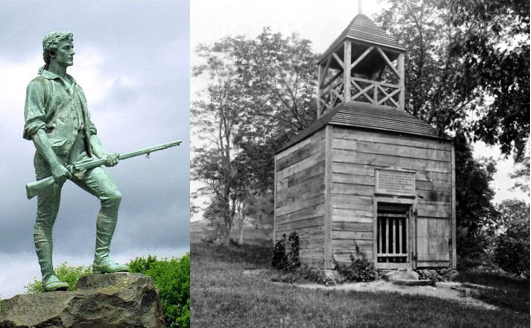
Beach’s design portrayed the full body of the Concord minuteman on the obverse facing right. Surmounting him is “UNITED STATES OF AMERICA” above and “PATRIOT HALF DOLLAR” below. To his right is “IN GOD WE TRUST” and behind him is “CONCORD MINUTEMAN”. The reverse depicts the Old Belfry in Lexington with “LEXINGTON-CONCORD SESQUICENTENNIAL 1775 – 1925” around the coin. Underneath the Belfry is “OLD BELFRY, LEXINGTON.”
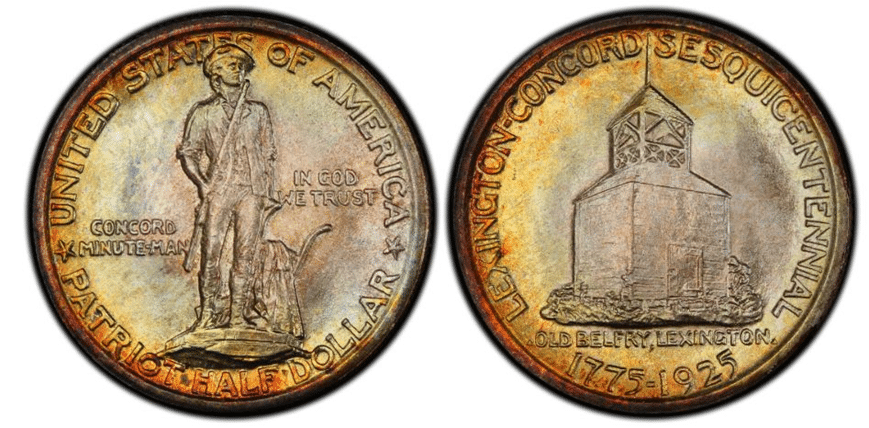
The coins were struck in time for the April celebrations in Massachusetts. Distribution was handled by both the Lexington Trust Company and the Concord National Bank. The coins were sold during the celebrations and for more than a year afterward. The first coin was presented to President Coolidge, and later sales were conducted by banks throughout New England. About 162,000 coins were sold and distributed across the country.
Coins sold at the celebrations in Lexington and Concord were distributed in small pine boxes depicting a Minuteman on the front and the Old Belfry on the reverse. It is believed that approximately 200 of these boxes may still exist today. This issue remains part of the broader category of U.S. classic silver commemorative coins collected today.
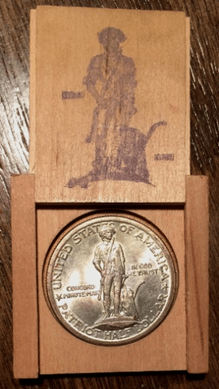
(Original Pine Box used to distribute the 1925 Lexington-Concord Sesquicentennial Commemorative Half Dollar.)