
Among Revolutionary-era monetary experiments, the three unofficial Massachusetts copper pieces stand out for their rarity and design. Unlike later state-authorized issues, these coins were not produced under a clear legislative framework and were never issued in large quantities for daily commerce. Instead, they appear to be prototypes or presentation pieces created during a period when Massachusetts and the other colonies were wrestling with coin shortages, inconsistent foreign coin circulation, and the need for symbols that matched a new political reality.
The three pieces most often discussed are the Massachusetts Pine Tree copper penny, the “Native American with bow” copper, and the unusual three-headed “Janus” copper halfpenny. All three are very scarce and feature Revolutionary-era symbols (Liberty, vigilance, and Massachusetts identity), rather than any evidence of mass production or broad circulation.
Why Unofficial Coppers Mattered in Revolutionary Massachusetts
In the 1770s, coinage in New England remained a patchwork. Foreign silver and copper circulated alongside worn British pieces, privately made tokens, and occasional local issues. Massachusetts had a deep historical memory of coinage, including the famous 1652 Pine Tree shillings, but the legal and practical ability to strike a new, widely accepted copper coin was not yet settled.
This is where unofficial pieces come into focus. They may have been patterns, public-reaction trials, or patriotic artwork. In each case, the designs aimed to convey legitimacy, vigilance, and liberty rooted in both local tradition and classical symbolism.
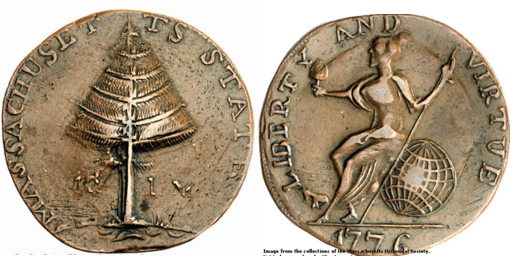
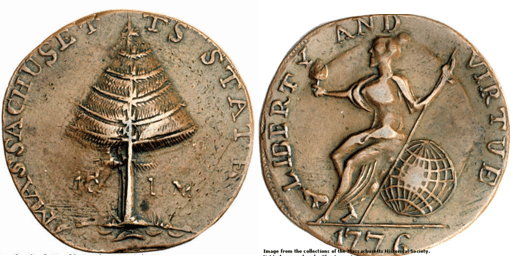
This unique coin was discovered during excavations in Boston’s historic North End, quite near where the Paul Revere homestead is located. It was presented to the Massachusetts Historical Society in 1870 by William Sumner Appleton. The coin is unique!
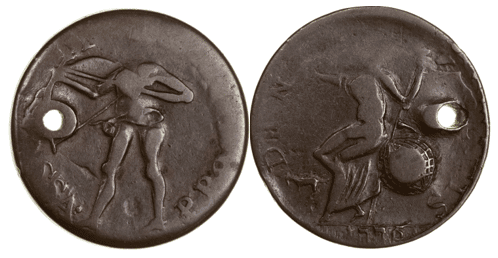
This second coin is believed to be from the same source, Paul Revere. The obverse depicts a Native American holding a bow in his right hand and holding the nocked arrow in his left. Around the periphery is “PROVINCE OF MASSA.”
The reverse appears to have the goddess of Liberty, modeled after Britannia, seated on a globe, holding a royal scepter in her left hand. The legend around the periphery appears to be “DEFENSOR LIBERTATIS” (Defender of Liberty). Likewise, this coin is also unique and resides in the American Numismatic Society collection.
The Pine Tree Copper Penny
The Pine Tree copper penny is tentatively attributed to Boston silversmith and patriot Paul Revere due to stylistic similarities in lettering and engraving, and to the broader context of Revere’s documented work producing engraved Massachusetts notes and related material. But this connection is not conclusively documented.
The design itself blends Massachusetts identity with Revolutionary-era symbolism. The obverse features a pine tree, a deliberate nod to the earlier Massachusetts Pine Tree silver coinage and to the pine tree symbolism used locally in 1776, including patriotic flags associated with the Sons of Liberty. Around the border is the legend “MASSACHUSETTS STATE”.
The reverse shifts to a classical allegory: Liberty, likely adapted from Britannia-style imagery familiar from English coinage, holds a liberty cap (often described as the pileus/Phrygian cap). That cap had long-standing Roman symbolism as an emblem of freedom from slavery, making it especially potent during a revolution framed around self-rule. At Liberty’s feet is a small watchdog, a straightforward symbol of vigilance. The surrounding legend reads “LIBERTY AND VIRTUE”, with the date “1776” in the exergue.
Only one specimen is known. It was reportedly found in Boston’s historic North End, not far from the Revere homestead, and was later presented to the Massachusetts Historical Society in the 19th century. The fact that only one specimen is known places it in a category closer to a pattern or essay than a circulating issue.
The Native American and the Janus Copper
The second piece is another unique copper, also often associated with Revere. Its obverse shows a Native American holding a bow, with an arrow drawn and ready, surrounded by the abbreviated legend “PROVINCE OF MASSA.” The design uses a figure that colonial America frequently employed as a symbol of the land and its identity, even while real Native nations were experiencing upheaval and conflict during the era.
The reverse again uses the familiar Liberty figure, seated and modeled in a way that recalls Britannia. Here, Liberty is seated on a globe and appears to hold a scepter, with a legend believed to read “DEFENSOR LIBERTATIS”, meaning “Defender of Liberty.” This piece is also unique and is associated with an institutional collection.
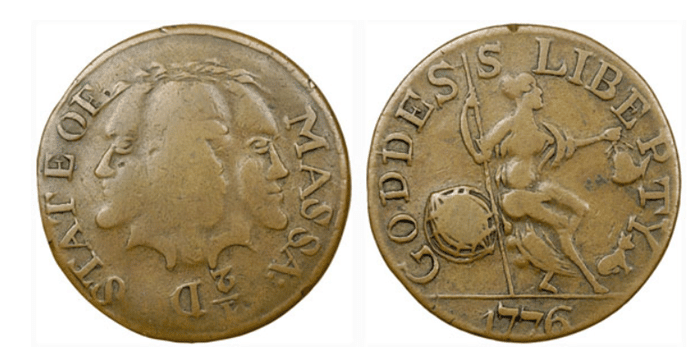
The third piece, the “Janus” copper, is the most visually distinctive. It bears three heads facing left, forward, and right, a clear departure from typical colonial designs and a clear reference to classical and symbolic art. Around the obverse is “STATE OF MASSA. 1/2D.”, implying a halfpenny denomination. The reverse returns to the seated Liberty-on-globe motif with the legend recorded as “GODDESS LIBERTY 1776” (with minor punctuation/spacing variations in different descriptions).
A Small Group with Historical Significance
Taken together, these three coppers capture Massachusetts in transition. They look backward to the colony’s seventeenth-century coin heritage, sideways to familiar British visual language, and forward to an American identity built on liberty, virtue, and public legitimacy. Their extreme rarity strongly suggests they were not intended as mass coinage. Instead, they survive as artifacts of experimentation, propaganda, and craftsmanship at the birth of a nation.