
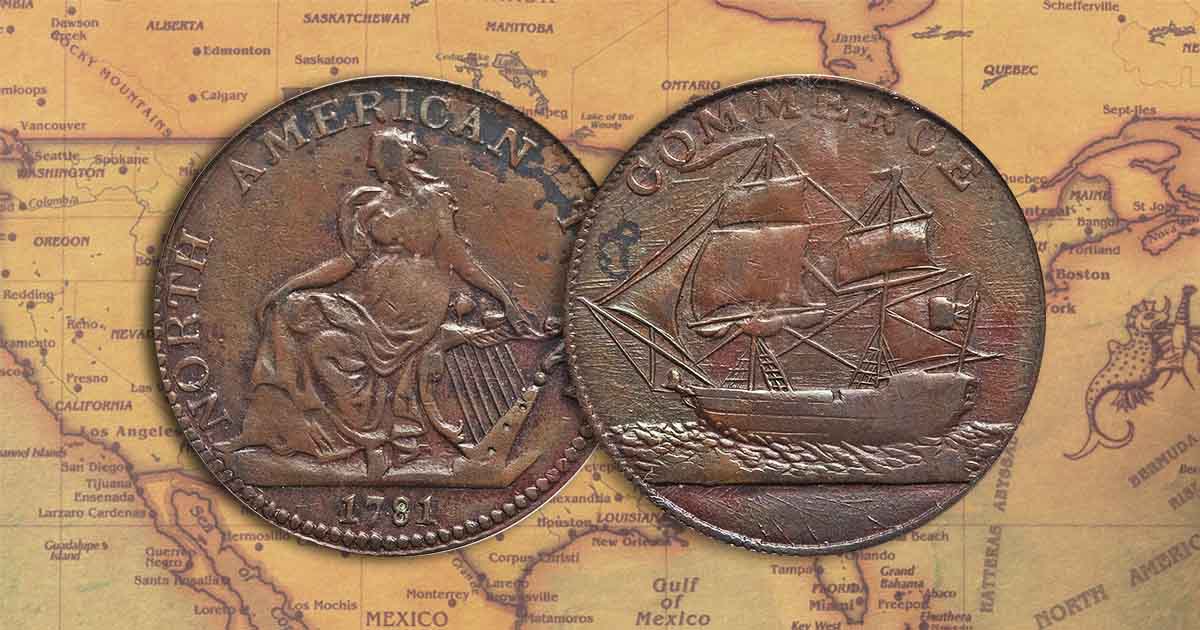
Like many pieces that circulate alongside official coinage, the 1781 North American Token leaves several questions open. Who ordered it, where it was struck, and why it was produced remain debated. Most surviving examples show evidence of use, but when and where they circulated is part of the broader dating debate. Some research record finds in New England and near the Canadian border. Other studies suggest the tokens were struck in Dublin in the early 1800s and later entered North American trade..
The token reflects late-18th-century realities of reliable small change in constant short supply, and commerce therefore relying on a patchwork of coins, tokens, and imported coppers. That economic environment helps explain why a piece that appears regularly in collections focused on colonial-era material looks partly Irish but is labeled North American, and is linked by some sources to Canada.
Design and What It Suggests
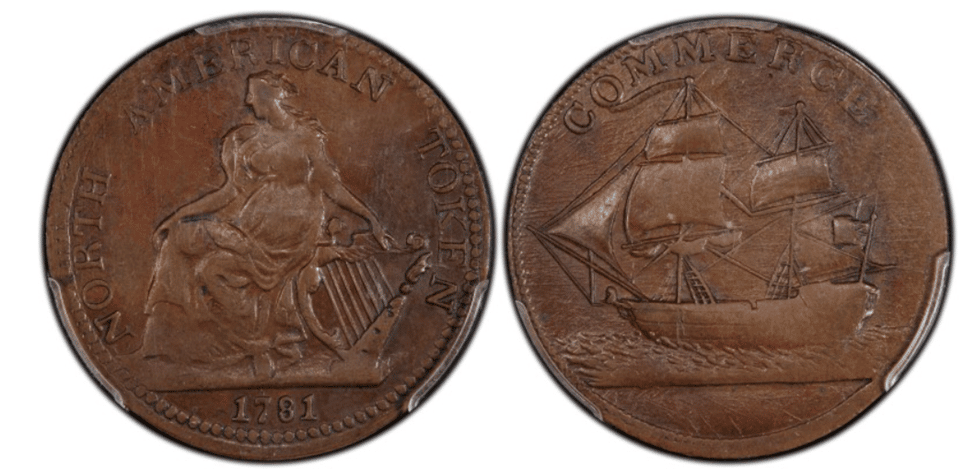
The obverse depicts a seated figure of Hibernia, the traditional female personification of Ireland, facing left and holding a large harp. Around the figure is the inscription “NORTH AMERICAN TOKEN” with the date “1781” below. The harp, paired with the Hibernia figure, is the primary reason the token is often associated with Ireland. Collectors note its resemblance to Irish copper, especially William Wood’s 1723 Hibernia coinage, though the token is not a direct copy.
The reverse shows a ship under full sail heading left, with the simple legend “COMMERCE” above. This Hibernia-and-commerce pairing fits themes of transatlantic trade and migration. It also explains why this token is sometimes collected alongside Canadian “commerce” themed pieces of the broader era, even if the token’s exact origin remains unsettled.
Circulation, Manufacturing Quality, and Collectability
Whatever the token’s backstory, its physical characteristics point toward a piece made for use rather than display. Many examples are slightly irregular in shape, which may indicate they were struck without the tight collaring seen on more mechanically standardized coinage. The token is frequently softly struck, and some detail weakness appears to be die-related rather than purely from wear; many surviving examples are also worn or impaired from use, which further reduces legibility.
This creates a common challenge to collectors. The token is available, but examples with sharp detail are much harder to find than average worn pieces. The market tends to reward pieces that show a clear Hibernia figure, a crisp harp, and a fully outlined ship with readable legends, because those traits are not common survivors.
The Ongoing Debate About Origin
The token’s origin has been argued for decades, and competing explanations can coexist because hard documentation is scarce. One long-circulating attribution connects the token to Ireland, largely because of the Hibernia-and-harp motif. Another line of interpretation, referenced in the Charlton Canadian catalog, asserts that the token was produced in Dublin in 1825, and that it was backdated to 1781. The practical motive is that a backdated date could avoid Canadian import duties on modern tokens, easing entry into circulation.
If an early-19th-century Dublin origin is correct, it would help explain why pieces dated “1781” show up in North American collecting and 19th-century contexts, even though the date may not reflect the actual year of manufacture. Regardless of which attribution a reader prefers, the token’s repeated presence in colonial-focused collections reflects a broader truth: collectors often follow circulation reality and tradition as much as strict legal status.
Conclusion
The North American Token (1781) remains notable because it sits at the intersection of design symbolism, commercial necessity, and unanswered questions. Its Hibernia obverse and commerce reverse make an explicit statement about trade and identity, while its worn survivors suggest some regular use. Whether struck in 1781 or later backdated, the token reminds us how coin shortages and cross-border trade shaped daily transactions.