
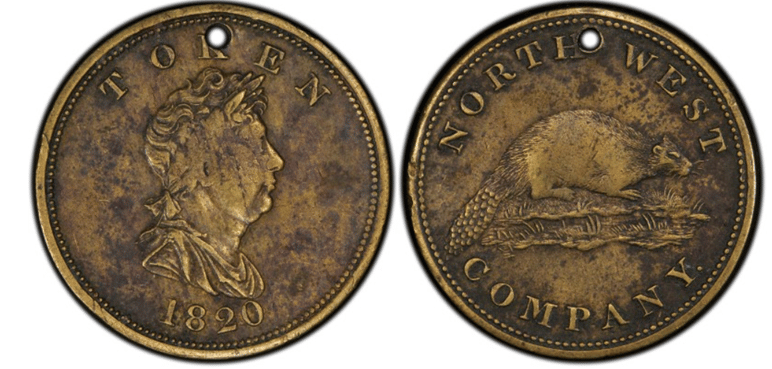
The 1820 North West Company Token shows how commerce worked on the frontier. Before banks and steady coin supplies reached inland North America, traders still exchanged goods across long, rugged routes. Founded in Montreal in 1779, the North West Company created a token system to buy beaver pelts in areas where cash was scarce and barter unreliable. While not U.S. colonial coins, the tokens join early North American collections because they record frontier trade in action.
A Fur Trade Payment System
Company agents bought furs from traders, trappers, and Native American and Indigenous Canadian communities. In remote posts, paying in circulating coin was often impractical, and credit arrangements could be misunderstood, disputed, or hard to enforce. Tokens were portable, familiar, and encouraged repeat trade. In practice, a hunter could trade pelts to the Company and receive a token that was redeemable later for the goods needed to survive and work in the field, including provisions, tools, and other trade supplies. In this way, the token served as a bridge between the moment of sale and the later acquisition of necessities.
The system also provided an advantage during a period of intense competition. The North West Company’s principal rival was the Hudson’s Bay Company, and both firms sought pelts from the same limited pool of suppliers. Prices could rise as each company competed, and disputes over territory and access were common. Tokens offered a portable and recognizable instrument that encouraged repeat trade with the issuer, especially when the trader could rely on a familiar redemption value at Company posts. That rivalry ended in 1821, when the companies were merged under the name and charter of the Hudson’s Bay Company, stabilizing the fur trade in many regions.
Design, Varieties, and Survival
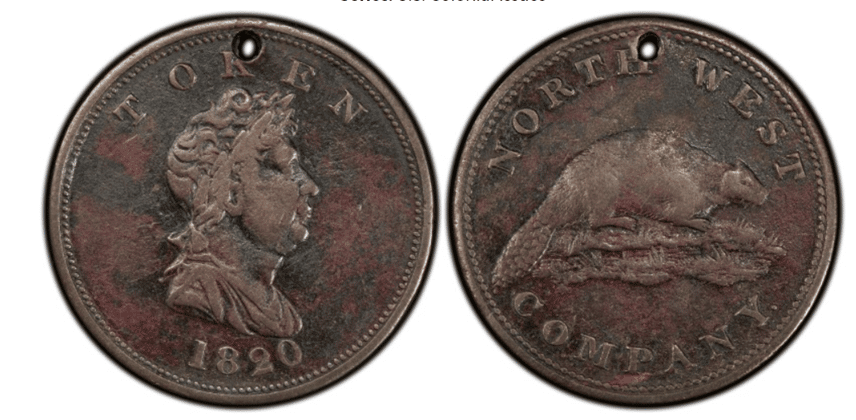
These tokens were struck in England and shipped back to North America, reflecting the period’s reliance on British minting capacity and established industrial production. The obverse features a draped bust of King George IV facing right, wearing a laurel wreath. Above the portrait is the word “TOKEN”, and below the bust is the date “1820”. A monarch’s portrait on a privately issued piece conveyed familiarity and authority, which likely mattered when trust was essential and transactions were conducted far from formal institutions.
The reverse is straightforward and symbolic: a beaver standing on branches, with “NORTH WEST” above and “COMPANY” below. The beaver, the era’s most sought-after pelt, makes the token’s purpose immediately clear. The design is simple and legible, well suited to a piece intended for repeated handling in rugged conditions.
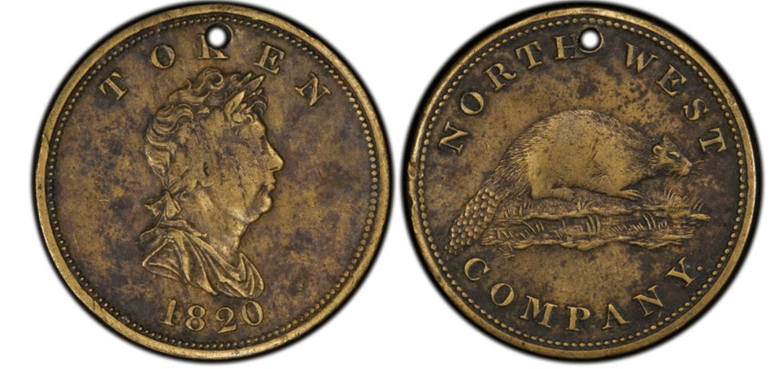
Collectors recognize several varieties. Tokens were struck in both copper and brass, and edge treatments can differ, including plain edges, diagonal reeding, and an engrailed edge. The Birmingham maker John Walker and Company is associated with producing these pieces. Because the tokens circulated in daily trade rather than being saved as souvenirs, most examples show significant wear. Most surviving specimens are holed, and many interpret this as evidence they were worn as adornments, including in Indigenous trade contexts. The holes also would have made the tokens easier to carry and keep secure in the field.
Survival numbers are low. Estimates commonly place the surviving population at roughly 75 to 90 pieces across all metals and varieties, with brass examples forming the majority. Unholed specimens are especially rare, making them notable when encountered. For collectors on either side of the U.S.-Canada numismatic divide, the 1820 North West Company token has enduring appeal. It is a private currency designed to keep trade moving, and it captures the fur trade’s influence on the commercial development of North America in a single, utilitarian piece of metal.