
The Coin Design Approval Process and Revolutionary War-Era Vermont
This commemorative half dollar is known by a few other names. It’s known as the Vermont Sesquicentennial Coin, the Bennington-Vermont Sesquicentennial Half, the Vermont Sesquicentennial (Bennington) Half Dollar, and the Battle of Bennington Sesquicentennial Half Dollar. While it has several names, this coin underwent several design changes to fully capture the weight of the sesquicentennial it was meant to celebrate.
Vermont artist Sherry Fry was the first artist chosen to design this commemorative half dollar. She created a bust of Ira Allen, the “Father of Vermont”. The coin was to bear a likeness of Allen on the obverse and, on the reverse, something representative of Vermont, such as the Battle of Bennington monument. Fry’s design was questioned and disapproved. Fry was replaced by sculptor Charles Keck.
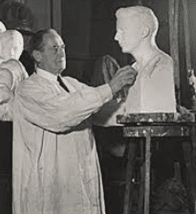
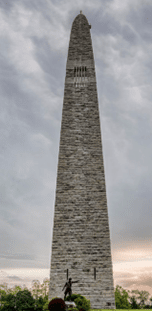
His initial designs were a bust of Ira Allen and a monument to the Battle of Bennington. The CFA wanted to replace the obelisk that was the Battle of Bennington monument. This monument commemorates the Battle of Bennington that took place on August 16, 1777, during the Revolutionary War. The battle was a major strategic success for the Americans. Instead of the obelisk design, Keck used a depiction of Fay’s House, known as the Catamount Tavern. Again, this reverse design was rejected.
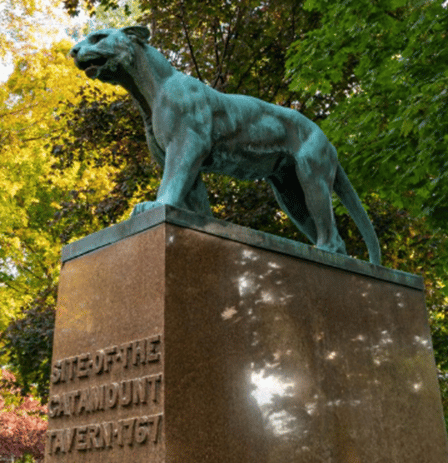
This tavern was a famous Revolutionary War-era haunt where the “Green Mountain Boys” would plot their skirmishes against the British. The Green Mountain Boys were led by Ira Allen’s older brother, Ethan Allen. These men were Vermont Patriots fighting against the British. In 1775, the Catamount was also the site of Vermont’s government meetings.
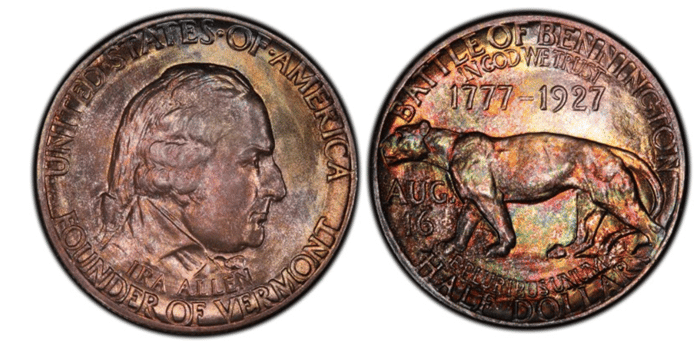
Next to Fay’s Tavern was a stuffed catamount (wildcat) that was placed to warn of British troop movements during the Revolutionary War. After the tavern burned down, a statue of the wildcat was erected on the spot where the tavern once was. Keck chose this wildcat as the subject for the reverse of the coin. Finally, the design was approved.
Design Details
The obverse of the coin depicts a right-facing portrait of Ira Allen, one of the founders of Vermont. Above him is “UNITED STATES OF AMERICA” and on his chest is his name, “IRA ALLEN”. Beneath him is the “FOUNDER OF VERMONT.” The reverse depicts a full-length catamount, walking left. Above the catamount is “BATTLE OF BENNINGTON – IN GOD WE TRUST – 1777 – 1927.” Below the catamount is “E PLURIBUS UNUM” and the denomination “HALF DOLLAR”. Below the Catamount’s chin is “AUG 16” on two lines, the date of the important Revolutionary War battle.
A total of 40,034 half dollars were struck at the Philadelphia Mint during January and February of 1927. The coins were placed in special cardboard holders and distributed by at least three local banks at the cost of $1.00 per coin. Only 28,142 coins were distributed and sold. Expand your collection today with this historic coin and shop other U.S. classic silver commemorative coins.