

The 1792 Getz Pattern Washington Cents are early American prototype coins believed to have been produced by engraver Peter Getz for Senator Robert Morris while Congress was considering national coinage legislation. Struck in copper and silver, these pattern pieces allowed lawmakers to examine possible designs for a future United States coinage system.
The Search for Early Federal Coinage
In the early 1790s, the United States still lacked a mature, reliable coinage system. Small change was scarce, foreign coins circulated alongside private tokens, and merchants often had to accept whatever copper or silver pieces were available. That shortage created an opportunity for pattern issues, prototype coins intended to demonstrate what official national coinage might look like. Among the most important of these experiments are the 1792 Washington-Getz patterns, a small group of trial pieces connected to Robert Morris and engraver Peter Getz of Lancaster, Pennsylvania.
Unlike earlier Washington Cents that were produced abroad by private interests hoping to win a contract, the Getz patterns are notable because they were tied to domestic political planning. They are widely believed to have been struck so lawmakers could examine sample designs while national coinage legislation was under consideration.
Who Commissioned Them and Why It Mattered
Robert Morris, who headed a Senate committee considering coinage legislation, is widely believed to have had Peter Getz prepare prototype pieces based on the committee’s proposed coin designs. If Congress was going to vote on a coinage proposal, prototypes allowed members to evaluate proposed designs rather than rely on written descriptions.
The Getz pieces were struck in both copper and silver and are best known in Small Eagle and Large Eagle forms, with additional distinctions involving edge varieties and later related copies. Numismatic sources often estimate that about 30 to 40 silver pieces and roughly 100 to 150 copper pieces were struck, likely for presentation to senators, representatives, and other officials, though these figures are not firmly documented mintages.
The Obverse: Washington, Titles, and a Political Problem
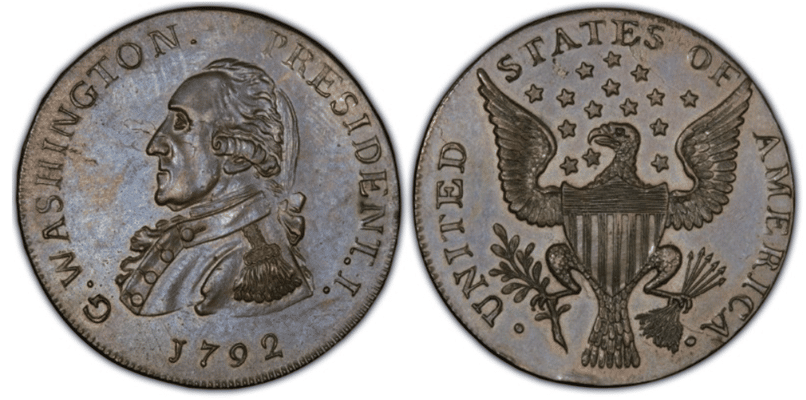
All of the Getz patterns share the same essential obverse concept: a military bust of George Washington facing left. Around the periphery is the identifying legend “WASHINGTON – PRESIDENT. I. – 1792”.
This phrasing is notable because it presents the pieces as official national coinage, explicitly naming Washington as President and anchoring the issue to 1792. Getz appears to have based his work on the British-made 1791 Washington Cent proposals, adapting their Washington portrait and eagle motifs for his own 1792 patterns. Those earlier pieces had already been rejected, but the design vocabulary was readily available, so Getz adapted it.
That choice also carried the same political risk that had doomed earlier Washington portrait coin proposals. Washington did not want his likeness on the nation’s coinage. He considered leader portraits too closely associated with monarchy, and he had just led a revolution against a monarchial system. Even when a design was well executed, the symbolism could still be unacceptable.
The Two Reverse Designs: Small Eagle and Large Eagle
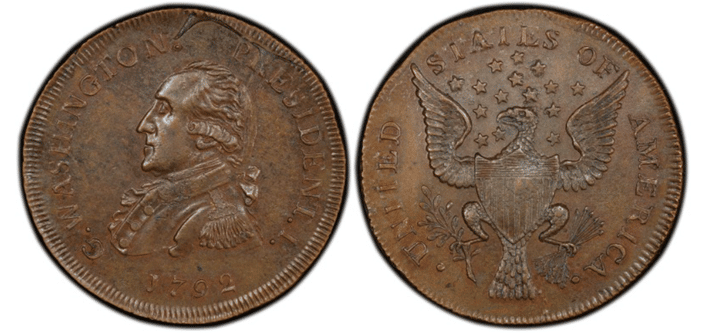
The series is commonly introduced through its Small Eagle and Large Eagle reverses, though collectors also distinguish pieces by metal, edge varieties, and later related copies.
Small Eagle Reverse
On the Small Eagle version, the eagle faces left with wings spread and upraised. Above it are 15 five-pointed stars. The eagle carries a shield on its breast, holds six arrows in its left talon, and an olive branch in its right talon. The surrounding legend reads “UNITED STATES OF AMERICA”.
The star count is one of the more distinctive details in this series, reflecting how early federal symbolism could be fluid and experimental.
Large Eagle Reverse
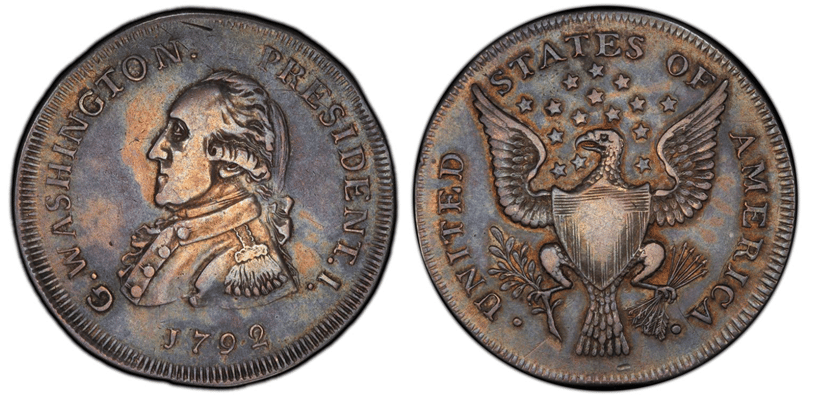
The Large Eagle version also faces left, but the wings are spread with a downward emphasis, giving the eagle a heavier and more heraldic appearance. The breast is covered by a large shield. In the left talon are thirteen arrows, while the right talon again holds an olive branch. The same national legend, “UNITED STATES OF AMERICA”, appears around the periphery.
Taken together, the two reverses present different interpretations of national imagery. The Small Eagle appears more delicate and emblematic, while the Large Eagle presents a more formal, heraldic style.
Five Collectible Pattern Variations
Collectors commonly group the Washington-Getz patterns into multiple combinations of metal and reverse type. Based on the information provided, five practical variations to understand are:
- Copper pattern cent with Small Eagle reverse
- Copper pattern cent with Large Eagle reverse
- Silver pattern (half dollar size) with Small Eagle reverse
- Silver pattern (half dollar size) with Large Eagle reverse
- Later related copies, especially the circa-1860 William Idler copies of the Getz type, which are collectible in their own right but are not original Getz patterns.
That fifth category is less certain, but it highlights ongoing debate about when all specimens were struck. Even the possibility of later production highlights how desirable and influential the basic design became.
Outcome and Legacy
Like the earlier Washington pieces, the Getz patterns were undermined by Washington’s objection to presidential portraiture on coinage and by the fast-moving shift toward an official federal mint system. However, their importance is not diminished by rejection. These patterns document an intense, transitional moment when the federal government was trying to move from an improvised patchwork of money toward a coherent national system.
Whether viewed as political prototypes, numismatic experiments, or early expressions of American identity, the 1792 Washington-Getz patterns represent an important chapter in the development of United States coinage.