
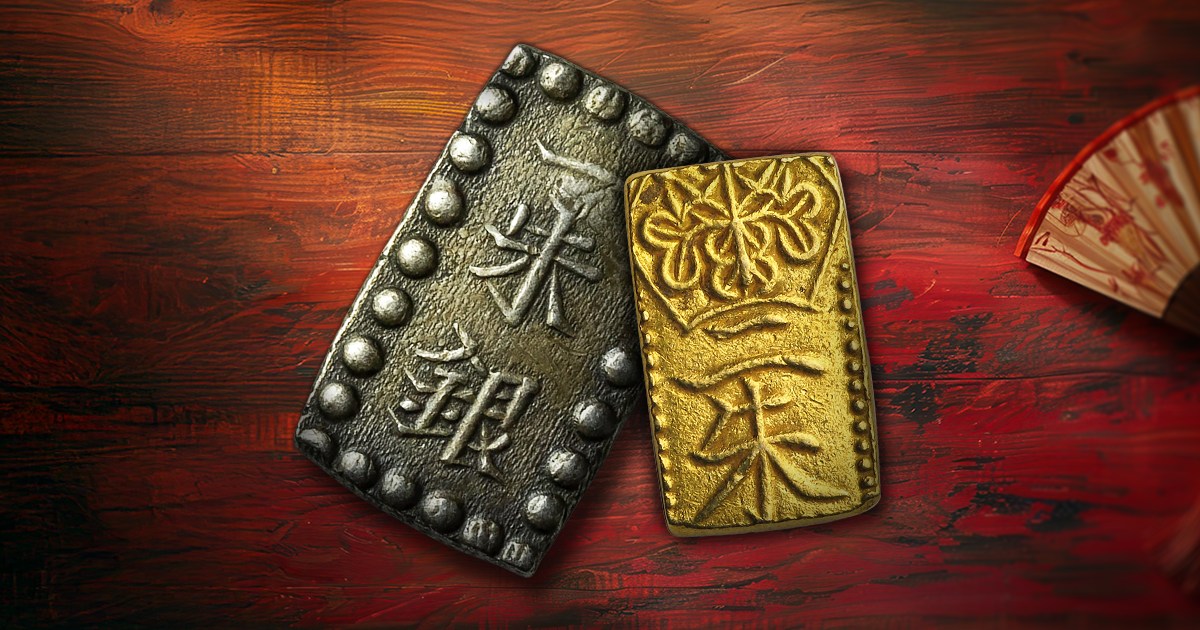
A Japanese shu coin was a rectangular silver or gold coin used during Japan’s Edo period (1603–1868). The Japanese shu denomination served as a fractional monetary unit within the Tokugawa shogunate’s tri-metallic currency system, which combined gold, silver, and copper coins.
Historical and Monetary Context
Origins and Evolution
The shu unit emerged as a Japanese coin during the Edo period, and the Tokugawa shogunate standardized the shu as a fractional currency unit primarily in silver and gold coinage.
Tokugawa Monetary Policies
The Tokugawa government pursued a centralized, trimetallic monetary policy balancing gold, silver, and copper coinage to stabilize the economy. Standardized gold coins denominated in ryō or Koban included the Koban, worth 1 ryō, and the Nibuban, which was worth half of a Koban. Lower value gold and silver Ichibuban coins were worth ¼ Koban, while Nishuban and Isshuban were denominated in 2 shu and 1 shu, respectively.
Shape, Composition, and Design of Japanese Shu Coins
Japanese shu coins were rectangular, which facilitated easier stacking and sorting, earning the favor of merchants. Issues such as the Ichishu Gin and Nishu Gin were made from high-purity silver, typically above 95%. Their weights ranged from roughly 1.4 to 2.6 grams, depending on face value, composition, and issuance period. Gold Shu coins are composed of varying percentages of gold alloyed with silver.
The edges were usually plain or slightly beveled, not typically reeded or grooved. Coins were struck using hammering and casting methods, which occasionally produced rare alignment variants.
Notable Japanese Shu Designs and Composition
Bunsei Ichishu Gin (Silver, 1829–1837)
Obverse
Incuse characters for the face value, “One Shu Silver,” vertically arranged, typically inside a dotted or beaded border, rendered in clear kaisho script.
Reverse
Reverse inscriptions varied and were not always present, but when they were, they were incuse inscriptions of the mint location and a guarantee to certify weight and purity.
Composition of 98.95% silver, 0.14% gold, and 0.91% other metals.
Kaei Ichishu Gin (Silver, 1853–1865)
Obverse
Incuse characters for the face value, “One Shu Silver,” with minor stylistic variations such as curved upper strokes, typically inside a beaded border.
Reverse
Incuse inscription for “Silver Mint Office” and “guaranteed” to certify weight and purity, with refined engraving.
Composition of 96.8–96.9% silver, remainder of other metals.
Bunsei Isshu Kin (Gold, 1824–1832)
Obverse
Incuse characters for the face value, “One Shu Gold,” and the Paulownia crest (Tokugawa symbol).
Reverse
Signature of mint official Goto Shozaburo, sometimes abbreviated as a character or mark.
Composition of 12.3% gold, 87.4% silver, and 0.3% other metals.
Tenpō Nishu Kin (Gold, 1832–1858)
Obverse
Incuse characters for the face value, “Two Shu Gold,” and a prominent Paulownia crest.
Reverse
Incuse characters for the face value, “Two Shu Gold,” and a prominent Paulownia crest.
Reverse
Man’en Nishu Kin (Gold, 1860–1869)
Obverse
Incuse characters for the face value, “Two Shu Gold,” with a refined Paulownia crest; minimalist style.
Reverse
Sparse mint marks, sometimes only a single character or symbol.
Composition of 22.9% gold, 76.7% silver, and 0.3% other metals.
Economic Role and Daily Usage
Currency Hierarchy and Conversion
In Edo Japan’s monetary system, gold coins like the koban were used for large transactions and wealth storage. Silver coins, including shu coins, were used for intermediate-value transactions, and copper coins denominated in mon were utilized for everyday small-scale trade. Copper mon coins, with their square hole, could be strung together in large strings for easy transport and accounting, supporting widespread small transactions.
Transition and Legacy
The shu was demonetized in 1874 after the introduction of the yen, a decimal currency modeled on Western systems in 1871. Shu coins were demonetized but survive as historical artifacts.
Japanese shu coins bridged everyday copper mon coinage and higher-value gold coins. Its distinctive rectangular design facilitated commerce and symbolized a unique blend of pragmatic governance and cultural symbolism. Although they were replaced after the Meiji Restoration, shu coins remain an illuminating example of Edo Japan’s economic structure, political authority, and artistic traditions.