
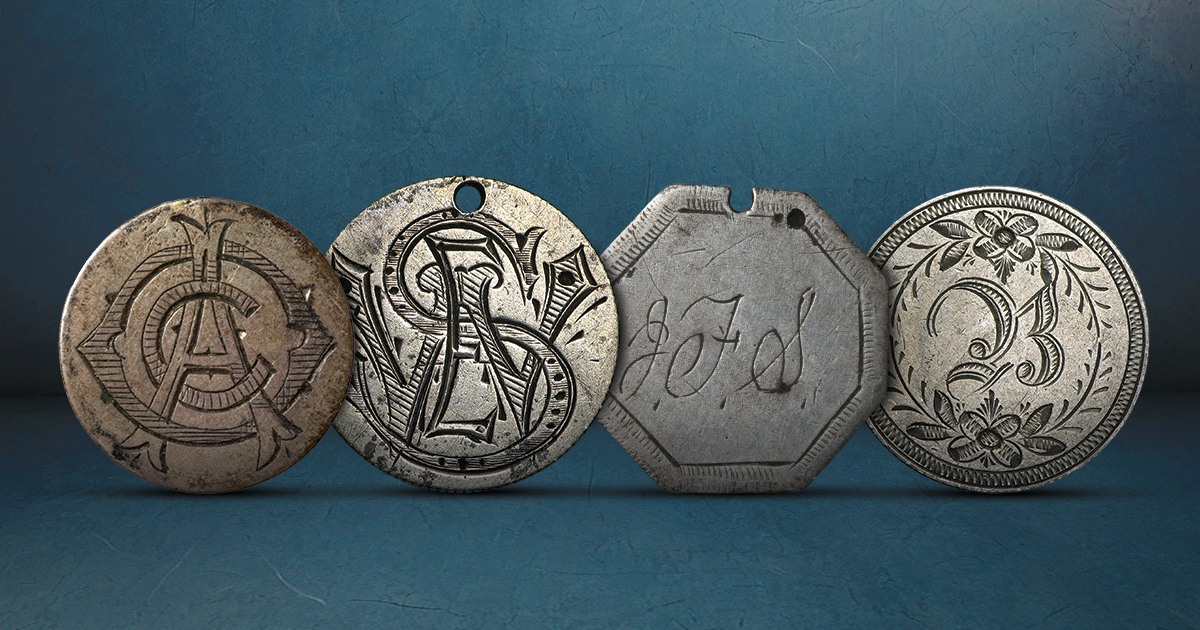
A Seated Liberty dime love token is a Seated Liberty dime that has been engraved on one side as a representation of love, loss, or remembrance. These dimes were issued from 1837 to 1891 and were sanded smooth and hand-engraved with initials, dates, or miniature scenes. Love tokens offer a window into the emotions of the past when a single silver coin could speak volumes for a loved one.
Historical Context of Love Tokens
The Seated Liberty Dime was designed by Christian Gobrecht and based on sketches by Thomas Sully and Titian Peale. The design surfaced amid a broader series of U.S. Mint coinage that featured an allegorical figure of Liberty seated on a rock, with a shield and a liberty pole. This reflected the neoclassical ideals of the young American republic and remained in circulation for over five decades. During this period, especially the Victorian era, sentimentality and symbolic gestures flourished. Jewelry, mourning art, and keepsakes became deeply personal expressions of love, loss, and memory.
Though the practice of altering coins dates to medieval Europe, it gained popularity in the United States during the mid-to-late 19th century. The Civil War, westward expansion, and industrialization all contributed to a society in flux, where tokens of affection served as tangible anchors to loved ones and home.
The concept of exonumia, like love tokens, can be traced even further back to ancient Rome, where lovers exchanged rings, carved gemstones, and inscribed coins. By the 13th century in Britain, the practice of bending silver pennies into S-shapes as pledges of love or spiritual vows emerged as precursors to the engraved love tokens of later centuries. In Georgian England, convict love tokens emerged, which were engraved by prisoners awaiting transportation to Australia as final messages to loved ones.
Craftsmanship and Design of Love Tokens
Crafting a love token involved smoothing one side of a coin, typically the reverse, to allow for engraving. This maintained the obverse, with the date and Liberty’s portrait, for identification and historical reference. Engraving ranged from simple monograms etched by hand to elaborate scenes featuring floral motifs, ships, birds, or religious symbols crafted by skilled artisans.
The Seated Liberty dime’s manageable size, high silver content, and broad circulation made it both a practical and symbolic choice for love tokens. These tokens were often transformed into wearable jewelry, such as bracelets, brooches, pendants, cufflinks, or portable keepsakes. Some were pierced to hang from necklaces; others were mounted or linked in sentimental chains. While many tokens were gifted by men to women, especially during courtship or wartime, women also commissioned or created tokens for family members in mourning.
Cultural Impact
Love tokens were intimate messages and a means of remembrance. A soldier may have left one with his girlfriend or wife before heading to war. A mother may have worn a bracelet of dimes, each engraved with a child’s name. A suitor might propose with a token bearing the initials of both parties. In some cases, they served as mourning pieces that were engraved with dates of death or symbols of remembrance.
These tokens reflected broader Victorian-era trends, such as the era’s fascination with coded language. Symbols like horseshoes for luck, anchors for hope, and forget-me-nots for remembrance formed a symbolic vocabulary of emotion. While hearts are rare on love tokens, floral imagery on them often carried deep, coded meanings drawn from the “language of flowers.”
Causes and Decline
The rise of love tokens coincided with the emergence of sentimental trends among a growing middle class. Their decline came as photography gradually became more widespread and accessible, especially from the 1860s onward. Mass-produced jewelry and a shift toward modern aesthetics also contributed to this trend. The tradition was briefly revived during wartime (as trench art) but never regained its Victorian popularity.
Value and Collectibility
For much of the 20th century, love tokens were dismissed by numismatists as post-mint damage. Today, they are increasingly valued as folk art and social artifacts.
Their value depends on:
- Artistry: Pictorial or enameled designs fetch higher prices.
- Rarity: Gold host coins are extremely rare and highly desirable; most love tokens were made from silver coins, such as dimes.
- Condition: Clear, intact engravings and preserved surface matter.
- Provenance: Tokens with known stories, photos, or names carry a premium.
Values range from $20 for simple initials to over $1,000 for intricate or rare examples. Reference works like Love Tokens as Engraved Coins by Lloyd L. Entenmann remain vital for serious collectors.
Enduring Appeal and Modern Echoes
The legacy of love tokens persists in modern practices:
- Personalized Jewelry: Engraved rings and lockets reflect the tradition of love tokens.
- Letters and Notes: Handwritten words maintain the intimacy of engraved inscriptions.
- Symbolic Keepsakes: Pressed flowers or charms carry private meaning.
- Handmade Gifts: DIY art or crafts show affection through effort.
- Tattoos: Dates, initials, or coordinates inked on skin serve as modern permanent tokens.
Each token represents a singular human moment, and how it is treated today can either preserve or erase that history.
From Roman rings and bent British coins to Victorian dimes and digital keepsakes, love tokens reflect a universal longing to connect, remember, and express. These small objects, whether engraved, carved, or stitched, show that love, when made tangible, endures across time, cultures, and materials.