
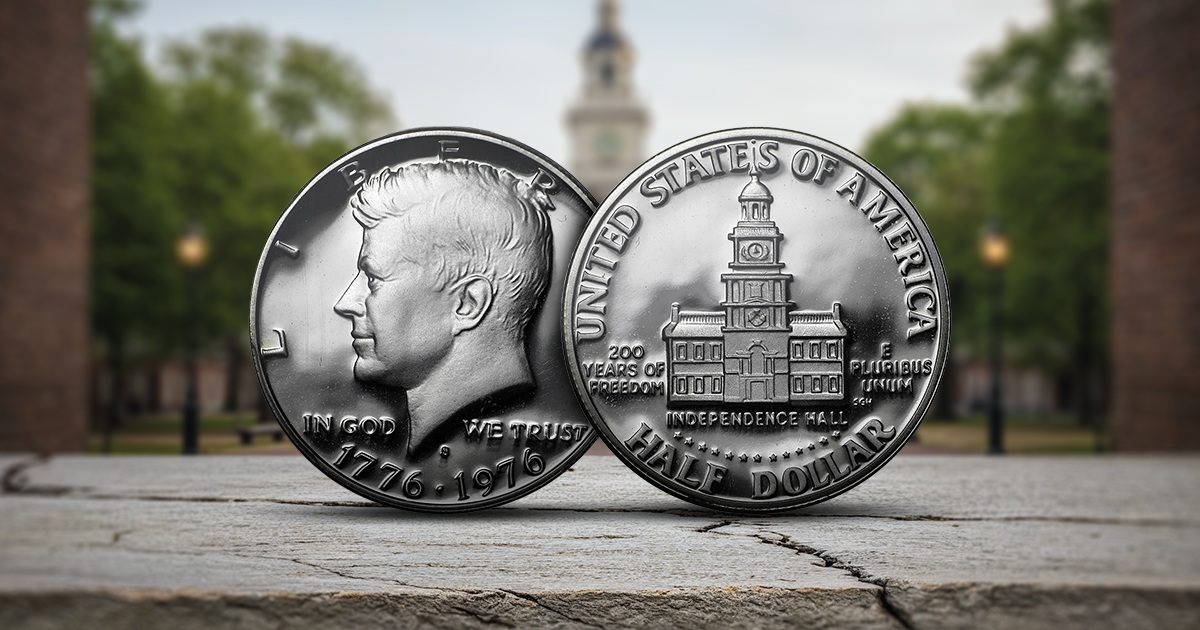
Few circulating U.S. coins are as unique as the 1976 Bicentennial Kennedy Half Dollar. Its dual date, single year reverse selected by public competition, optional silver composition, and role as a gateway coin combine to make it more than pocket change.
Why Was the Bicentennial Half Dollar Struck?
The Bicentennial Kennedy half was struck to celebrate the 200th anniversary of American independence. Several converging factors, from unique dating, a one-year reverse, silver composition options, and condition rarity, turn an otherwise common coin into a market mainstay for casual and advanced collectors.
Public Contest & Independence Hall Reverse
Collectors assembling comprehensive Kennedy half dollar sets must acquire this specific reverse to maintain continuity, which artificially inflates demand. Unlike transitional designs, the Bicentennial reverse was a hard cutoff. No 1975-dated halves exist, and no 1977-dated coins featured the Bicentennial design.
The public design competition that produced Seth G. Huntington’s depiction of Independence Hall marked a rare moment of civic engagement in U.S. coinage. The process democratized circulating coin art and signaled a move toward realism over allegory, attributes that resonate with collectors who value provenance and public participation.
Huntington’s realism, an architectural rendering instead of Liberty personifications, was groundbreaking for circulating U.S. coinage.
Composition & Manufacturing: Silver vs. Clad
The silver-clad issues also exhibit distinct toning characteristics over time, often developing attractive peripheral hues absent in clad counterparts. This aesthetic differentiation adds a layer of desirability for collectors who prize eye appeal.
Condition Rarity & Market Pricing
The grading curve for Bicentennial halves is famously steep, with population reports that make dramatic drops above MS-66, particularly for clad business strikes. Few collectors socked away rolls in the 1970s with modern grading standards in mind, so most surviving Mint State coins show bag marks or dull luster. Higher grade examples are therefore conditional rarities, not mintage rarities, a nuance that fuels registry set bidding wars and auction premiums.
Why the cliff? Census data from authoritative grading organizations like PCGS and NGC show fewer than 100 examples graded MS-69 across all Bicentennial halves, explaining the exponential curve.
Documented Die Varieties & Mint Errors
The known die varieties are undercataloged compared with the marquee series, presenting genuine discovery potential. Specialists continue to surface minor hub doubling and die clashes that remain unattributed by the major grading services.
The compressed Bicentennial production schedule also accelerated die fatigue, which resulted in subtle anomalies that reward sharp-eyed collectors. Some reverse dies exhibit progressive cracks through the bell tower or inscription fields, offering a timeline of die degradation and a forensic window into Mint production practices during the Bicentennial surge.
| Variety | FS Number | Key Marker |
| DDO001 | FS101 | Doubled IN GOD |
| DDR001 | FS801 | Extra steeple line |
| Wrong Planchet | — | Struck on Roosevelt dime blank |
| Double Strike | — | 2nd impression 30° CW |
| Clad Layer Missing | — | Copper core visible |
Under the Radar Distinctions & Comparative Traits
Even after accounting for silver content and conditional rarity, the Bicentennial Half Dollar stands apart for several other distinctions.
- No 1975 issue: The only circulating U.S. coin to skip an entire calendar year.
- Publicly selected reverse: A precursor to State Quarters and other crowd-sourced designs.
- Early release: Minted in mid-1975 for advance circulation ahead of July 4, 1976.
- Gateway legacy: Its patriotic imagery and mass availability sparked countless new collectors.
From the absence of a 1975 date to its publicly selected reverse, the Bicentennial Kennedy half dollar may be the most structurally unique modern circulating U.S. coin. Those quirks establish the framework of value, but it’s the coin’s steep population decline in grades above MS66 and the growing catalog of die varieties that keep variety hunters engaged. Millions of Americans began their numismatic journey with this coin, proving that thoughtful design and perfect timing can transform pocket change into a cultural landmark.