
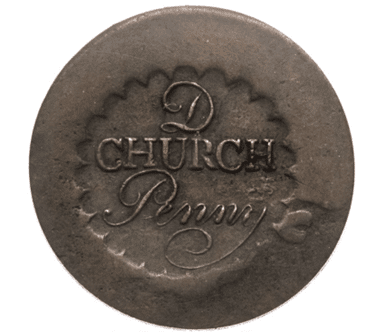
A Colonial Tithing Coin
Before the U.S. Mint began striking federal copper coins in 1793, Americans often faced a shortage of reliable small change for everyday purchases. In places like Albany, the copper in day-to-day use could include worn pieces, counterfeits, and a patchwork of non-federal issues, which made routine transactions and small donations inconvenient. The problem reached churches as well. In Albany, weekly offerings were often made with the kinds of worn or questionable copper then circulating, so the church created its own tokens to improve the weekly collections and make giving small amounts easier and more orderly.
The First Presbyterian Church of Albany, New York, responded with a practical solution. It authorized 1,000 copper, uniface tokens and exchanged them with the congregation at the rate of 12 tokens for 1 shilling. Numismatic summaries explain that the goal was to reduce contributions of worn or counterfeit coppers and to “add respect” to the weekly collections by standardizing what went into the plate.
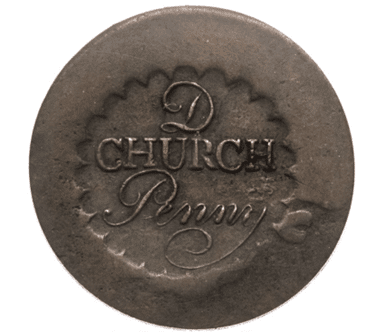
There are two varieties of this simple design. Both are blank on one side and carry the inscription on the other. The first variety simply has two words—CHURCH PENNY—with “CHURCH” in block letters and “PENNY” in script. The second variety has the same two words with a large, scripted capital D above the word CHURCH. Both varieties are undated, yet archival and numismatic research places their striking in 1790.
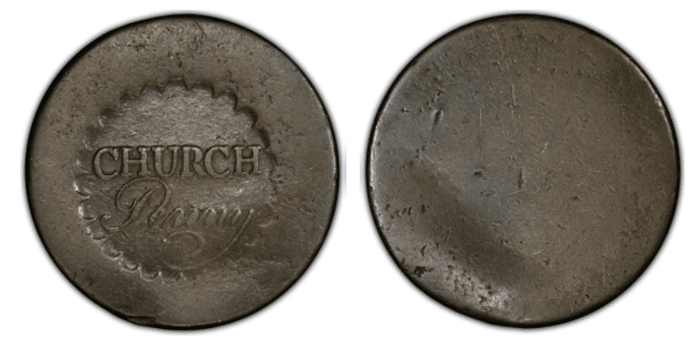
Surviving pieces also show how practical the project was. Some Albany Church Pennies were struck over worn coppers or imitation British halfpennies, and additional documentation highlights undertypes visible on certain specimens. That kind of overstriking fits the period’s copper shortage and helps explain why some survivors display uneven surfaces or traces of earlier designs beneath the church inscription.
The Two Types of Albany Pennies
Numismatists have not reached a definitive conclusion about why two varieties exist, because no surviving church documentation explains the letter D. Most researchers interpret the D as a period abbreviation connected to “penny,” often in connection with denarius usage for pennies, while a minority view suggests it may be an initial tied to a clergyman. Major references and auction descriptions present “D = penny” as the prevailing interpretation, while acknowledging that neither explanation is proven by contemporaneous records.
Both varieties are scarce today. Fewer than a dozen examples of each variety are typically encountered in the marketplace, with many known pieces traceable through long collector pedigrees. Institutional holdings are limited; for example, the Albany Institute of History & Art lists an Albany Church Penny dated circa 1790 and credits it as a gift of the First Presbyterian Church of Albany.
Most surviving pieces show heavy wear, indicating regular use. A few, however, grade as high as XF. When higher-grade examples surface, prices can be high: there’s a recorded EF-40 example selling for $49,350 in 2017, and auction records show a Heritage sale of a high-grade D variety for $115,000 in 2012.
Collectors interested in early American tokens can browse APMEX’s selection of colonial-era issues.