
A Coin Born of Urgency
In 1792, the United States was still forming a unified economy. Everyday commerce leaned heavily on foreign coinage and an inconsistent mix of local and private issues. Federal leaders viewed the shortage as more than an inconvenience. A country that could not reliably produce its own money struggled to project stability at home and credibility abroad.
President George Washington was aware of the need for a national coinage, but he was equally wary of symbolism. He objected to proposals for coinage bearing his portrait, a choice often explained as avoiding monarchical symbolism. Early federal-era designs instead used allegorical Liberty rather than depicting a sitting president. The Coinage Act of 1792 had set the stage for a decimal system, including a “disme” (one tenth of a dollar) and the “half disme” (half that value). Before the Mint’s operations were fully mature, producing a small run of silver coins became a practical and symbolic priority.
In July 1792, a short series of half dismes was struck, traditionally cited as 1,500 pieces. A popular story claims the silver came from Martha Washington’s tableware, but modern research points instead to Jefferson providing 75 Mexican silver dollars. The tableware claim remains part of the coin’s lore, not a documented fact.. However the metal was sourced, the message was clear: the United States intended to make real coin, not merely talk about it.
Design, Striking, and Legacy
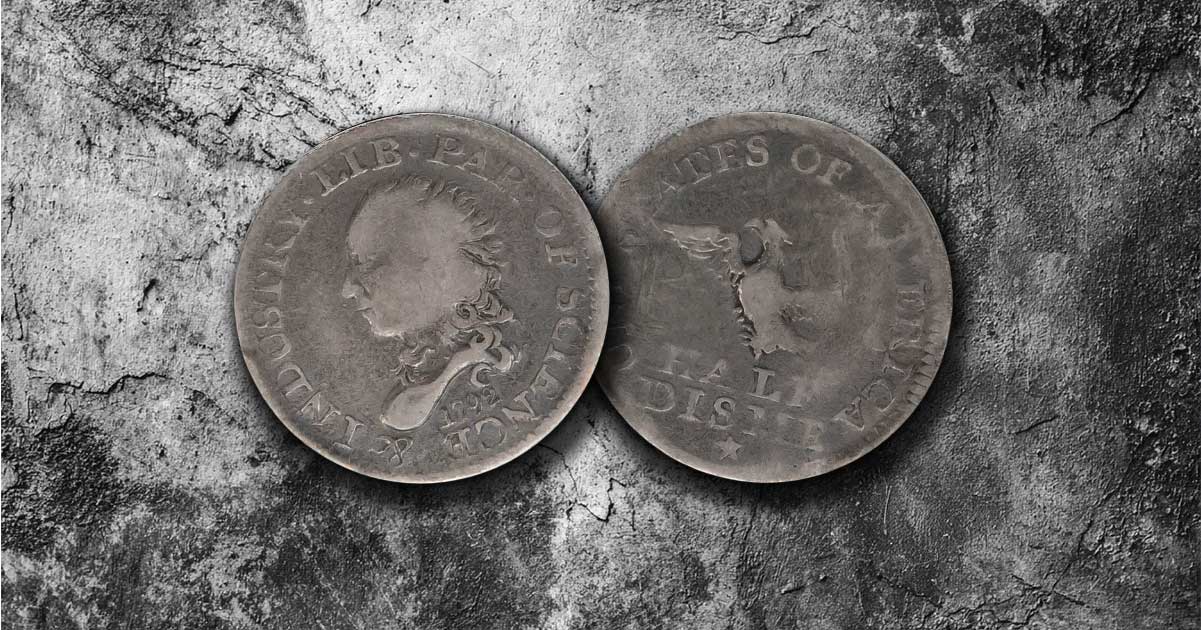
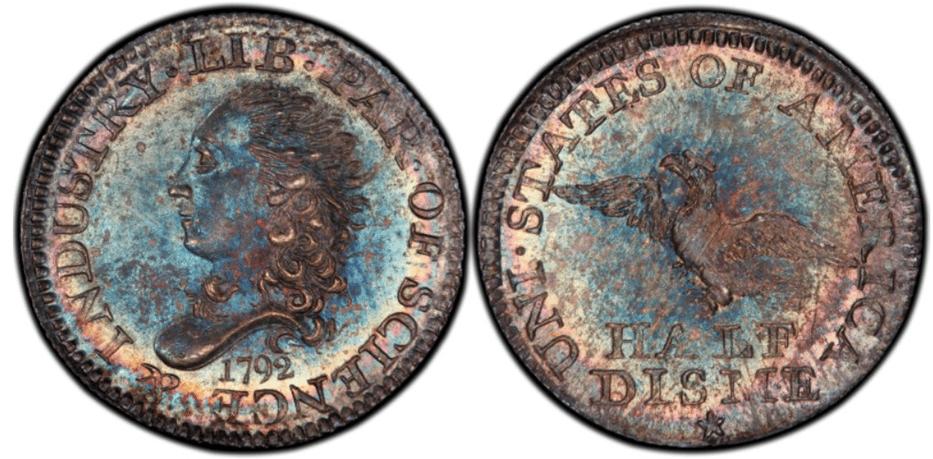
The 1792 Half Disme is small in size but significant in concept. The obverse features an allegorical Liberty facing left. The surrounding legend is typically seen in abbreviated form as “LIB. PAR. OF SCIENCE & INDUSTRY”, compressing the phrase “LIBERTY, PARENT OF SCIENCE AND INDUSTRY”. The date “1792” appears below the portrait.
On the reverse, an eagle in flight stretches its wings in a design that looks modest compared with later federal coinage. Beneath the eagle appears the denomination “HALF DISME”, while the outer legend reads “UNITED STATES OF AMERICA”. The design has a straightforward, early-federal look. There is debate on whether the 1792 half dismes were meant for circulation or for experiment. Many surviving coins show wear, proving they reached commerce.
The coins were not produced in vast numbers and they were not intended to solve the country’s nationwide need for small change. Instead, they served an early demonstration of capability. Washington wanted the pieces widely seen, and tradition holds that examples were distributed to government officials and even to foreign visitors as tangible proof that the new republic could create coinage quickly. Although the issue’s original purpose is debated, many half dismes entered real use, and surviving coins often show signs of circulation.
Because they are the first federal cents and many circulated, 1792 Half Dismes hold an important place in American numismatics. Survivors exist in worn, honest grades that reflect actual handling, and in higher-quality examples that show how sharply the design could appear when well struck and preserved. Prices vary widely by grade and strike characteristics, but published guides and recent auction results commonly place authenticated examples from the five-figure range into six figures, with the strongest premiums for high-grade and special-strike pieces. Top-grade special-strike pieces have sold for more than one million dollars at public auction.