
The 1760 Hibernia-Voce Populi Coins are a little-documented group of Irish copper farthings and halfpennies that became familiar to American colonial collectors because many examples crossed the Atlantic and circulated in parts of British North America. They emerged during a period when Ireland faced an acute shortage of low-value copper coinage, and when unofficial pieces could fill a gap even if they were underweight and crudely made.
Why the Hibernia-Voce Populi Coins Appeared in Ireland
By the mid-18th century, small copper was scarce across Europe, and Ireland was particularly affected. The rise of the Voce Populi coppers are tied to a practical breakdown in supply: official regal farthings and halfpennies intended for Ireland were not reaching the market in adequate quantity by about 1760, which created room for privately made substitutes.
The origin story is not fully documented, but a frequently repeated tradition attributes the coinage to Roche, a Dublin button maker, as a likely organizer of production and distribution. Button makers already worked in metal, maintained commercial networks, and could arrange subcontracted minting, adding to the plausibility of Roche’s involvement.
Even though the dated pieces themselves almost always read “1760,” and these pieces are commonly associated with that year, the coins were struck prior to 1760 and into at least 1761. This “single date, multiple-year production” pattern is not unusual for token-like coinages meant to look uniform and familiar.
By 1762, official regal copper began circulating in greater quantity, but the Voce Populi pieces continued to circulate alongside official coinage. Because small change was scarce, merchants often accepted lightweight or unofficial pieces.
Designs and Key Identifiers
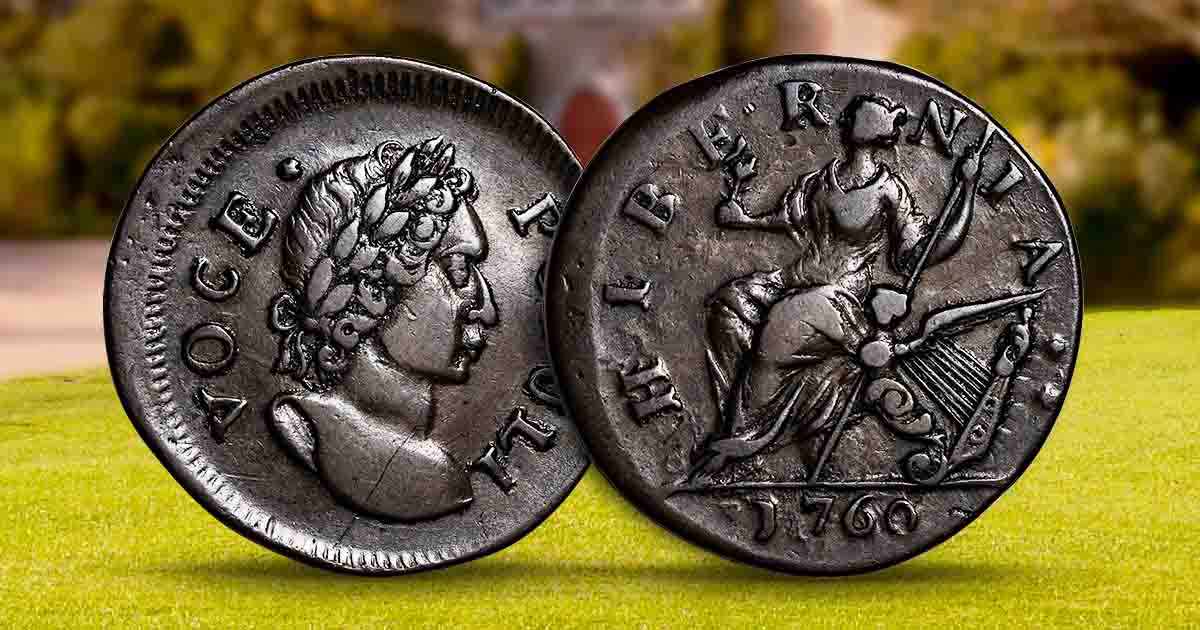
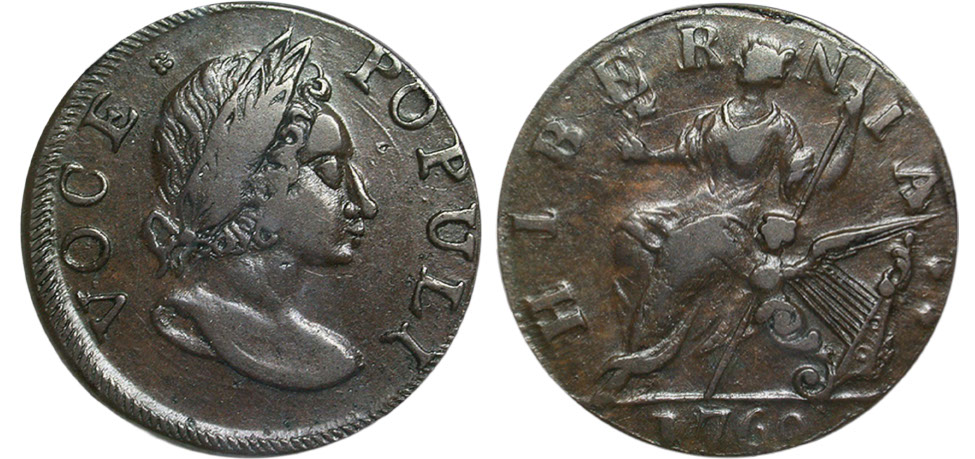
The designs are consistent across both farthings and halfpennies. On the obverse is a male bust facing right, wearing a laurel wreath. Around the portrait appears the Latin motto “VOCE POPULI”, generally translated as “BY THE VOICE OF THE PEOPLE” or “VOICE OF THE PEOPLE”.
The reverse depicts Hibernia, the classical personification of Ireland, seated and facing left. She holds a staff, and a harp appears nearby, a clear national symbol. The legend “HIBERNIA” appears above, with the date “1760” in the exergue.
Collectors recognize several varieties. Some halfpennies show a letter “P” in front of the face or in related positions, and there are recognized legend and spelling variants as well. These differences, along with multiple border styles such as beading or milling, have led researchers to conclude that numerous dies were used and possibly more than one engraver or workshop contributed to production. Varieties are often distinguished by punctuation and accompanying devices, and catalogers recognize multiple die combinations.
How Hibernia-Voce Populi Coins Relate to the American Colonies
There is no definitive proof that the Voce Populi issues were originally struck with America as the primary destination. However, several sources argue it is reasonable that significant quantities reached the colonies through migration and trade. One common theory is that speculators bought them in quantity once regal coppers arrived and then shipped them to America, where they could pass as useful small change in a similarly coin-starved economy.
In short, the 1760 Hibernia-Voce Populi coins were unofficial Irish copper struck to relieve a local shortage and later carried into Atlantic trade. Their enduring appeal comes from that dual identity: local Irish necessity on one side and early American colonial presence on the other.