
The 1694 New England Elephant Token is a very scarce colonial-era token with an uncertain origin and purpose. Like the better-known Carolina Elephant Halfpenny, it bears the date 1694, yet its real purpose remains uncertain. What is clear is that it combines late 17th-century English token production and the colonies’ persistent shortage of small change. Only three examples are known, making it the rarest documented member of the Elephant token family.
Shared Origins and a Distinct Reverse
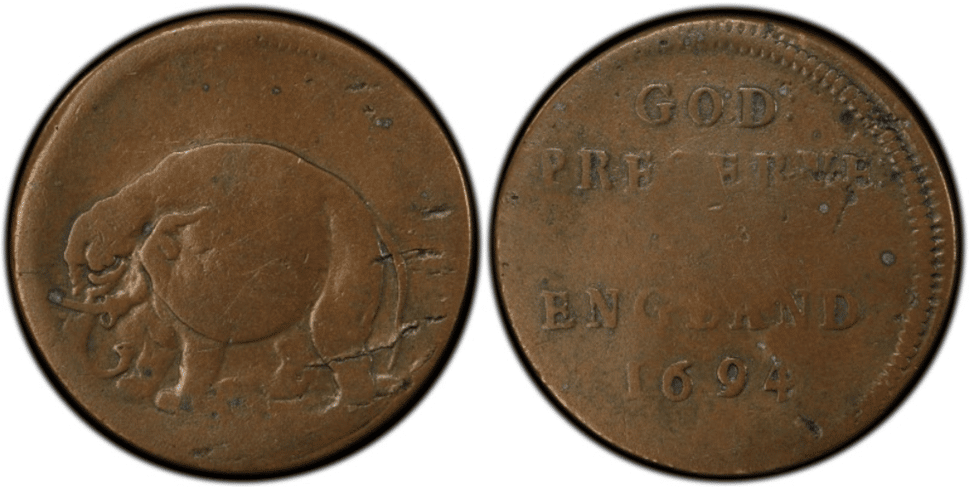
All Elephant tokens are closely related (including shared dies), and it is argued they were produced in or near London, possibly involving Royal Mint/Tower personnel. The strongest practical evidence is in the dies themselves. The same African elephant obverse die appears across the London, Carolina, and New England issues, though it can be positioned slightly differently on individual strikes. On some examples the tusk tips sit close to the edge, while on others they appear farther from the border, even though the elephant is fundamentally the same device.
The New England piece separates itself on the reverse. Instead of a London civic shield or a Carolina legend, the reverse reads “GOD PRESERVE NEW ENGLAND 1694”.
Collectors often note weak or uneven reverse lettering on some examples. This weakness matches striking issues on other Elephant tokens. At least some of the known New England examples show off-center striking, reinforcing the view that these were not produced to the standards of official regal coinage. Unlike the London Elephant Token series, which includes multiple varieties, the New England Elephant Token is generally treated as a single-variety issue.
Why an Elephant for New England?
The elephant itself is part of what makes the series so memorable and so puzzling. Elephants were not native to North America, and certainly not to New England. The design choice has prompted several theories.
One hypothesis is that the token’s design served a promotional or novelty purpose connected to colonial interest. In 1694, England was still deeply engaged in colonial development and overseas trade. A striking, exotic animal paired with a “GOD PRESERVE” legend may have functioned as a promotional token linked to colonial ventures. Would an English citizen in 1694 accept the idea that elephants existed in the colonies, or would they simply enjoy the bold, unusual design? Either reaction could have been useful for promotion, fundraising, or general public interest.
Another possibility is more utilitarian. The late 1600s saw recurring shortages of low-denomination coinage in both England and the colonies. Private and semi-private tokens often stepped into that gap. Even if the New England token wasn’t intended as official small change, it may have circulated in limited ways. Wear on some Elephant tokens and documented “New World” associations for related types are consistent with at least some movement into colonial channels, though the extent of actual colonial circulation is unclear.
Rarity and Modern Collecting
Its rarity defines the New England Elephant Token’s modern reputation. With only three known specimens, it remains highly sought after among advanced colonial token collectors. One specimen has been described as a particularly high-grade example, and it has not been publicly visible for decades after an appearance in the early 1980s.
With populations this small, even basic metrics like original mintage, intended destination, and normal planchet weight are difficult to establish. Reported planchet weight variation only adds to the uncertainty. What remains is the token’s core appeal: a shared elephant obverse, a region-specific New England reverse, and a level of rarity that ensures the 1694 New England Elephant Token will remain one of the most discussed “mystery pieces” in the colonial series.