
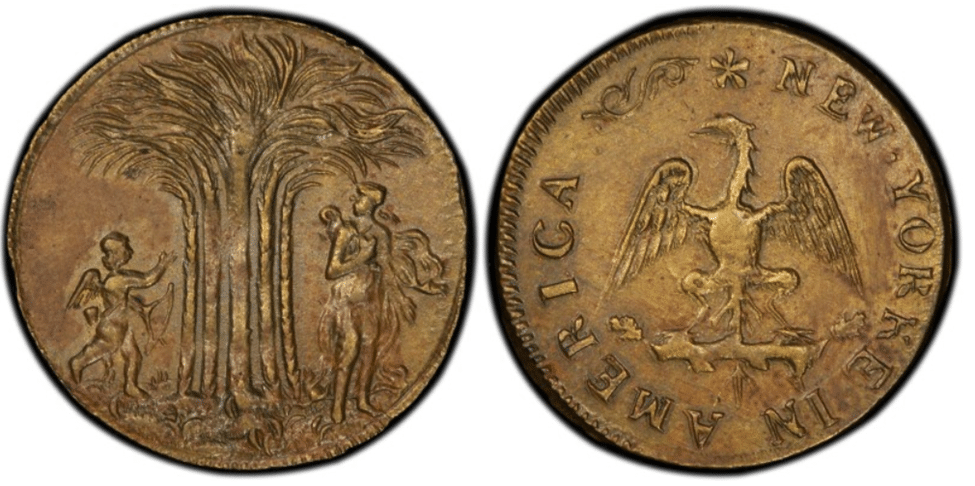
The “New Yorke in America” Token is often described as an English-made trade token intended for New York and sometimes interpreted as a small-change substitute, but there is no firm evidence it ever circulated in the colony. Although undated, the token is commonly attributed to the period of Governor Francis Lovelace (1668–1673) and is often linked to him by later researchers. The extent of his direct involvement in the design or issuance is not conclusively documented, however.
Produced before standardized American coinage, the token falls into the same category as many early colonial pieces that bridged the gap between barter, foreign coin circulation, and locally useful substitutes. Tokens served as day-to-day change, status symbols, or promotional pieces, depending on their distribution.
Origins and Intended Use
The token’s legends and theme strongly imply that it was intended for the New York colony. The reverse inscription, “NEW YORKE IN AMERICA”, states the destination plainly, while the spelling “Yorke” with a final “e” reflects common English usage before the early 18th century. This detail helps support a late 1600s attribution, consistent with Lovelace’s tenure.
Despite the clear colonial reference, there is continuing uncertainty about whether the token circulated widely in New York. The piece was produced in England as a trade token, and it may have been planned and struck prior to 1673. That timing matters because a Royal Proclamation in 1672 (along with new regal copper farthings in 1672 and halfpennies in 1673) effectively ended the legal use of private tokens, which may have curtailed or disrupted distribution. In other words, the token may represent an initiative that was overtaken by policy changes before it could become a familiar part of daily commerce.
No uncirculated examples are known, and most survivors are in worn or impaired condition. Their condition suggests colonial use, though wear alone cannot prove it. Even if the token did not become a standard medium of exchange in New York, it clearly lived a working life somewhere, rather than being preserved in pristine condition.
Design, Survival, and Collecting
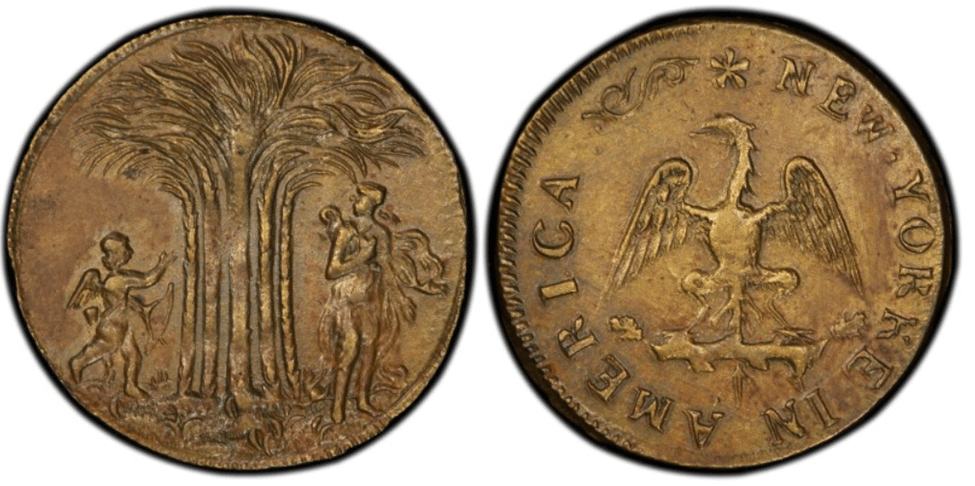
The token’s design is distinctive among colonial-era pieces. The obverse shows a mythological motif commonly described as Cupid pursuing butterfly-winged Psyche (often depicted beneath/near a palm tree), a visual pun often read as a rebus on the name Lovelace. This imagery references the classical story of Cupid and Psyche, a tale of love, trials, and reunion. Mythological themes are uncommon on pieces intended for day-to-day trade in the colonies, which makes the choice particularly striking and has fueled interest in the symbolism and the motives behind it. Whether the scene was meant as a moral allegory, a fashionable classical reference, or simply an eye-catching design, it sets the token apart from more purely heraldic or utilitarian issues.
The reverse displays a heraldic eagle with wings spread downward, surrounded by the defining legend “NEW YORKE IN AMERICA”. This side anchors the token’s identity, pairing the obverse’s artwork with a clear statement of place.
Rarity is a major driver of collector demand. Only a small population is recorded across multiple metals, with approximately 20 known in brass and about four in lead. Additional specimens are reported in pewter, further emphasizing that this issue was produced in limited quantities and perhaps experimentally, rather than as a large, standardized emission. Because so few survive, any identifiable specimen draws attention, and condition rarity matters even more. For most collectors, the opportunity is not to choose a perfect example, but to secure any genuine example at all.
Today, the New Yorke in America Token is valued for more than scarcity alone. It is a compact artifact of colonial ambition, transatlantic production, and early attempts to express local identity in monetary form. Its mythological artwork, explicit colonial legend, and tiny surviving population make it one of the most memorable tokens linked to early New York.