


Among Revolutionary War–era pieces, the Rhode Island Ship Medals stand out because they served a propaganda function rather than acting purely as commemorative items. Struck with explicit political intent, they blend naval imagery, a specific military episode, and Dutch-language inscriptions. Although commonly called medals today, many surviving examples show circulation wear, suggesting they also passed in commerce as small-change substitutes in the late 18th century.
A Medal with a Diplomatic Message
The Rhode Island Ship Medals were produced in the context of an expanding European war. By 1779, Spain had joined France in supporting the American cause against Great Britain. British leaders wanted to shape continental opinion and, in particular, to influence the Dutch, an important trading partner. The Dutch had deep commercial interests, a history in North America, and the naval capacity to matter. The medal’s Dutch text appears to have been chosen to speak directly to that audience, presenting Britain as militarily decisive and the American effort as unstable.
In that sense, the piece can be viewed as a concise political narrative in metal. The date on the obverse is 1779, while the action depicted on the reverse refers to events in August 1778. The timing supports the idea that the medal was struck after the fact, with the benefit of framing and spin.
The Rhode Island Campaign, in Brief
The scene commemorated is tied to the attempt by American forces to reclaim Newport, Rhode Island, from British control in the summer 1778. Major General John Sullivan led roughly 10,000 Continental troops, supported by around 4,000 French troops who did not join in the land battle after the fleet was driven off. Naval events proved decisive. Admiral Lord Richard Howe’s fleet challenged the French, and a storm scattered and damaged the French ships, which then withdrew to Boston. With naval support lost, Sullivan’s army retreated and fought the Battle of Rhode Island on August 29, 1778, before leaving Aquidneck Island. With the allied effort thrown off balance, the American forces withdrew and the attempt to retake Newport collapsed.
The medal portrays this as a clear British success, emphasizing flight and disorder on the American side. The accuracy of that portrayal mattered less than its persuasive impact.
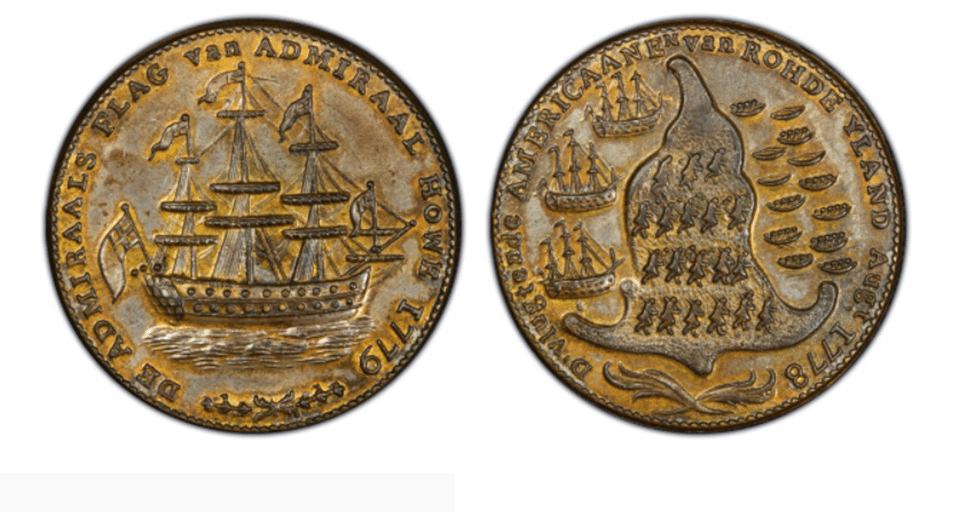
Design Elements and Varieties
The obverse depicts Admiral Howe’s flagship sailing left. Around the rim is a Dutch legend commonly transcribed as “DE ADMIRAALS FLAAG van ADMIRAAL HOWE 1779” (with minor letterform/spelling variations noted by catalogers). It is a direct identification rather than an abstract allegory, anchoring the piece to a named commander and a claimed victory.
The reverse shows three British warships and the American retreat across Aquidneck Island (Newport, Rhode Island). The island’s outline is filled with fleeing Continental troops moving to the right, where small boats wait as if to carry them off. The reverse legend is commonly transcribed along the lines of “D’vlugtende AMERICAANEN van ROHDE YLAND AUG. 1778”, with minor spelling/punctuation variations reported in different references.
One of the most discussed diagnostics involves the placement of the word “VLUGTENDE”. A major early diagnostic is the word VLUGTENDE below the ship on the obverse, which could be read as implying Howe was “fleeing.” Later varieties remove the word or replace the space with a wreath, avoiding that implication. Pieces with the mistaken placement are therefore particularly desirable.
Collectors commonly describe the main varieties by what appears below the ship on the obverse: (1) VLUGTENDE below ship, (2) no word below ship, and (3) a wreath below ship; some references also treat a distinct metal/striking variant (e.g., pewter) as a fourth major variety. Most examples encountered are brass, and pewter is much scarcer, though other compositions/finishes (including copper and silvered examples) are also documented in the marketplace and reference listings.
Collecting and Historical Interest
These medals are frequently found in circulated condition, and a meaningful number have been located in England, consistent with the idea that they were not solely collectibles. Their appeal today comes from three factors: the detailed naval artwork, the unusual use of Dutch for an Anglo-American conflict, and the clear evidence of hurried production in the corrected legend. As a category, the Rhode Island Ship Medals combine medallic art, wartime messaging, and everyday economic life. They show that, even during the Revolution, metal pieces could convey political messages as well as monetary value.