

The Washington Cents of 1792 connects early American politics, a chronic shortage of small change, and a nation still unsure what its money should say about itself. Collectors group them with early federal patterns and post-colonial tokens for a reason. After independence, Americans needed practical coinage and symbols that avoided monarchy.
A Coinage Problem in the New Republic
When the Revolutionary War ended, the United States had no steady national coinage to distribute for everyday trade. In the former colonies, now states, commerce relied on an uneasy blend of foreign silver and gold, British coppers, locally used tokens, and other substitutes. This “mixed currency” could function, but it was inconsistent in value, availability, and trust. Small change was especially scarce, which is precisely where private makers and token issuers often tried to fill the gap.
W. & Alex. Walker, a firm in Birmingham, England, sponsored the production of Washington-themed copper pieces dated 1791 in hopes of attracting official interest in a private coinage contract. The dies used are widely attributed to John Gregory Hancock Jr.. The coins were finely made and carried a clear national theme. The pieces were privately made, and several leaders objected to portrait designs that echoed monarchy. As a result, the Walker cents were never adopted as an official U.S. issue.
Why the Washington Portrait Was Controversial
Washington was reportedly uneasy about his portrait appearing on official U.S. coinage because it risked echoing monarchical imagery. Despite this, private makers continued using his likeness on tokens and patterns. His concern was not artistic quality. It was the message. A president on a coin could read like a king on a coin, and Washington had no interest in the new republic adopting imagery that echoed British and European monarchical traditions. After years of war against the forces of King George III, Washington wanted American coinage to avoid anything that suggested a personal ruler.
Despite Washington’s concerns, Walker still shipped about 4,000 pieces (roughly 1,500 Small Eagle Cents and 2,500 Large Eagle Cents) to Thomas Ketland & Sons in Philadelphia for presentation to legislators. Washington’s emphatic refusal meant no large government order would follow. By the time the decision was clear, additional pieces dated 1792 had also been struck.
Design, Rarities, and Legacy
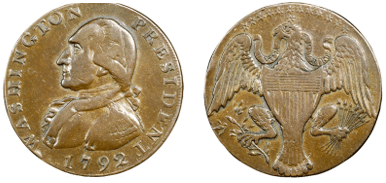
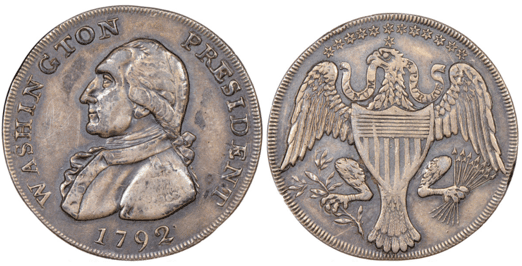
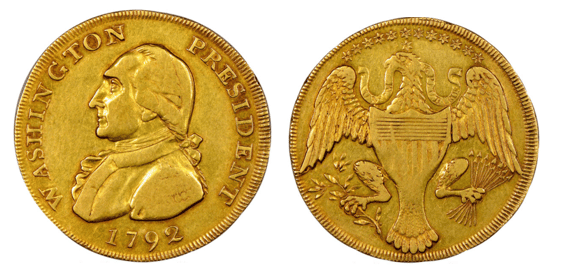
Several Washington-themed pieces dated 1792 exist, with reverse designs differing by variety. On the Large Eagle “Washington President” pattern (Baker-21A), the eagle carries a ribbon inscribed “UNUM E PLURIBUS”, and the denomination area is replaced by a star grouping (commonly described as 12 stars in an arc with a 13th below). The obverse shows a bust of Washington facing left in military dress, with the legends “WASHINGTON” and “PRESIDENT” placed around the portrait and the date 1792 below. The reverse presents a distinctly national emblem: an American eagle with wings spread but angled downward, a shield on its breast, a banner with “E PLURIBUS UNUM”, and symbolic groupings that echo the new union. Thirteen six-pointed stars appear above the eagle, reinforcing the identity of the original states. The eagle holds thirteen arrows in one talon and an olive branch in the other, balancing war and peace as national themes.
Some 1792 Washington patterns are undenominated, often substituting stars where “ONE CENT” appears on related 1791 designs, though other Washington pieces of the era do state a denomination. Surviving examples are very rare. Survival counts depend heavily on the variety: some 1792 copper patterns are known by only about a half-dozen specimens, while other 1792 Washington issues (such as the Getz patterns) are estimated in the dozens. Silver patterns dated 1792 are known, but rarity varies by issue; for example, the silver Large Eagle Washington President pattern (Baker-20) has been described as having five known specimens. Only one gold example is known. Every format is scarce, and the occasional public sale highlights their historical importance. The unique gold specimen realized $1,745,000 at Heritage Auctions on August 16, 2018.
Today, Washington Cents dated 1792 are valued for more than scarcity. They capture a moment when the United States was still negotiating the line between practical money and political principle. The coins show how strong the demand for usable copper was, and how firmly Washington believed that American coinage should represent the republic, not the individual who led it.