

Celebrating the Founding of Cleveland, Ohio, and the Great Lakes Exposition
In 1936, Cleveland, Ohio, was celebrating two milestones. The 1936 Cleveland Centennial marked the 100th anniversary of Cleveland, Ohio, being incorporated as a city, and the city hosted the Great Lakes Exposition that year. Like other locales with major celebrations, they, too, wanted a commemorative coin to help defray some of the costs of honoring the city and hosting the exposition. The Cleveland Centennial Committee was formed to oversee the celebrations and the distribution of the 1936 Cleveland Centennial/Great Lakes Exposition Half Dollar.
A bill was written authorizing a coin honoring both events, and it passed through Congress and was signed into law by President Franklin D. Roosevelt. But because so many coinage bills were authorized in 1936 and a majority of them passed Congress, amendments were not unusual. The amended bill required the Committee to purchase at least 25,000 coins in a single transaction to prevent future restrikes and speculative manipulation.
Design Details
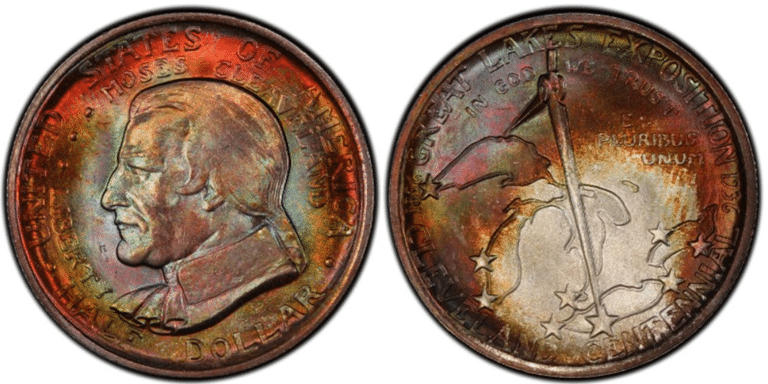
Brenda Putnam, a well-known and accomplished sculptor, designed the 1936 Cleveland Centennial/Great Lakes Exposition Half Dollar. The obverse depicts a left-facing portrait of Moses Cleaveland. Surmounting the portrait are the words “UNITED STATES OF AMERICA,” the word “LIBERTY” and “MOSES CLEAVELAND.” The bottom periphery has the denomination “HALF DOLLAR.”
The reverse of the coin features a central vignette of the five Great Lakes and a large compass, with its point on a five-pointed star representing the city of Cleveland. The other eight major Great Lakes cities that are represented by smaller stars are Chicago, Detroit, Buffalo, Toronto, Duluth, Milwaukee, Toledo, and Rochester. Around the periphery are: “GREAT LAKES EXPOSITION – 1836 CLEVELAND CENTENNIAL – 1936” and “IN GOD WE TRUST” and “E PLURIBUS UNUM” are in the open fields.
Distribution Details
Cincinnati businessman Thomas G. Melish became the sole distributor of the 1936 Cleveland Centennial/Great Lakes Exposition Half Dollar. Melish distributed the coins through the exposition, at local banks across Cleveland, and by mail order from his office. Sales were strong, and ultimately the full authorized mintage of 50,000 coins was struck.
As treasurer of the Cleveland Centennial Committee, Melish ordered 25,000 coins in July 1936, and they were shipped from the Philadelphia Mint. At Melish’s direction, the Philadelphia Mint was instructed to place the first 201 struck into individually numbered envelopes; these were later placed in special cardboard holders, the first by itself and each two thereafter together, with a notarized statement.
The Great Lakes Exposition opened on June 27, 1936, and before it closed, about four million people passed through its gates. The coins were sold at the fairgrounds, at Ohio banks, and by mail order from Melish.
Melish sent form letters to collectors, warning that his committee had received offers from speculators to buy the entire issue and urging them to act quickly to place their orders. By the end of July, Melish wrote that 24,000 pieces had been distributed and that the remaining 1,000 would soon follow. Sales were strong enough that Melish ordered the remaining 25,000 coins from the authorized quantity. Shop now and grow your collection with our exceptional assortment of U.S. classic silver commemorative coins.