
Celebrating the 150th Anniversary of Captain Cook’s Discovery of Hawaii
In 1927, the legislature of the Territory of Hawaii passed a resolution asking the US Government to honor the Sesquicentennial of the Landing of Captain Cook in the Hawaiian Islands. Captain James Cook was a British explorer whose voyages expanded European geographic knowledge of New Zealand, Australia’s east coast, and many Pacific islands before he died in Hawaii. He was stabbed after he took a paramount chief, Kalaniʻōpuʻu, hostage in order to force the return of the boat taken by Hawaiian natives.
In 1893, the Committee of Safety, made up mostly of American and other non-native business interests, overthrew the Hawaiian monarchy with help from the U.S. minister and U.S. Marines. Hawaii was annexed by the United States in 1898 and later organized as a U.S. territory, so by the time this coin was issued in 1928, Hawaii was already under U.S. governance. The bill for the Hawaiian Half Dollar passed through Congress and was signed by President Coolidge on March 7, 1928. The bill provided for the issuance of 10,000 commemorative Half Dollars.
The Captain Cook Sesquicentennial Commission of Hawaii
The Captain Cook Sesquicentennial Commission of Hawaii was formed as the organization designated to sell the Commemorative Half Dollars to the public. The U.S. Mint charged the commission $0.50 per coin, allowing it to sell the pieces at a profit to cover celebration costs. Priced at $2.00 each, they carried the highest asking price for a commemorative Half Dollar at the time.
The commission next sought a design that would appeal to buyers. Honolulu artist Juliette May Fraser supplied preliminary sketches. Sculptor Chester Beach converted her sketches into plaster models and refined them for die creation.
Design Details
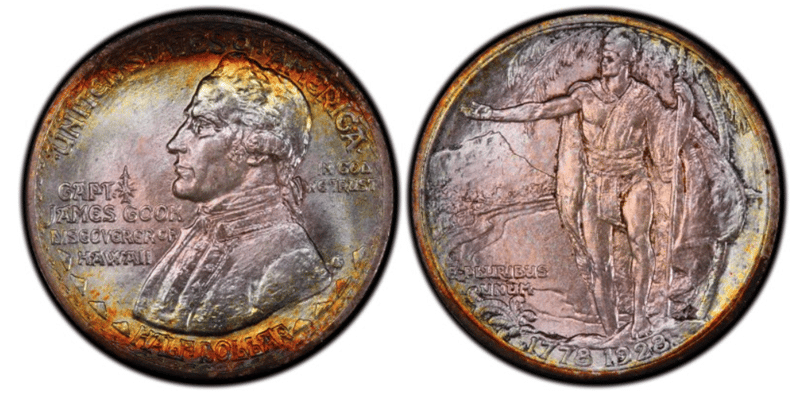
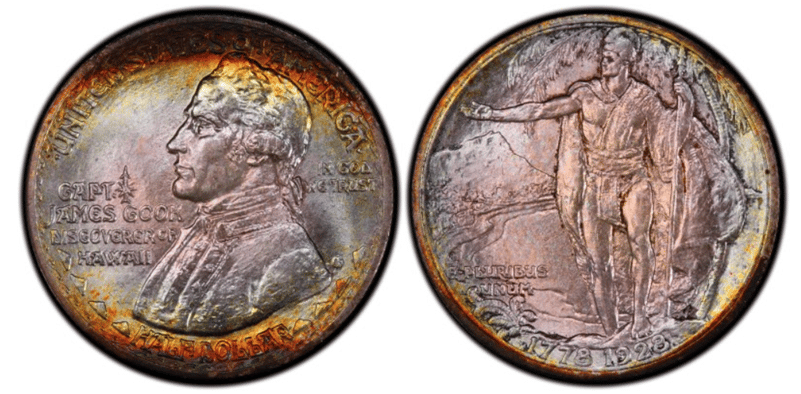
The obverse features Captain James Cook in military dress. He faces left toward a compass needle and the inscription “CAPT. JAMES COOK, DISCOVERER OF HAWAII.” The top periphery has “UNITED STATES OF AMERICA” with “IN GOD WE TRUST” to the right and behind Cook. The denomination “HALF DOLLAR” sits below the bust, flanked by eight small triangles representing Hawaii’s largest islands.
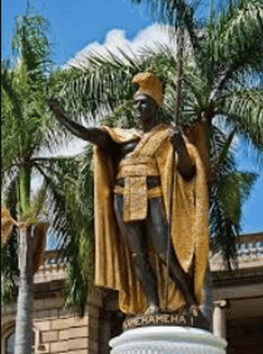
The reverse shows King Kamehameha I in ceremonial dress, standing with his arm extended in greeting. A large palm tree rises behind him, with a small Hawaiian village, beach, and Diamond Head in the distance. Lettering is limited to “E PLURIBUS UNUM” at lower left and the dates “1778 1928” along the bottom rim.
The Philadelphia Mint struck 10,008 coins, which included 8 for assay, and the Bank of Hawaii took charge of the collection and distribution of the coins. Fifty coins were struck as proofs and sandblasted to provide a satiny finish. These proofs were distributed to dignitaries, including President Coolidge and members of the British Admiralty, who took part in the proceedings. Explore our curated selection of U.S. classic silver commemorative coins to enhance your collection.