
Celebrating 300 Years Since the Arrival of Dutch Colonists
The tercentenary of the Dutch settlers’ landing on Long Island was scheduled for 1936. A land deed dated June 16, 1636, recorded a conveyance on Long Island to two Dutch colonists, and three hundred years later, communities across the island planned major commemorations. As was common in 1936, local cities and towns formed tercentenary committees, with the Long Island Tercentenary Committee emerging as the leading organization. With considerable political influence, the committee, like many commemorative groups of the era, pursued a United States commemorative coin to help defray the costs of the celebration.
New York Congressman John Delaney authored a bill that sought authorization for a minimum of 100,000 1936 Long Island Tercentenary Silver Half Dollar to be struck by the United States Mint. The bill passed the House of Representatives, was amended in the Senate, and was ultimately approved by both chambers. It was signed into law by President Franklin D. Roosevelt.
Design Details
Once the bill became law, the Tercentenary Committee began the process of selecting an appropriate design for the coin. The Commission of Fine Arts recommended that Howard K. Weinman design the coins after multiple designs were reviewed and revised. Weinman was the son of Adolph Weinman, who successfully designed the Mercury Dime and the Walking Liberty Half Dollar, both of which were still being struck in 1936.
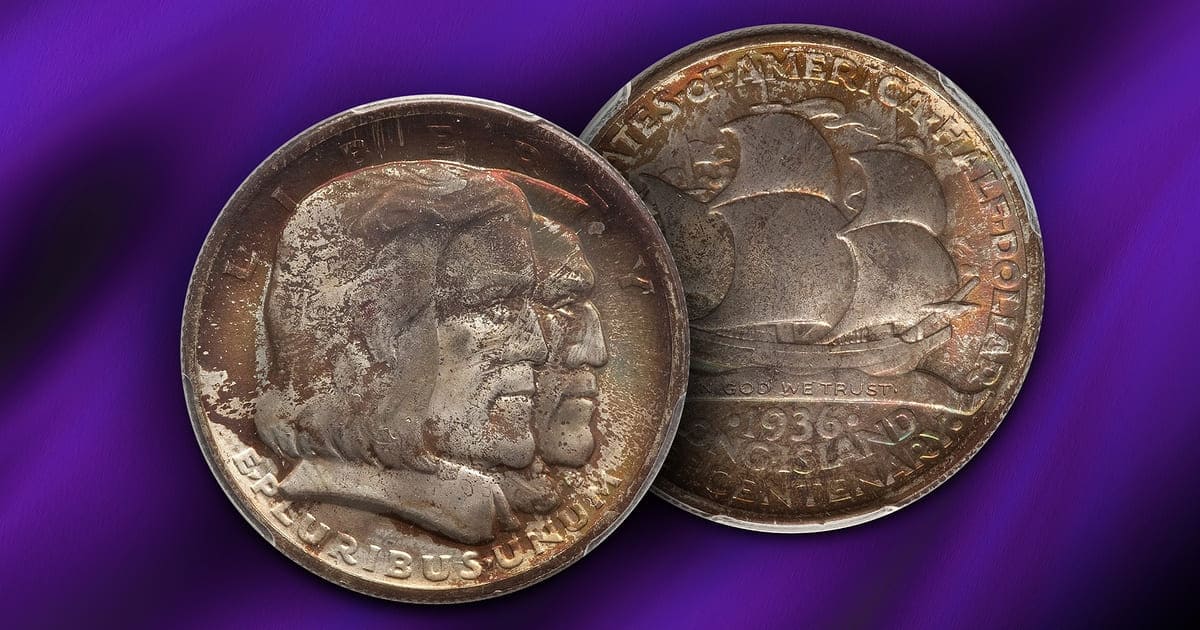
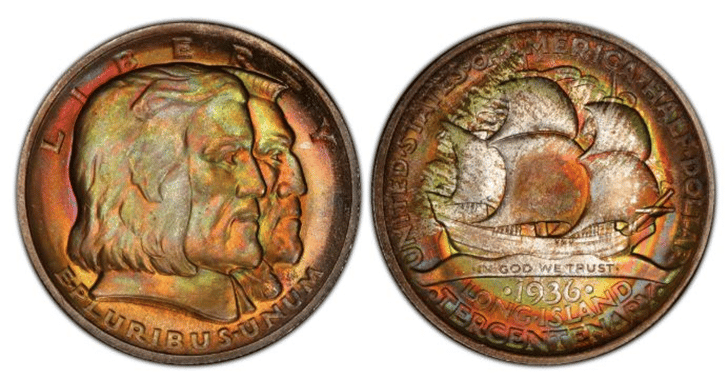
Weinman’s design for the obverse contained conjoined busts of a Dutch settler and an Algonquin Indian, both facing right. The Dutch settler and the Algonquian tribesman represent early colonial encounters rather than specific individuals. Above them was the word “LIBERTY,” and below them was the motto “E PLURIBUS UNUM.”
The reverse depicts a stylized Dutch ship sailing to the right in deep waves. In those waves are the words “IN GOD WE TRUST,” and under the waves are “1936” and “LONG ISLAND TERCENTENARY” in three lines. The periphery has “UNITED STATES OF AMERICA” and the denomination “HALF DOLLAR.”
Mintage & Distribution
Because of delays, the coins were not struck until August of 1936, too late for the June Tercentenary celebrations held all across Long Island. Of the 100,000 coins struck at Philadelphia and sent to the Committee, 81,826 were sold and distributed, making the program financially successful. Advance sales generated by the Committee totaled nearly 19,000 coins sold through the mail. The remaining sales were conducted on Long Island and in New York City, as the coins were widely distributed across dozens of local banks.
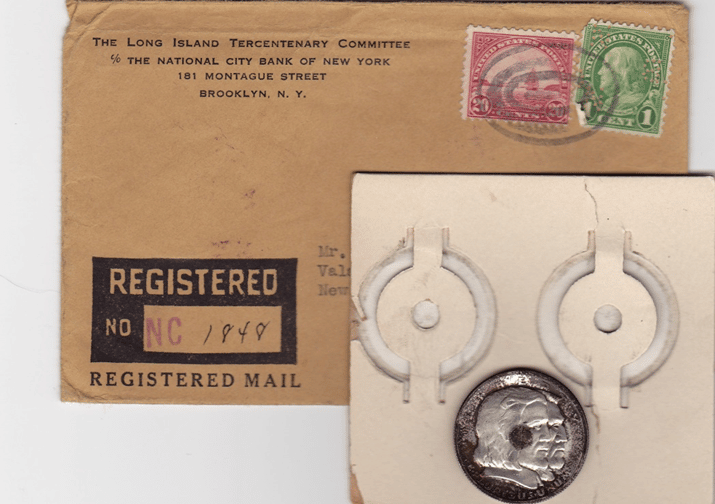
Coins were distributed by mail in 5-coin holders, sent in envelopes from the Long Island Tercentenary Committee. Due to the large number bought by mail, a greater number of original holders and envelopes exists than for many other issues. This coin is one of the many commemorative coins we have in our inventory. Expand your collection today and shop our U.S. classic silver commemorative coin collection.