
New Rochelle’s Semiquincentennial and the “One Fatt Calfe”
Huguenots, a group of religious settlers, came to the New World from France. They settled in an area in New York, near Connecticut, in 1688. The following year, the Huguenots purchased a tract of land from the landowner, John Pell. They named this tract after their hometown city, calling it New Rochelle. One of the conditions of the purchase was that they would give to Pell or his heirs “One Fatt Calfe” on June 24 each year, if they so requested it.
In 1938, the 250th Anniversary of that first calf purchase was approaching. The Westchester Coin Club was instrumental in promoting a coin for New Rochelle’s anniversary. The profits from the sale of the coins would help to defray the expenses for the planned local celebrations. Bills were introduced in the House and Senate in 1936 by local politicians. During negotiations, it was agreed that the minimum order for coins would be 25,000 and that all coins would be struck at a single mint. The bill passed both houses of Congress and was signed into law by President Franklin Roosevelt.
Design Details
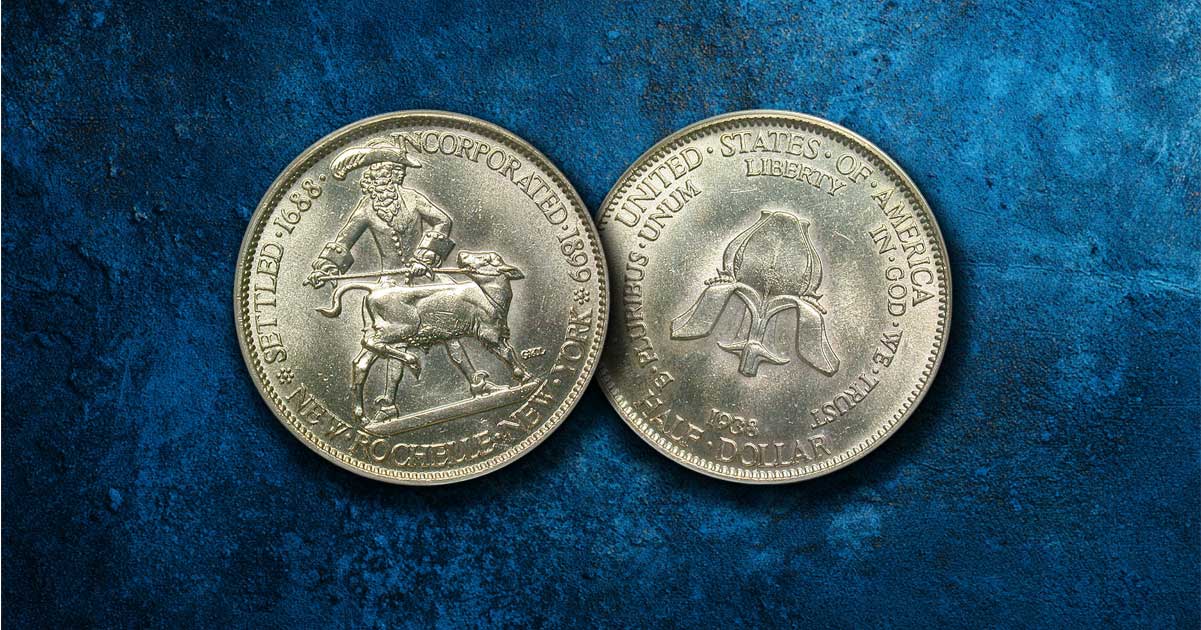
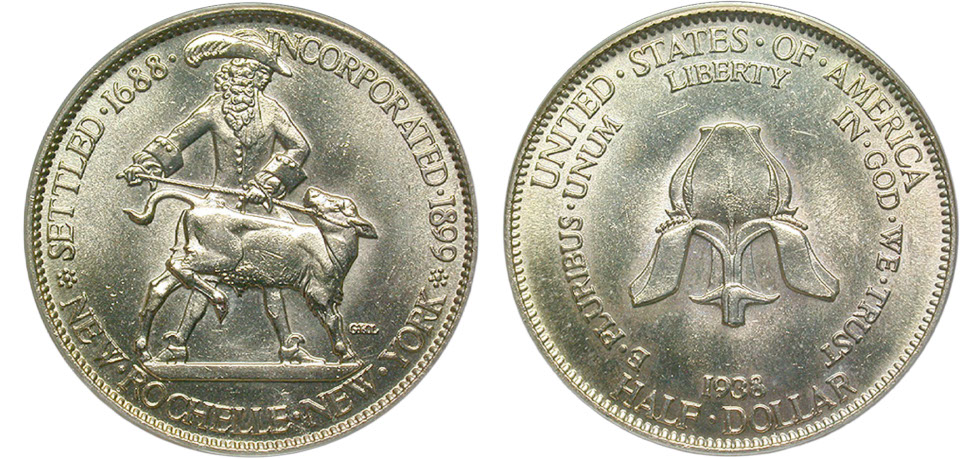
Gertrude K. Lathrop designed the 1938 New Rochelle, New York Half Dollar. Her design for the obverse featured a man, presumably John Pell, the original landowner, holding a rope around the neck of a “fat calf”. Arranged around the periphery of the obverse were the legends, “NEW – ROCHELLE – NEW – YORK – SETTLED – 1688 – INCORPORATED – 1899”.
The reverse design has a fleur-de-lis as the central device surrounded by mottoes and legends in two concentric circles. The inner-circle has “E – PLURIBUS – UNUM – LIBERTY – IN – GOD – WE – TRUST – 1938.” The outer circle has “UNITED – STATES – OR – AMERICA” and “HALF – DOLLAR”.
Mintage & Distribution
The Philadelphia Mint struck 25,015 coins. The extra 15 coins were reserved for assay. All coins were distributed to the First National Bank of New Rochelle on behalf of the Coin Committee and were sent through the mail in an imprinted envelope, as seen below.
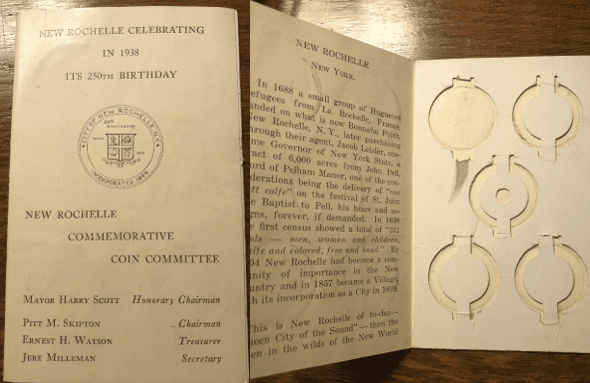
(The New Rochelle 5-coin holder of distribution)
The Coin Committee sold the coins at $2.00 each, profiting $1.50 per coin. Coins sold through the mail went to all 48 states and to a dozen foreign countries. By the spring of 1939, the sales had slowed, so the Committee returned over 9,700 coins to the Mint for melting. The net amount sold, including assays, was 15,266.
The U.S. Mint struck the first fifty coins on specially-polished proof blanks. These coins have mirrored fields like proof coins. They bring significant premiums when graded as a specimen. The first fifty or so strikes after the proofs have “proof-like” qualities. When graded “proof-like,” they also attract higher premiums.
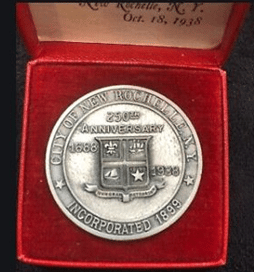
Because its members helped secure the coin’s authorizing legislation, guided the bill through Congress, bought many of the new half dollars from the issuing committee, and oversaw fair distribution, the Westchester County Coin Club also produced a companion medal.
Expand your collection today and shop for this coin and many other commemoratives in the U.S. classic silver commemorative coins collection.