

The 1926 United States Sesquicentennial Expo
The nation’s sesquicentennial was going to be celebrated in 1926 in the city that served as the first American capital – Philadelphia. The United States National Sesquicentennial Exhibition Commission was organized to plan, maintain, and run the Sesquicentennial Exposition in that city. On March 4, 1925, the United States Congress authorized one million commemorative half dollars and 200,000 $2.50 gold quarter eagles to defray the costs of the Exposition.
1926 Sesquicentennial of American Independence Half Dollar
When Chief Engraver John R. Sinnock and the Commission failed to agree on his proposed designs, they invited Philadelphia attorney and numismatist John Frederick Lewis to submit sketches for the silver half-dollar. Sinnock adapted the sketches to meet the coin requirements without giving Lewis any credit for more than 40 years. Lewis was eventually acknowledged by numismatic historians, and the Commission of Fine Arts later clarified his role in documentation.
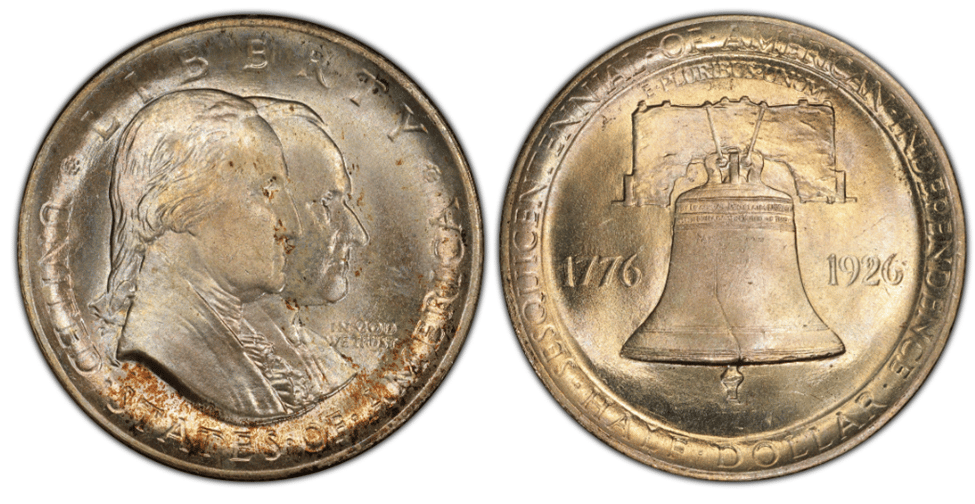
The obverse of the half dollar featured conjoined busts of President George Washington and President Calvin Coolidge, making Coolidge the first president to have his likeness on a coin while in office and still living. The busts faced right, and “LIBERTY” was displayed above the busts, and “UNITED STATES OF AMERICA” was below them, and “IN GOD WE TRUST” was beneath Coolidge’s chin.
The central vignette on the reverse was the Liberty Bell. The periphery of the coin carried the mottoes “SESQUICENTENNIAL OF AMERICAN INDEPENDENCE – HALF DOLLAR” and “E PLURIBUS UNUM” above the bell. On the left side of the bell was the date “1776” and on the right was “1926”.
1926 Sesquicentennial of American Independence Quarter Eagle
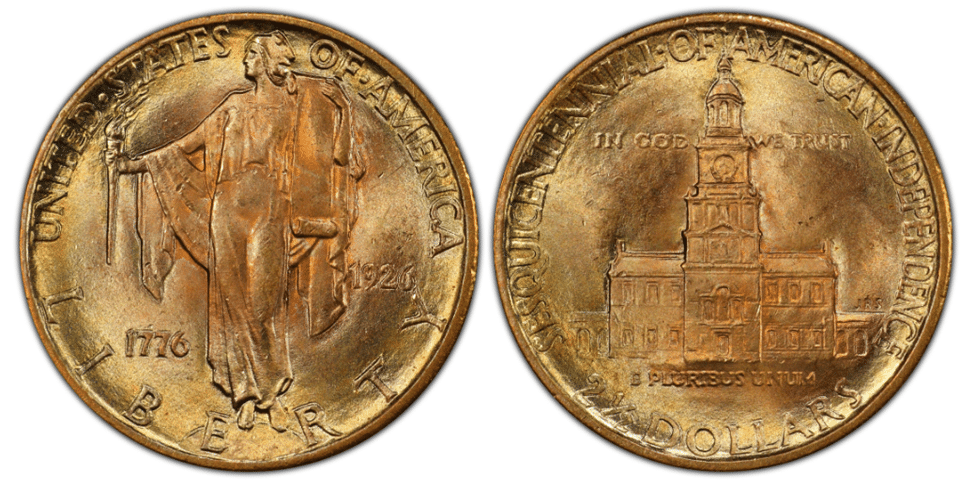
John R. Sinnock designed the obverse and reverse of this gold quarter eagle. The coin depicts a full figure of Lady Liberty, facing left, holding her torch in one hand and a scroll of the Declaration of Independence in the other. “UNITED STATES OF AMERICA” is above Lady Liberty, and “LIBERTY” is below. The date “1776” is to the left of Miss Liberty, and “1926” is to the right.
The reverse of the quarter eagle depicts Independence Hall in Philadelphia, with the sun rising behind it. “SESQUICENTENNIAL OF AMERICAN INDEPENDENCE” and the denomination “2 ½ DOLLARS” at the bottom is lined around the rim. Under Independence Hall are “E PLURIBUS UNUM” and “IN GOD WE TRUST,” separated by the tower of Independence Hall.
When President Coolidge visited the Exposition, he was presented with the first half dollar that was struck. Over one million half-dollar coins were struck, but only 141,120 were sold and distributed, with the rest melted. 200,000 gold eagles were struck, and 46,019 were sold and distributed.
Coins sold at the Exposition were distributed through the Commission, while mail requests were handled by the Franklin Trust Company. The half dollar was priced at $1.00, as were prior commemorative half dollars. The Sesquicentennial of American Independence Quarter Eagle was priced at $4.00.
At the request of the Commission, the coins were struck in low relief so that they could be struck quickly. Finding a well-struck coin today, especially the half dollar, is a remarkable accomplishment. Expand your collection with these coins today and view other U.S. classic silver commemorative coins and modern U.S. gold commemorative coins.