
Celebrating 100 Years Since the Establishment of the Wisconsin Territory
After the Revolutionary War, the United States gained control over lands formerly claimed by Great Britain. Over the next several decades, this region was successively organized as parts of the Northwest, Indiana, Illinois, and Michigan Territories before Congress established the Wisconsin Territory in 1836.
The region was originally inhabited for thousands of years by Native American nations, including the Menominee, Potawatomi, Ojibwe (Chippewa), and others. The first American settlers in the territory were Cornish lead miners from England and settlers from New England, New York, Ohio, and Pennsylvania. Germans were the largest immigrant group and settled largely in Milwaukee. These immigrants who moved to this land and built farms, communities, and mines led to Wisconsin’s statehood in 1848 and shaped its unique cultural landscape.
The centennial of the establishment of the Wisconsin Territory was in 1936, and it was decided to mint a commemorative coin. The legislation for a coin celebrating this centennial was approved by Congress and was signed into law by President Franklin Roosevelt. The legislation for the 1936 Wisconsin Territorial Centennial Half Dollar called for minting a minimum of 25,000 coins with no maximum.
Design & Mintage Details
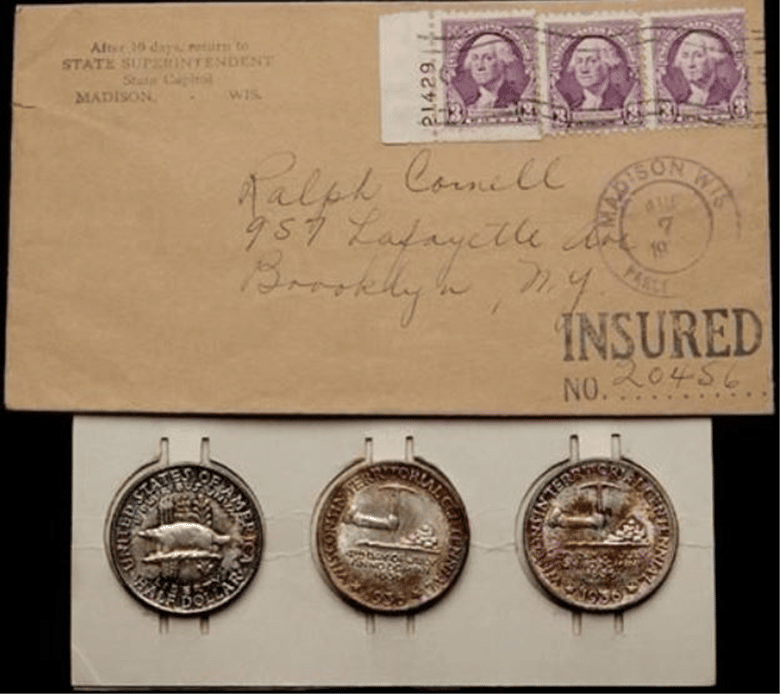
The approved design features an arm holding a pickaxe and a mound of lead ore on the obverse. Around the periphery are “WISCONSIN TERRITORIAL CENTENNIAL” and the date “1936” with a five-pointed star before it and one after it. Below the pickaxe and mound is the date “4TH DAY OF JULY / ANNO DOMINI / 1836”.
The reverse depicts a badger on a log, arrows behind, olive branch behind, with “IN GOD WE TRUST” between the arrows and Olive Branch. Around the periphery are “UNITED STATES OF AMERICA” and the denomination “HALF DOLLAR.” The word “LIBERTY” is above the denomination, and “E PLURIBUS UNUM” is beneath the country. This symbolism of the olive branch and the arrows comes from the Great Seal of the United States, first adopted in 1782, which depicts an eagle holding both arrows and olive branches.
The pickaxe design was chosen because lead mining was central to Wisconsin’s early settlement and economic development in the early 19th century. Southern Wisconsin was a major lead-mining region, and miners were among the first non-Native settlers in the territory. The badger is Wisconsin’s long-standing state symbol and nickname (“The Badger State”). The nickname originated from early miners who often lived in hillside dugouts resembling badger burrows. Over time, the badger came to represent perseverance, independence, and frontier spirit.
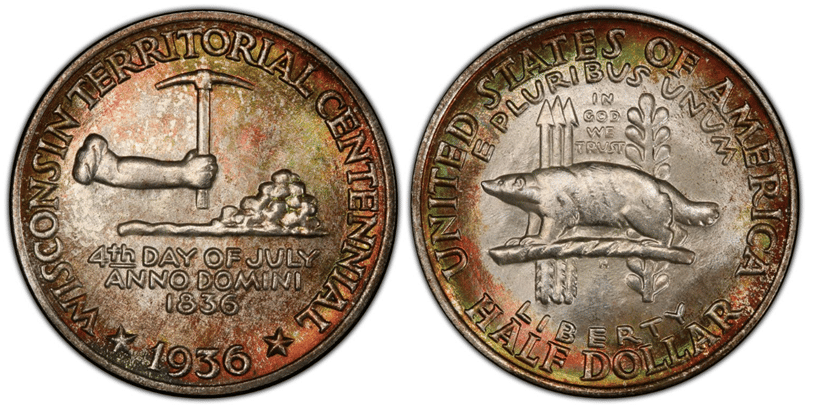
A total of 25,015 1936 Wisconsin Territorial Centennial Half Dollars were struck at the Philadelphia Mint and were then quickly shipped to the Wisconsin Territorial Centennial Committee for distribution. The coins did not arrive during the celebration, but were sold by mail and at banks in Madison, Wisconsin. Most were sold at $1.50 each. They were sold for 16 years, until 1952, at a slightly reduced price of $1.25 each.
They were sold in plain cardboard holders and shipped through the mail in simple Kraft envelopes. Expand your collection with this historic half dollar today and explore other U.S. classic silver commemorative coins.