
The Founding of Moffat and Co.
It is generally accepted by the numismatic community that, while Moffat & Company’s coinage was not the earliest of California’s private gold coinage, it is among the most important gold coins of the Gold Rush era. They operated an assay office that conducted assays, and when the United States decided to build and operate a mint in San Francisco, the two surviving members of Moffat & Company were asked to establish and operate it.
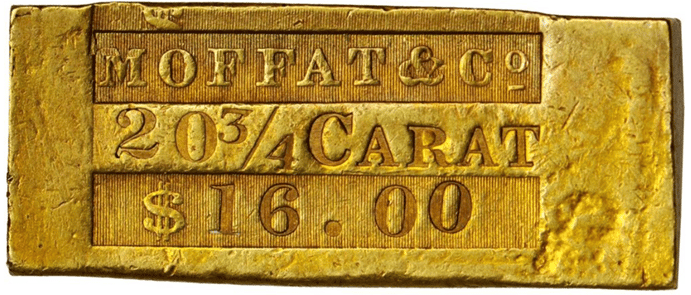
Sometime during the winter of 1848-1849, Moffat traveled to California to establish a minting facility, Moffat and Co. Originally, they struck gold ingots in face values ranging from $9.43 for the smallest ingot to $264 for the largest. A $16.00 face-value ingot was offered at a public auction and fetched $235,000 at a Stacks’ Bowers sale in 2018. Several other ingots of different denominations reside in the Smithsonian collection.
The ingots were easier to make, but they proved unwieldy as a medium of exchange. Later that same year, George Kuner arrived in California from his homeland of Bavaria. He immediately joined Moffat & Company as the chief engraver, and he was immediately tasked with designing and engraving Half Eagle and Eagle coins.
1849 Moffat & Co. Gold Coins
Kuner designed the coins to closely resemble the then-circulating United States Half Eagles and $10 Liberty Eagle Coins. The workmanship was excellent, and the resemblance to U.S. Coinage was unmistakable.
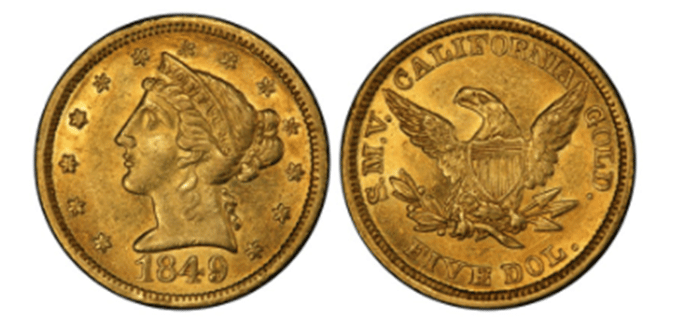
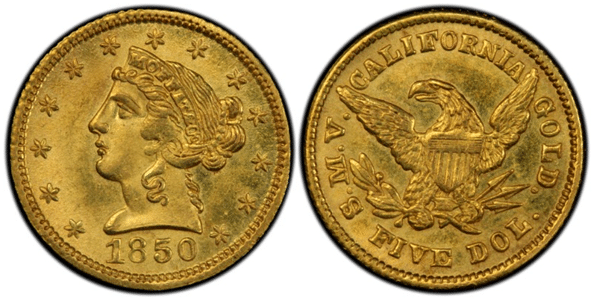
The issuance and acceptance of the 1849 Moffat & Company Half Eagles guaranteed the striking and future acceptance of his 1850 Five Dollar Half Eagle, which only differed from the 1849 version in the dates.
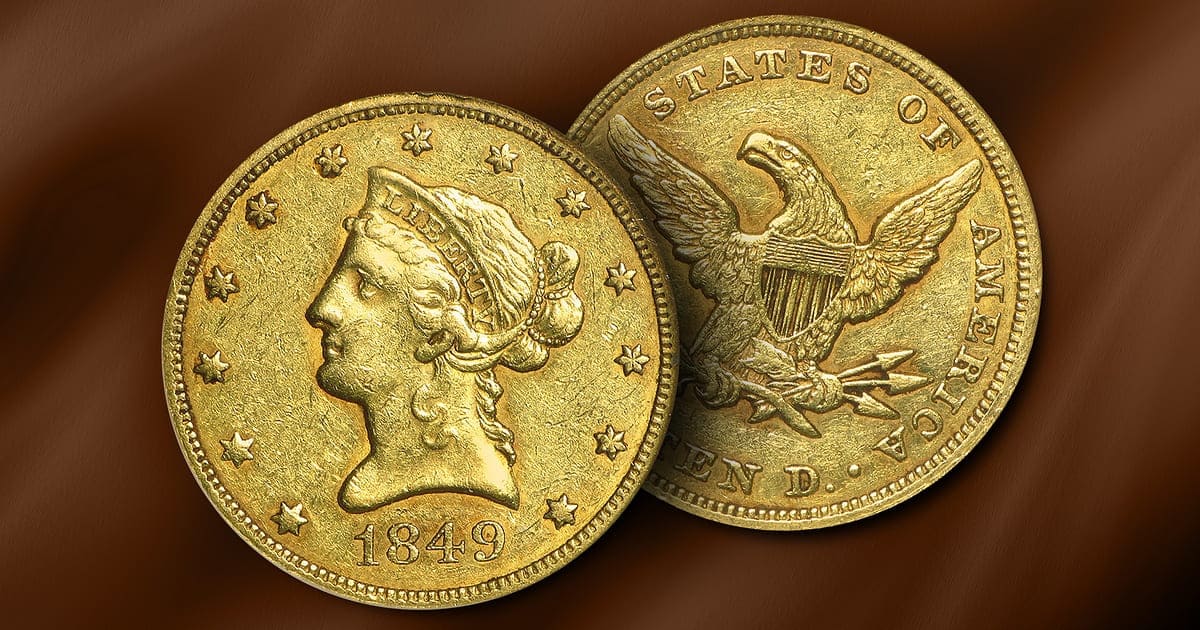
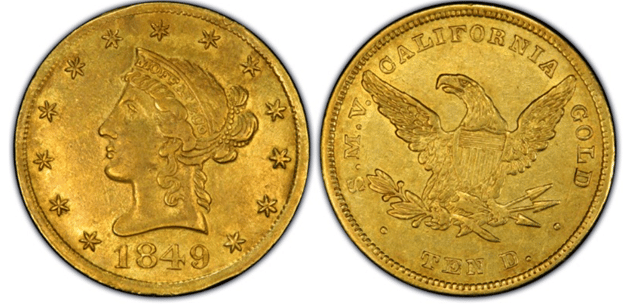
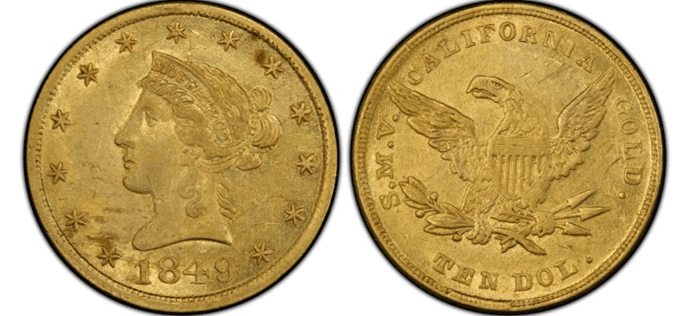
The other two coins in the series were two 1849-dated $10.00 Eagle Gold coins. These coins resembled Moffat & Company’s Half Eagles, except for their size and denomination. One example says “TEN D.” as the denomination, and the other says “TEN DOL.”
1852 Moffat & Co. Gold Coins
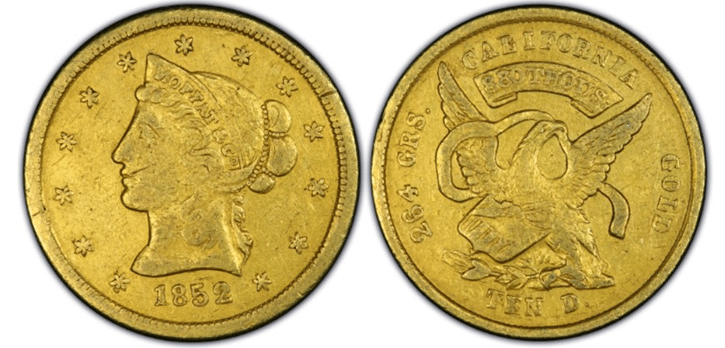
The coins closely resembled U.S. coinage. The obverse of the coins depicted an allegorical Lady Liberty facing left, wearing a coronet in her hair. On the coronet was “MOFFAT & CO.” with a date below Liberty “1852” and 13 five-pointed stars around the upper periphery.
The reverse of the coins depicted a heraldic eagle with upswept wings, a patriotic shield at its breast, on a rock, with arrows and an olive branch in its claws. Around the upper reverse periphery was “264 GRS. CALIFORNIA GOLD” and above the eagle was a banner bearing “880 THOUS.” Below the eagle was the denomination “TEN D.”
The coinage resembled U.S. gold coinage of the day but, upon closer inspection, was undeniably private gold coinage from California. There were two distinct varieties that otherwise looked identical. One variety had a “wide date,” and the other had a “close date.” The “close date” is more valuable in higher grades (Extremely Fine and up) and significantly higher in grades approaching Mint State.
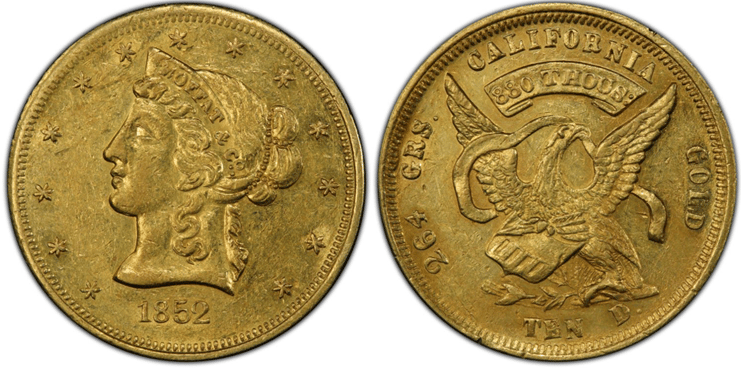
The other variety is exactly the same except that the date is more widely spaced and uneven.
Moffat & Co. & Humbert Join Forces (1852)
Moffat & Company received a government contract to produce coinage, and Augustus Humbert was the Assayery, and by 1852, they had joined forces. Moffat used the withdrawal of private-mintage coins to argue for issuing lower-denomination coins with a face value under $50. In fact, the withdrawal of private coinage may have pulled as much as $3,000,000 worth.
Although private mints had been discouraged from striking their own gold coins, Moffat & Company decided to proceed. They struck $300,000 to be shipped to bankers and merchants in San Francisco.
1852 Moffat – Humbert Coin Descriptions
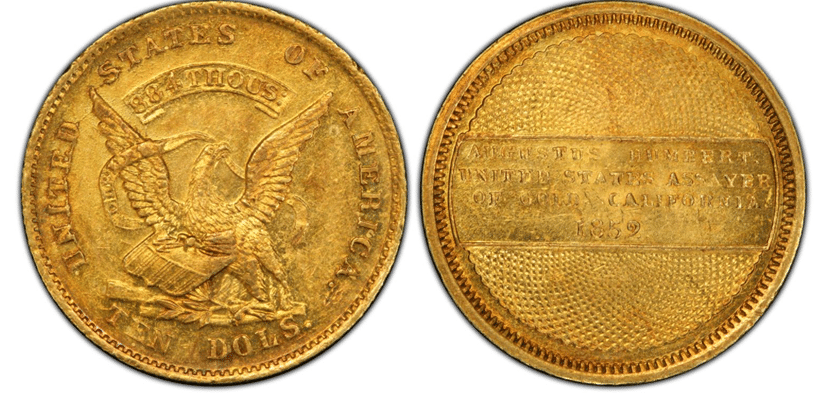
The 1852 $10 Moffat and Humbert gold coins looked radically different from their year-earlier counterparts. The obverse had a circular pattern both above and below a central panel. The central panel had four lines of text followed by the date “UNITED STATES ASSAY / OFFICE OF GOLD / SAN FRANCISCO / CALIFORNIA 1852.”
The reverse bore the same heraldic eagle with upswept wings and a banner above her with “884 THOUS” on it. The upper periphery had the legend “UNITED STATES OF AMERICA” while the lower periphery had the denomination “TEN DOLS.”
Moffatt & Company’s California private gold coins, including Moffat-Humbert strikes, are among the most recognizable, desirable, and affordable privacy coins. Expand your collection today and shop our assortment of pre-1933 U.S. gold coins.