
The 38 Partners of the Pacific Company
The Pacific Company was a large group of people who shared the common goal of going to California in 1849 to strike gold coins, which were desperately needed. They were from Boston and sought their fortunes by helping those on the gold fields. Each member contributed $1,000, and the group that started with 30 participants expanded to 38 members.
It is believed that the Pacific Company brought with them coin dies created back East, and, like most of their valuable possessions, the coining dies were also sold to recoup some of their investments. It is also believed that the firm of Broderick and Kohler bought the coinage dies and struck $5 and $10 gold coins under the “Pacific Company” name. The coins produced by Broderick & Kohler using these dies were found to be worth less than their face value (e.g., a $5 coin contained only about $4.48 in gold). As a result, most of the coins were melted down, making the remaining 1849 Pacific Company coins extremely rare today.
Like other large groups that came to California seeking riches, this group disbanded within a month due to disagreements among its founders. The gold coins struck using the Pacific Company dies were a $1.00 coin, a $5.00 coin, and a $10.00 coin.
Coin Details
The $1.00 gold coin displays a Phrygian cap on a pole on the obverse, with 30 six-pointed stars arranged in 10 groups of 3, separated by rays, seemingly emanating from the cap. On the lower periphery was the denomination “1 DOLLAR.” The cap symbolizes liberty, freedom, and revolution, first associated with freed slaves in Rome, and later with the French and American Revolutions. The cap still holds meaning in the 21st century, as it was the Paris 2024 Olympics mascot.
The reverse displayed an eagle with upraised wings as its central device. The eagle is holding an olive branch in one talon and a gold hammer in the other. Around the periphery are the words “PACIFIC COMPANY CALIFORNIA 1849”.
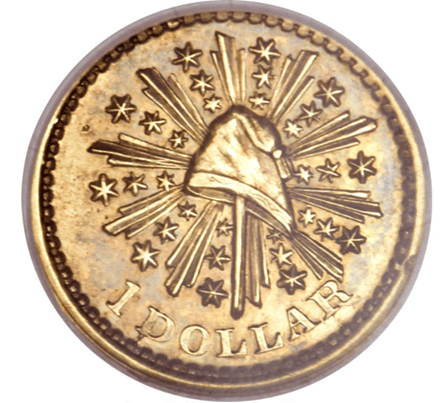
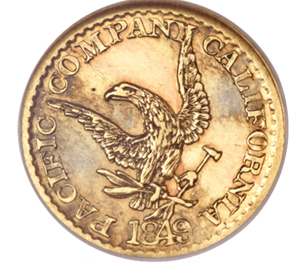
(A Pacific Company $1.00 Gold coin, obverse [left], Reverse [right].)
The $5.00 gold coin has the exact same design, except for the denomination on the obverse being changed to “5 DOLLARS”, and the size is considerably larger. There are no changes to the reverse design.
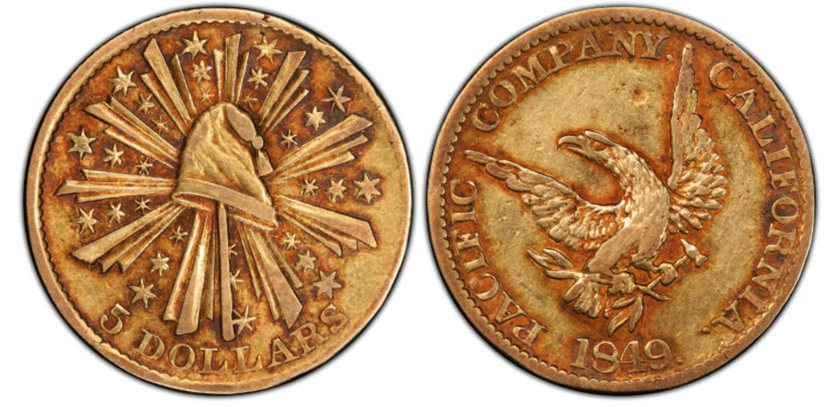
Again, the $10 gold coin version had the exact same design but was larger and bore “10 DOLLARS” as the denomination on the obverse.
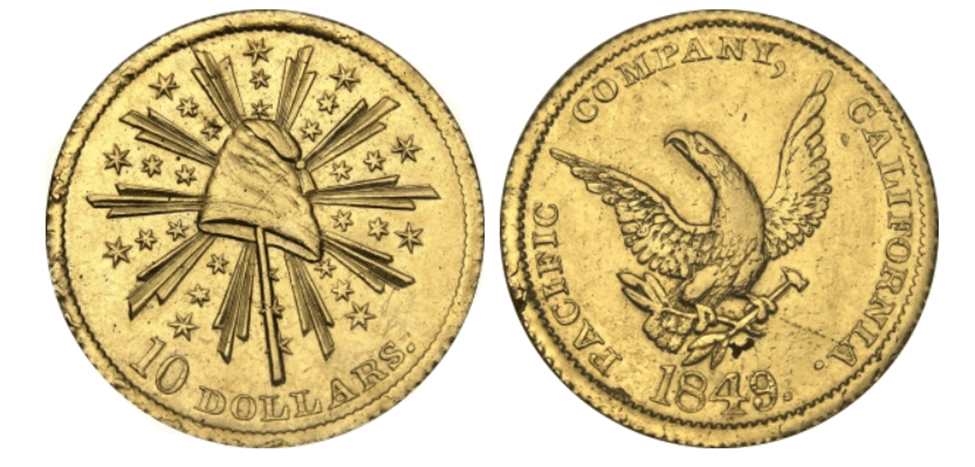
Existing examples of gold coins from the Pacific Company are very few. The 1849 $5 gold piece is considered a rare coin among collectors, with very few known examples, including one that sold for over $1 million. There are four known examples of the $10 piece, and one is stored at the Smithsonian. Only a small number of 1849 Pacific Company $1 gold coins are known to exist today. Expand your collection today and shop our assortment of pre-1933 U.S. gold coins.