


Franklin Half Dollar Values
How Much Franklin Half Dollars are Worth: Franklin Half Dollar Values & Coin Price Chart
Year | Mint | Variety | Designation | VG-8 | F-12 | VF-20 | EF-40 | AU-50 | U-60 | MS-63 | MS-64 | MS-65 | MS-66 | MS-67 |
|---|---|---|---|---|---|---|---|---|---|---|---|---|---|---|
1800 | P | Plain 4- Stemless Wreath | Red-brown | 200 | 300 | 400 | 500 | 600 | 700 | 800 | 900 | 1000 | 1200 | 1100 |
| Year | Mint | Variety | Designation | VG-8 | F-12 | VF-20 | EF-40 | AU-50 | MS-60 | MS-63 | MS-64 | MS-65 | MS-66 |
|---|---|---|---|---|---|---|---|---|---|---|---|---|---|
| 1948 | (None) Phil | -- | -- | $42 | $56 | $42 | $42 | $43 | $66 | $50 | $56 | $94 | $298 |
| 1948 | D | -- | -- | $42 | $56 | $42 | $42 | $58 | $66 | $47 | $63 | $83 | $245 |
| 1949 | (None) Phil | -- | -- | $42 | $56 | $42 | $42 | $58 | $70 | $59 | $76 | $114 | $262 |
| 1949 | D | -- | -- | $42 | $56 | $42 | $43 | $45 | $65 | $61 | $88 | $197 | $830 |
| 1949 | S | -- | -- | $43 | $56 | $43 | $43 | $62 | $95 | $87 | $94 | $116 | $174 |
| 1950 | (None) Phil | -- | -- | $42 | $56 | $42 | $42 | $58 | $62 | $52 | $75 | $124 | $339 |
| 1950 | D | -- | -- | $42 | $56 | $42 | $42 | $58 | $62 | $56 | $68 | $176 | $573 |
| 1951 | (None) Phil | -- | -- | $42 | $56 | $42 | $42 | $58 | $44 | $47 | $54 | $71 | $143 |
| 1951 | D | -- | -- | $42 | $56 | $42 | $42 | $58 | $66 | $52 | $62 | $114 | $357 |
| 1951 | S | -- | -- | -- | -- | -- | -- | -- | $5,500.00 | $13,975.00 | $22,550.00 | $27,250.00 | $44,000.00 |
| 1952 | (None) Phil | -- | -- | $42 | $56 | $42 | $42 | $58 | $66 | $48 | $50 | $72 | $159 |
| 1952 | D | -- | -- | $42 | $56 | $42 | $42 | $58 | $66 | $47 | $52 | $88 | $270 |
| 1952 | S | -- | -- | $42 | $56 | $42 | $42 | $44 | $80 | $74 | $85 | $106 | $148 |
| 1953 | (None) Phil | -- | -- | $42 | $56 | $42 | $42 | $58 | $44 | $46 | $57 | $102 | $227 |
| 1953 | D | -- | -- | $42 | $42 | $42 | $42 | $58 | $66 | $46 | $49 | $78 | $243 |
| 1953 | S | -- | -- | $42 | $56 | $42 | $42 | $58 | $66 | $49 | $53 | $68 | $164 |
| 1954 | (None) Phil | -- | -- | $42 | $56 | $42 | $42 | $58 | $66 | $48 | $50 | $54 | $198 |
| 1954 | D | -- | -- | $42 | $56 | $42 | $42 | $58 | $66 | $47 | $49 | $80 | $249 |
| 1954 | S | -- | -- | $42 | $56 | $42 | $42 | $58 | $66 | $48 | $50 | $56 | $113 |
| 1955 | (None) Phil | -- | -- | $42 | $56 | $42 | $42 | $43 | $66 | $48 | $48 | $70 | $113 |
| 1956 | (None) Phil | -- | -- | $42 | $56 | $42 | $42 | $56 | $66 | $48 | $49 | $56 | $69 |
| 1957 | (None) Phil | -- | -- | $42 | $56 | $42 | $42 | $43 | $66 | $48 | $49 | $49 | $64 |
| 1957 | D | -- | -- | $42 | $42 | $42 | $42 | $43 | $66 | $47 | $49 | $55 | $90 |
| 1958 | (None) Phil | -- | -- | $42 | $56 | $42 | $42 | $43 | $66 | $48 | $49 | $54 | $69 |
| 1958 | D | -- | -- | $42 | $56 | $42 | $42 | $43 | $66 | $48 | $49 | $54 | $89 |
| 1959 | (None) Phil | -- | -- | $42 | $56 | $42 | $42 | $43 | $66 | $48 | $49 | $61 | $264 |
| 1959 | D | -- | -- | $42 | $56 | $42 | $42 | $43 | $66 | $47 | $49 | $60 | $346 |
| 1960 | (None) Phil | -- | -- | $42 | $56 | $42 | $42 | $43 | $66 | $48 | $50 | $61 | $327 |
| 1960 | D | -- | -- | $42 | $42 | $42 | $42 | $43 | $66 | $47 | $49 | $75 | $320 |
| 1961 | (None) Phil | -- | -- | $42 | $56 | $42 | $42 | $43 | $66 | $48 | $50 | $52 | $309 |
| 1961 | D | -- | -- | $42 | $56 | $42 | $42 | $43 | $66 | $47 | $49 | $71 | $274 |
| 1962 | (None) Phil | -- | -- | $46 | $56 | $42 | $42 | $43 | $66 | $48 | $49 | $57 | $338 |
| 1962 | D | -- | -- | $46 | $56 | $42 | $42 | $43 | $66 | $48 | $50 | $62 | $426 |
| 1963 | (None) Phil | -- | -- | $46 | $56 | $42 | $42 | $42 | $61 | $47 | $41 | $46 | $316 |
| 1963 | D | -- | -- | $46 | $56 | $42 | $42 | $42 | $44 | $47 | $49 | $54 | $216 |
History of the Franklin Half Dollar
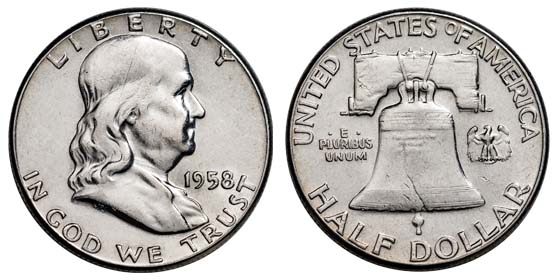
The Franklin Half Dollar was introduced in 1948, marking a break from the traditional U.S. half-dollar designs and replacing the Walking Liberty Half Dollar series, which had been in production since 1916. It features a profile of Benjamin Franklin on the obverse and the famed Liberty Bell, complete with crack, on the reverse. The design was created by John R. Sinnock and launched in part to honor Franklin’s scientific, diplomatic, and philosophical contributions to the United States.
Minted from 1948 until 1963, the Franklin Half Dollar maintains a 90% silver, 10% copper composition (for circulation issues). It was the last regularly-issued U.S. half dollar before the assassination of President John F. Kennedy in late 1963 caused production to shift to the Kennedy design in 1964.
The reverse design also includes a small eagle adjacent to the Liberty Bell, which was required by federal law requiring an eagle on silver coinage. The coin’s aesthetic marked a departure from purely allegorical figures, instead featuring a real statesman and symbol of independence.
When circulated, the Franklin Half Dollar saw widespread use in everyday commerce, though by the late 1950s fewer circulated and many were hoarded or removed from circulation for their silver content. This is part of why, despite large mintages, specific dates and varieties are highly sought by collectors. The combination of historical theme, silver content, and specialized variety interest has sustained long-term demand.
Rarest Coins in the Series
While the Franklin Half Dollar was produced in relatively large quantities compared with many older coin series, certain dates and variety combinations are much rarer and sell for higher prices. A few of the most important include:
- The 1949-S issue: Early San Francisco mint strikes tend to be weaker, making sharp, well-struck examples harder to find.
- The 1953-S issue: This date is often cited as among the toughest regular issues in the series, especially in uncirculated condition with strong Full Bell Lines (FBL).
- The 1955 issue: With a relatively low mintage of 2,498,181 for the P-mint in the series, high-grade examples of this date are hard to find.
- Full Bell Lines (FBL) designation: Regardless of date, coins showing uninterrupted horizontal lines across the Liberty Bell face are far more desirable. These detail-specific criteria often separate average coins from premium examples. Many guides show a significant “grade jump” in value when a coin earns an FBL designation.
In terms of Franklin Half Dollar value, many standard circulated coins start near the silver-melt baseline, but the top varieties in high grades can trade many times over that baseline. For instance, standard circulated examples may be in the several tens of dollars range, while MS-65 or FBL high-grade specimens can reach the low- to mid-thousands.
Types of Collections
Collectors of Franklin Half Dollars may organize their holdings in several common ways, depending on the level of specialization and budget:
- Representative / Type Set: A collector might include a single Franklin Half Dollar (for example, a circulated common date) as part of a broader type set of U.S. half dollars.
- Complete Date-Mint Mark Set: A more extensive collection aims to gather one example of each year and mint mark (Philadelphia, Denver, San Francisco) from 1948 through 1963. The goal might be to acquire coins in decent condition (EF-AU) rather than ultra-high grade.
- Variety or Specialty Set: Some collectors focus on the FBL designation across years, seek coins with known die varieties (e.g., “Bugs Bunny” die clash in 1955, doubled dies, repunched mintmarks), or aim for high-grade examples.
- High-Grade / Investment Grade Set: At the top tier, collectors aim for the best possible examples: high mint state grades (MS65+), FBL designation, minimal marks, strong original surfaces, etc. These coins are fewer and command elevated prices.
Each of these collection types meets different interests. For example, someone might begin with a circulated common date to learn the series; another might aim for a “champion” piece; still another may systematically build a full set of mint marks and grades.
Beginner vs. Advanced Collecting
Beginner Collecting
For those new to coin collecting, the Franklin Half Dollar offers an interesting entry point into silver coinage. Common circulated dates are relatively affordable relative to many older coins, allowing a beginner to become familiar with coin handling, grading lingo, mint marks, and condition factors. Beginners might purchase a circulated 1958 or 1960 Franklin Half in decent shape, examine what marks to watch (hairline scratches, bag marks, toning), and gradually upgrade as they learn. Price guides show many circulated examples trading near the silver value.
Advanced Collecting
At a more advanced level, the collector delves into specialty issues: recognizing FBL designation, separating subtle die varieties, verifying strike quality from different mints, and targeting the highest grades. Advanced collectors understand that small grade differences (MS63 vs MS65) or the presence of an FBL can produce large leaps in price. They also monitor auction results, certification populations, and market trends for premium coins. The advanced side is much more demanding in terms of budget, research, patience, and selectivity. In assessing Franklin Half Dollar value, advanced collectors consider grade populations, detail preservation, and desirability of variety/designation.
Whether a collector is just beginning or is operating at an advanced level, the Franklin Half Dollar series offers meaningful progression from accessible silver coins to high-end numismatic rarity.
Investment Potential
From an investment standpoint, the Franklin Half Dollar series offers several favorable features:
- First, the coins possess 90% silver content (for circulation issues), which provides a base value floor tied to the silver market price.
- Second, strong collector interest in rare dates, mint marks, and FBL designation ensures demand for premium examples. Many price guides and dealer listings show higher grades selling for substantially more, even within this “modern” silver coin series.
- Third, the combination of historical design (Benjamin Franklin and the Liberty Bell) and post-war coinage appeals to both silver stackers and numismatic collectors.
On the flip side, investing in the series does require caution: many common coins exist, so a basic coin may not appreciate significantly beyond silver value; high-grade and variety coins require higher budgets; grading and certification are critical; market timing and the broader numismatic environment matter. For serious pieces, the Franklin Half Dollar’s value can climb substantially, especially for MS-65+ FBL coins of 1949-S, 1953-S, or 1955. It’s also worthwhile to track certified populations (e.g., how many MS65 FBL pieces exist) and recent auction results.
For those willing to focus on examples with strong preservation, recognized variety/grade designations, and strong collector demand, the Franklin Half Dollar series offers silver content plus numismatic interest, with long-term potential for select pieces.