


Trime Values
How Much Trime are Worth: Trime Values & Coin Price Chart
Year | Mint | Variety | Designation | VG-8 | F-12 | VF-20 | EF-40 | AU-50 | U-60 | MS-63 | MS-64 | MS-65 | MS-66 | MS-67 |
|---|---|---|---|---|---|---|---|---|---|---|---|---|---|---|
1800 | P | Plain 4- Stemless Wreath | Red-brown | 200 | 300 | 400 | 500 | 600 | 700 | 800 | 900 | 1000 | 1200 | 1100 |
| Year | Mint | Variety | Designation | VG-8 | F-12 | VF-20 | EF-40 | AU-50 | MS-60 | MS-63 | MS-64 | MS-65 | MS-66 |
|---|---|---|---|---|---|---|---|---|---|---|---|---|---|
| 1851 | (None) Phil | -- | $71 | $84 | $102 | $154 | $205 | $318 | $412 | $614 | $838 | $1,513 | |
| 1851 | O | -- | $130 | $162 | $233 | $375 | $605 | $1,205 | $1,623 | $2,700 | $4,200 | $7,050 | |
| 1852 | (None) Phil | -- | $71 | $133 | $140 | $146 | $194 | $302 | $379 | $584 | $783 | $1,430 | |
| 1853 | (None) Phil | -- | $71 | $81 | $99 | $146 | $194 | $302 | $379 | $584 | $783 | $1,430 | |
| 1854 | (None) Phil | -- | $96 | $104 | $123 | $191 | $277 | $537 | $1,045 | $1,333 | $2,380 | $5,030 | |
| 1855 | (None) Phil | -- | $143 | $172 | $214 | $334 | $570 | $927 | $1,805 | $2,628 | $6,400 | $13,125 | |
| 1856 | (None) Phil | -- | $94 | $104 | $120 | $191 | $277 | $537 | $1,073 | $1,388 | $2,600 | $11,975 | |
| 1857 | (None) Phil | -- | $91 | $104 | $120 | $191 | $282 | $573 | $1,045 | $1,598 | $3,375 | $6,475 | |
| 1858 | (None) Phil | -- | $91 | $104 | $117 | $191 | $282 | $559 | $1,073 | $1,333 | $2,048 | $3,773 | |
| 1859 | (None) Phil | -- | $84 | $94 | $117 | $175 | $246 | $394 | $632 | $857 | $1,363 | $2,445 | |
| 1860 | (None) Phil | -- | $84 | $94 | $117 | $175 | $246 | $394 | $604 | $968 | $1,805 | $5,875 | |
| 1861 | (None) Phil | -- | $84 | $94 | $117 | $175 | $246 | $394 | $604 | $843 | $1,158 | $1,963 | |
| 1862 | (None) Phil | -- | $84 | $94 | $117 | $175 | $246 | $394 | $604 | $843 | $1,158 | $1,963 | |
| 1862/1 | (None) Phil | -- | $86 | $99 | $123 | $188 | $298 | $603 | $749 | $943 | $1,590 | $2,295 | |
| 1863 | (None) Phil | -- | $654 | $720 | $787 | $902 | $1,033 | $1,508 | $2,475 | $3,663 | $4,050 | $5,350 | |
| 1864 | (None) Phil | -- | $692 | $783 | $874 | $1,002 | $1,183 | $1,738 | $2,050 | $2,420 | $3,165 | $4,813 | |
| 1864 | (None) Phil | -- | PL | -- | -- | -- | -- | $1,073 | $1,540 | $1,815 | $2,255 | $3,830 | $5,380 |
| 1865 | (None) Phil | -- | $679 | $745 | $812 | $927 | $1,120 | $2,170 | $3,013 | $4,725 | $5,250 | $5,888 | |
| 1866 | (None) Phil | -- | PL | $715 | $825 | $878 | $1,048 | $1,253 | $1,770 | $2,738 | $3,648 | $4,403 | $5,500 |
| 1866 | (None) Phil | -- | -- | -- | -- | -- | -- | -- | -- | -- | -- | $9,500 | |
| 1867 | (None) Phil | -- | $667 | $733 | $824 | $1,055 | $1,558 | $2,613 | $4,188 | $5,225 | $9,125 | $18,400 | |
| 1868 | (None) Phil | -- | PL | $1,045 | $1,333 | $1,700 | $2,300 | $3,220 | $5,888 | $8,375 | $20,000 | $27,500 | $37,500 |
| 1869/'8' | (None) Phil | -- | $667 | $733 | $837 | $1,168 | $1,560 | $2,380 | $3,195 | $5,103 | $7,563 | $10,875 | |
| 1870 | (None) Phil | -- | $704 | $812 | $902 | $1,123 | $1,385 | $2,145 | $2,640 | $3,180 | $5,475 | $8,500 | |
| 1871 | (None) Phil | -- | $633 | $658 | $799 | $968 | $1,045 | $1,503 | $1,738 | $2,170 | $2,695 | $3,138 | |
| 1871 | (None) Phil | -- | PL | -- | -- | -- | -- | $1,073 | $1,265 | $1,540 | $2,255 | $2,860 | $4,400 |
History of the Trime, Also Known as the Three Cent Piece
The Three Cent Piece, colloquially called the “Trime,” occupies an important spot in U.S. coinage because of its unusual denomination and its role in mid-19th-century commerce. Minted from 1851 to 1889 in silver and nickel-copper alloys, the United States introduced the Three Cent Piece for several reasons, including facilitating the purchase of postage stamps and addressing a shortage of small-denomination coins. Its inception reflects the economic conditions and innovations of mid-19th-century America.
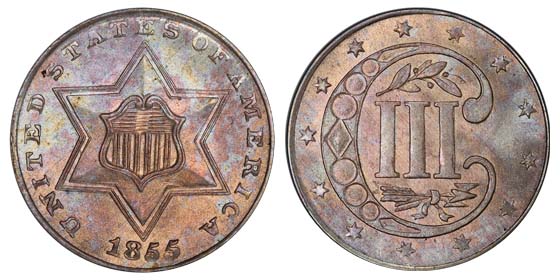
The first design was struck from 1851 to 1873 and made of a silver alloy. James B. Longacre, the fourth chief engraver of the U.S. Mint, designed this version. The second design phase began in 1865 and lasted until the coin’s discontinuation in 1889. This version, called the Nickel Three Cent Piece, used a copper-nickel alloy that matched other U.S. coins of the era.
For the silver three-cent piece (1851–1873): obverse shows a shield on a six-pointed star; reverse shows a Roman III inside a C-shaped ornament with 13 stars. For the nickel three-cent piece (1865–1889): obverse is Liberty Head; reverse is a Roman III inside a laurel wreath.
Rarest Coins in the Series
- 1851 First-Year Issue (“Small Star, Shield on Six-Pointed Star”)
- 1851-O Only New Orleans Mint Trime: The only branch mint issue, significantly scarcer than Philadelphia Trimes.
- 1852-1853 Early Issues: Common as type coins but demand high prices in Mint State.
- 1862/1 Overdate Variety: A major variety collectible, often identified by visible remnants of an earlier date under the 2.
- 1863–1872: low mintage years for silver and copper-nickel alloy.
- 1873 Closed 3 (“Final-year rarity”): A proof-only type, capping the series.
Types of Collections
- Trime Type Set: Collect examples from each design (Type 1, 2, 3). Type 1 (1851–1853), Type 2 (1854–1858, redesign), Type 3 (1859–1873, minor change to numeral “III”). This set is achievable for most collectors and illustrates the visual evolution of U.S. small silver coinage.
- Variety/Higher-Grade Set: Only seek out overdates, proof-only, or choice uncirculated coins.
Beginner vs. Advanced Collecting
Beginner Collecting
Because many silver three-cent pieces (Trimes) are scarce in higher grades, the series is often considered challenging. However, motivated beginners can still start with a few of the more common dates in modest, circulated grades, ideally purchased from reputable dealers or well-established online platforms. Focus on coins with clear shield lines and readable legends, and avoid examples that show harsh cleaning, heavy damage, or active corrosion. Store your coins in archival-quality holders in a dry, stable environment.
Advanced Collecting
Advanced collectors will find Trimes both rewarding and demanding. Many dates are difficult to locate in high grade, and certain late issues are known only as proofs, so assembling a complete set can require years of patient searching through major auctions, established dealers, large coin shows, and well-vetted online venues. Pay close attention to strike quality (especially on Type 2 Trimes), full Roman numeral III, and sharp shield detail, as well as any signs of cleaning or alteration. Be cautious of counterfeits or altered pieces on any high-value dates or varieties, and store important coins in certified holders under stable temperature and humidity to minimize oxidation and protect long-term value.
Investment Potential
Collectors highly value Trimes for their historical significance, rarity, and small size, making them legitimate long-term holdings. The 1851-O, 1863–64, and proof-only dates have trended upward in value, particularly in higher grades. Some proof issues come with third-party grading labels (e.g., PCGS, NGC, sometimes CAC) that add premium value. Choice uncirculated business strikes and well-preserved proof Trimes draw strong demand from advanced collectors and investors.