
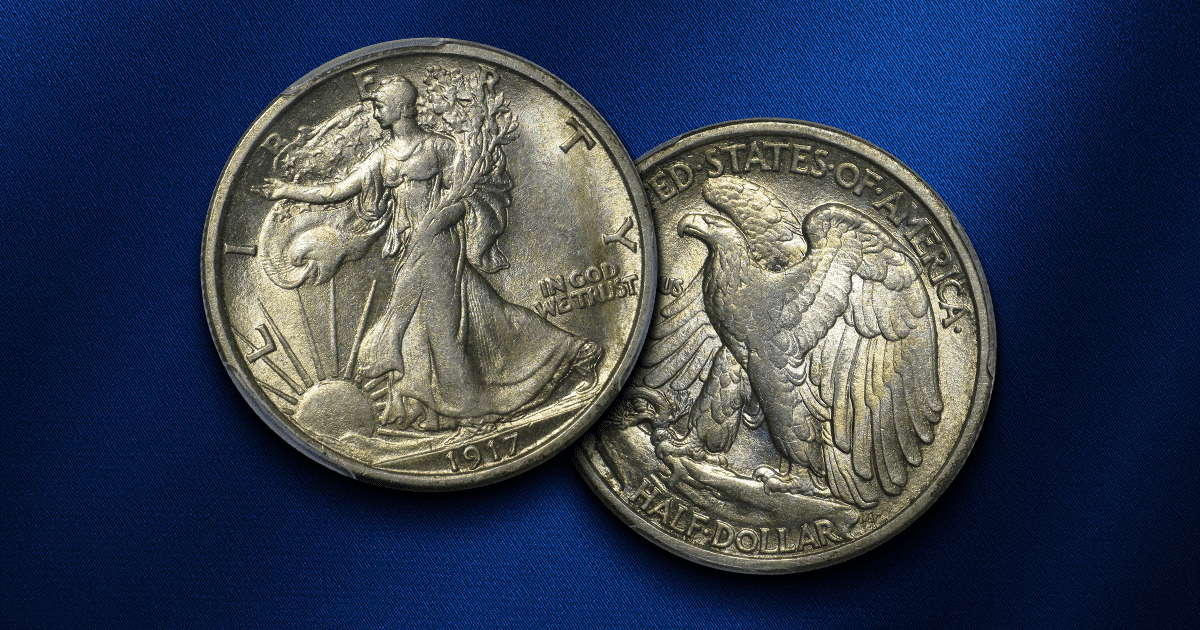
The Walking Liberty half dollar weighs 12.5 grams and has slightly less than one troy half ounce of fine silver (0.3617 oz). It has a diameter of 30.63 millimeters and was designed by Adolph A. Weinman and was issued from 1916 until 1947.
The Walking Liberty half dollar replaced the Barber half dollar as Liberty’s right facing bust was changed to a depiction of Liberty in motion, walking to the left with an outstretched arm, symbolizing freedom and progress. She is walking confidently towards the rising sun, towards hope and a new day, and she exudes optimism during challenging times.
The Weight of a Half Dollar
The weight of a half dollar has varied throughout its centuries of issue, but it has not changed drastically. Below is a table of half dollar weights from 1794 to the present day.
The Kennedy half dollar has experienced the greatest number of compositional and corresponding weight changes. The only 1976 Kennedy half dollars that were 40% silver and 60% copper were from the San Francisco branch of the U.S. Mint and were only found in collector’s sets.
Changes to the Weight of the Half Dollar from 1794 to Date
| Type | Years of Issue | Weight | Composition |
| Flowing Hair | 1794-1795 | 13.48 grams | .900 Silver .100 Copper |
| Draped Bust | 1796-1807 | 13.48 grams | .900 Silver .100 Copper |
| Capped Bust | 1807-1839 | 13.48 grams | .900 Silver .100 Copper |
| Seated Liberty | 1839-1891 | 12.44 grams | .900 Silver .100 Copper |
| Barber | 1892-1915 | 12.50 grams | .900 Silver .100 Copper |
| Walking Liberty | 1916-1947 | 12.50 grams | .900 Silver .100 Copper |
| Franklin | 1948-1963 | 12.50 grams | .900 Silver .100 Copper |
| Kennedy | 1964 | 12.50 grams | .900 Silver .100 Copper |
| Kennedy | 1965-1970, 1976 | 11.50 grams | .400 Silver .600 Copper |
| Kennedy | 1971-Date | 11.34 grams | .250 Nickel .750 Copper |
How Much Weight Do Coins Lose in Circulation?
Whether they are held as prized treasures or circulated as currency, most coins have a metallic composition made to withstand the effects of time. However, normal circulation can have a gradual impact as a result of handling. Continuous handling of a coin and exposure to environmental risk factors remove subtle particles from the surface of a coin. This erosion is almost always hidden from the naked eye.
As this surface erosion is typically so minute that it cannot be observed except by using a microscope, the loss remains very minimal. Weight reduction might have a minor impact on the intrinsic precious metal value of a coin, but since most numismatic coins are valued higher than their melt value, lost weight is rarely, if ever, proportional to a loss in the value of a coin.
If you are buying historic coins and numismatic items from yesteryear, it is a good practice to be mindful of imitations, forgeries, and fakes. There are ways to mitigate these risks, like checking the weight, diameter, and design of coins. The best way to be certain that you are purchasing authentic products is to buy from a reputable dealer. If you are unsure of the legitimacy of a shop or dealer, it is wise to glance over recent reviews they have received.
Collecting Half Dollar Coins
Regardless of which half dollar issues you collect and their respective weight, collecting U.S. half dollars is a popular and tangible way to explore and preserve United States history. The variety of designs and compositional changes tell a valuable story and provide insight into different periods of the nation’s history. Collectors and numismatists alike appreciate the historical significance and connection to past eras add to coin collections.