
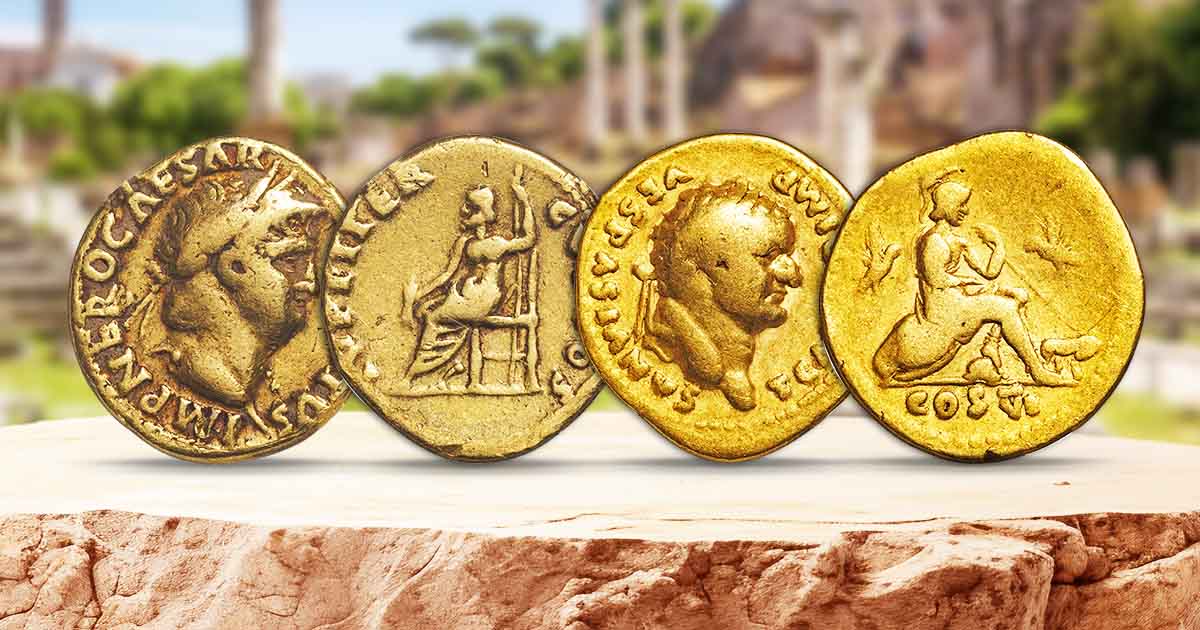
The aureus was a gold coin of the Roman Empire regularly issued from the time of Caesar Augustus in the first century B.C.E. until the reign of Constantine in the fourth century.
Size and Weight of the Aureus
The aureus was roughly the same size as a denarius but, because of the density of gold, was heavier than the silver denarius. It had been struck infrequently before the reign of Julius Caesar, who had the aureus struck regularity and standardized the weight at 1/40 of a Roman pound, or about 8 grams.
The Gold Aureus Lost Mass from Emperor to Emperor
| Emperor | Year | Gold Content | Aureus Weight |
| Julius Caesar | 50 BCE | 8.18 grams | 1.000 |
| Nero | 64 BCE | 7.27 grams | 0.889 |
| Caracalla | 213 CE | 6.55 grams | 0.800 |
| Severus Alexander | 235 CE | 6.08 grams | 0.740 |
| Gordian III | 240 CE | 4.96 grams | 0.610 |
| Decius | 250 CE | 3.58 grams | 0.440 |
| Gallienus | 255 CE | 3.40 grams | 0.420 |
| Gallienus | 265 CE | 3.07 grams | 0.380 |
| Claudius Gothicas | 269 CE | 5.38 grams | 0.660 |
| Diocletian | 301 CE | 5.45 grams | 0.667 |
| Constantius Chlorus | 305 CE | 4.55 grams | 0.556 |
Nero
During the reign of Nero (54-68), the mass of a gold aureus was reduced to 1/45 of a Roman pound or about 7.3 grams, while the purity of silver coins improved. Production of aurei was reduced following the reign of Marcus Aurelius (161-180 C.E.).
Caracalla
Amid the rule of Caracalla (198-217 C.E.), the mass of an aureus was again reduced, this time to 1/50 of a Roman pound or 6.5 grams.
Gallienus
In the time of Gallienus (253-268 C.E.), the purity of gold coins suffered and was reduced to 94%. Some coins from this period are as low as 80% pure.
Gothicas
Claudius II Gothicas (268-270) did not rule the Roman Empire for long, but he was able to restore the purity of Roman coinage to 99%.
Diocletian
Around 301 C.E. Diocletian (284-305) had the first Roman solidus struck in exceedingly small quantities. Diocletian’s solidus weighed about 5.5 grams of pure gold but did not make a large economic impact.
The first solidus did not impact historians, either. There is only one document from Diocletian’s rule that even used the word solidus.
Constantine I
Constantine I is generally credited with replacing the aureus with the solidus in 312 C.E. Constantine’s solidus held 24 Greco-Roman carats, which is about 4.5 grams of gold.
Value of a Gold Aureus
The aureus was initially valued at 25 silver denarii. The value fluctuated with the economic tides of its time, and the value of gold can change drastically over several centuries.
In the time of Augustus Caesar, legionaries were paid 225 denarii per year and therefore, a Roman legionnaire could be paid nine gold aurei per year.
A direct result of the Roman government issuing coins made from base metals and a refusal to accept any coins but silver and gold for paying taxes was runaway inflation. To make Roman inflation even worse, the value of an aureus grew inversely with the debasement of the silver denarius.
By the third century C.E., the Roman denarius contained little silver content. In 301, a gold aureus was worth 833.33 denarii. By 324, a gold aureus was worth 4350 denarii. In 337, one solidus was the equivalent of 275,000 denarii and by 356, a solidus was worth 4,600,000 denarii.
| Year | Gold Aureus Value | Silver Denarii Value |
| 301 C.E. | 1 | 833.33 |
| 324 C.E. | 1 | 4350 |
| 337 C.E. | 1 | 275,000 |
| 356 C.E | 1 | 4,600,000 |
In today’s world, gold Roman coins, like the gold aurei are coveted by collectors and command a high premium for their purity and historic value.