
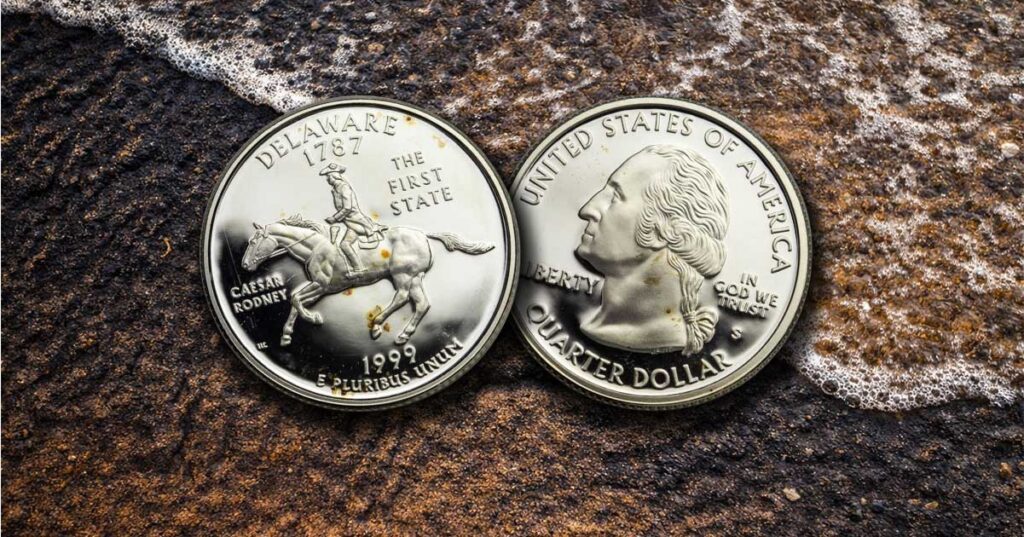
The Delaware state quarter was released in 1999 as the first coin in the U.S. Mint’s 50 State Quarters Program. The quarter features Caesar Rodney riding horseback during his historic ride to Philadelphia, where his vote helped secure support for independence. A variety of legitimate mint-made errors and die varieties have been discovered on this issue, making it a popular coin among collectors of state quarter errors. One of the most well-known quarter issues is the “Spitting Horse” error.
Die Cracks and the “Spitting Horse” Variety
Die cracks develop when coin dies begin to fracture after repeated use. One of the best-known Delaware quarter varieties is the “Spitting Horse,” where a die crack extends from the horse’s mouth, creating the appearance that the horse is spitting.
Physical Diagnostics of Die Cracks
- Raised Lines: Thin raised lines may cross the fields, lettering, or devices.
- Continuous Flow: Genuine die cracks travel naturally through the design rather than appearing randomly.
- No Surface Damage: The lines are raised instead of cut into the coin.
Frequency
Minor die cracks have been reported on Delaware quarters from both Philadelphia and Denver mints. Larger examples are considerably less common.
Off-Center Strike Errors
Off-center strikes happen when the planchet is improperly positioned during the striking process. Part of the design fails to transfer onto the coin, leaving a blank curved section.
Physical Diagnostics
- Curved Blank Area: A smooth crescent-shaped blank section appears along the edge.
- Missing Details: Portions of the date, lettering, or Caesar Rodney design may be absent.
- Normal Detail Elsewhere: The struck section usually remains sharp and fully detailed.
Frequency
Examples that show major off-center shifts yet keep the full date typically draw higher collector interest.
Cud Errors
Cuds form when a piece of the die breaks away near the rim, creating a raised blob of metal on the struck coin.
Physical Diagnostics
- Raised Rim Blob: Thick raised metal appears near the edge of the coin.
- Interrupted Rim: Part of the normal rim may disappear beneath the cud.
- Smooth Texture: Genuine cuds appear rounded and integrated into the strike.
Frequency
Large cud errors on Delaware quarters are scarce but collectible. Certified examples with obvious rim breaks are especially desirable among state quarter error collectors.
Struck-Through Errors
Struck-through errors occur when grease or debris becomes trapped between the die and planchet during striking, preventing part of the design from fully transferring.
Physical Diagnostics
- Weak Design Areas: Portions of the design appear faint or missing.
- Irregular Depressions: The affected section often looks recessed or uneven.
- Smooth Surfaces: Genuine struck-through areas lack signs of scraping or damage.
Frequency
Delaware quarters with struck-through errors appear periodically in circulation. Examples with dramatic missing details or clearly visible strike-through material often bring stronger premiums.
Clad Layer Errors
Modern quarters are struck using a copper core bonded between outer nickel-clad layers. Occasionally, bonding problems occur during production.
Physical Diagnostics
- Copper Exposure: Missing outer layers expose the reddish copper core.
- Abnormal Weight: Coins with missing clad layers weigh less than standard quarters.
- Uneven Coloration: Portions of the surface may display unusual color contrast.
Frequency
Missing-clad-layer Delaware quarters are scarce and actively collected by error specialists.
Wrong Planchet Errors & Experimental Planchet Errors
A small number of Delaware quarters have been discovered struck on planchets intended for other denominations. In some cases, Delaware quarters have been discovered to have been struck on experimental planchets originally produced for Sacagawea dollar testing.
Physical Diagnostics
- Incorrect Weight: The coin weighs differently from a normal quarter.
- Different Size: The diameter may appear too small or too large.
- Unusual Color: The surface may display bronze, gold, or pale silver coloration.
- Incomplete Design: Incorrect planchet sizes often prevent full design transfer.
Frequency
Wrong-planchet and experimental planchet Delaware quarter errors remain very rare. Because of their value and rarity, professional authentication is strongly recommended.
Delaware Quarter Error Values
Values for Delaware quarter errors depend on the type of mistake, overall condition, visibility of the error, and market demand. Minor die cracks typically sell for modest premiums, while dramatic off-center strikes, clad-layer errors, and wrong-planchet examples can command significantly higher prices.
Identifying Authentic Delaware Quarter Errors
Collectors should examine suspicious coins under magnification while paying close attention to rims, lettering, and surface texture. Genuine mint errors display smooth and consistent characteristics produced during the striking process rather than damage caused after the coin entered circulation.
A precise digital scale is especially useful when investigating possible wrong planchet or clad layer errors. Comparing potential finds to certified examples from grading companies such as PCGS and NGC can also help confirm authenticity.
As the first release in the 50 State Quarters Program, the Delaware quarter continues to attract strong collector attention. Certified mint errors and unusual strike abnormalities remain popular among collectors focused on modern U.S. coinage.