
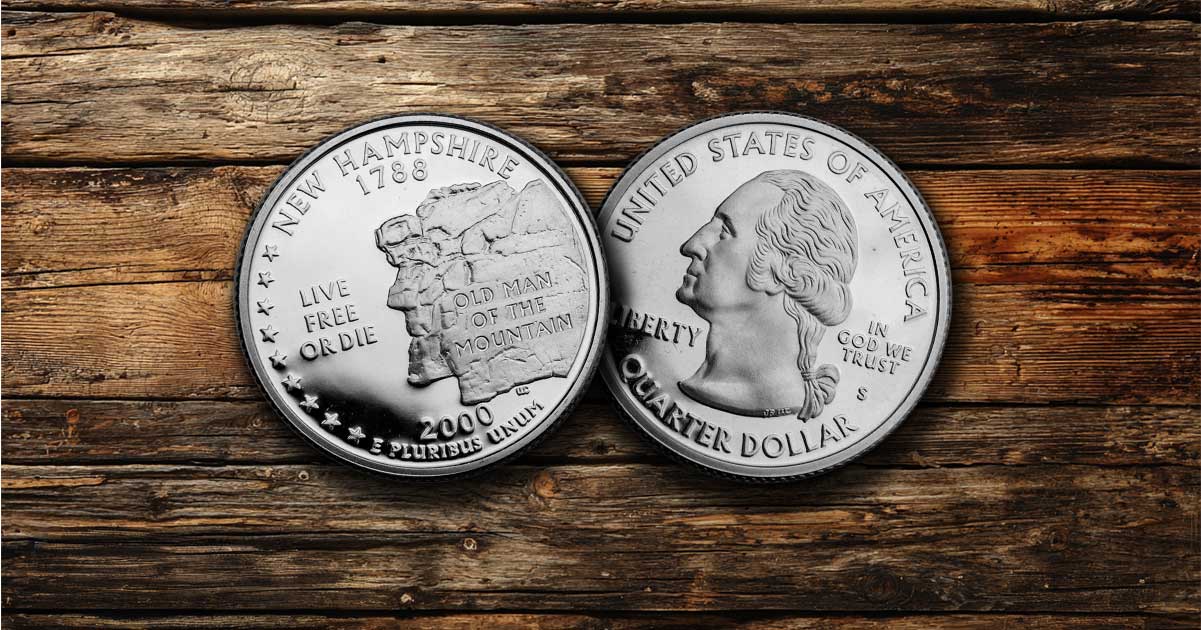
The New Hampshire state quarter, released in 2000 as part of the U.S. Mint’s 50 State Quarters Program, features the Old Man of the Mountain rock formation, the state motto “Live Free or Die,” and nine stars representing New Hampshire as the ninth state to join the Union. While the New Hampshire quarter is not known for a single famous mainstream variety, several documented mint-made errors and die varieties have been confirmed for the issue.
2000-P Doubled Die Obverse
One documented New Hampshire quarter variety is the 2000-P doubled die obverse. This variety is minor and usually requires magnification to identify.
Physical Diagnostics
- Raised Secondary Detail: A true doubled die shows raised doubling that is part of the struck design.
- Obverse Location: The doubling appears on the Washington side of the coin rather than the New Hampshire reverse.
- Consistent Placement: Verified examples should match the known location of the attributed variety.
Frequency
The 2000-P New Hampshire doubled die obverse is documented, but it is not considered a major dramatic doubled die. It is mainly collected by specialists who search state quarters for attributed die varieties.
Off-Center Strike Errors
Off-center strikes occur when the planchet is not properly aligned between the dies during striking. This causes only part of the design to transfer onto the coin.
Physical Diagnostics
- Blank Crescent Area: A smooth, unstruck section appears along one side of the coin.
- Missing Design Elements: Portions of the date, lettering, stars, or Old Man of the Mountain design may be absent.
- Sharp Remaining Detail: The struck portion should still show clear design detail.
- Shifted Design Placement: The design appears displaced from the center of the coin.
Frequency
Off-center New Hampshire quarters are scarce but documented. Examples that retain the full date while showing a noticeable shift are generally more desirable.
Missing Clad Layer Errors
Missing clad layer errors occur when one of the outer copper-nickel layers is absent. This exposes the copper core beneath the surface.
Physical Diagnostics
- Copper-Colored Surface: One side of the coin may show reddish, orange, brown, or copper-gold tones instead of the normal silver-gray color.
- Reduced Weight: A quarter missing a clad layer usually weighs less than a standard quarter.
- Visible Edge Contrast: The edge may show a difference between the remaining clad layer and the exposed copper core.
- Normal Strike Detail: The design should still appear struck into the coin rather than worn away, stained, or chemically altered.
Frequency
Certified examples are known with a missing clad layer, including coins struck at both the Philadelphia and Denver Mints.
Double Strike Errors
Double strike errors occur when a coin receives more than one impression from the dies. This can happen when the coin does not eject properly after the first strike and is struck again.
Physical Diagnostics
- Repeated Design Elements: Portions of the design may appear more than once.
- Rotated or Shifted Second Strike: The second impression may be slightly rotated or displaced from the first strike.
- Distorted Rim: Multiple strikes can change the rim or edge appearance.
- Raised Design Details: Genuine double strikes show struck design features rather than scratches, dents, or flattened damage.
Frequency
Double-struck New Hampshire quarters are rare but documented. Certified examples with visible remnants of the first strike are especially collectible.
Broadstrike and Type One Planchet Errors
A broadstrike occurs when a coin is struck outside the retaining collar, allowing the metal to spread outward. A Type One planchet is a blank that has not gone through the upsetting process to form a raised proto-rim.
Physical Diagnostics
- Expanded Diameter: The coin may appear wider than a normal quarter.
- Weak or Missing Rim: The normal raised rim may be incomplete or absent.
- Out-of-Collar Appearance: The edge may look abnormal because the collar did not contain the strike.
- Full Design Visibility: Many broadstruck coins still retain most of the central design.
Frequency
Broadstruck New Hampshire quarters are documented, including examples struck out of collar. Some certified examples have also been reported on Type One planchets, though these are considerably rarer.
Error Quarter Market Value
New Hampshire quarter error values depend on rarity, condition, eye appeal, and the strength of the error. Double strikes, missing clad layer examples, broadstrikes, and off-center strikes generally attract stronger premiums than minor doubled die varieties. Proper attribution and certification are especially important for high-value pieces.
How to Identify Authentic New Hampshire Quarter Errors
Collectors should inspect New Hampshire quarters carefully under magnification, especially around Washington’s earlobe, the rim, lettering, stars, and the Old Man of the Mountain design. True doubled die features should be raised and match known attribution points.
A precision digital scale can help identify missing clad layer errors and unusual planchets. Coins with unusual color should be evaluated carefully because toning, staining, environmental damage, and chemical alteration are often mistaken for mint errors.
For valuable New Hampshire quarter errors, comparison with certified examples from PCGS, NGC, or another established numismatic reference is recommended. While most circulated New Hampshire quarters are common, documented mint-made errors and properly attributed varieties continue to interest modern error coin collectors.