
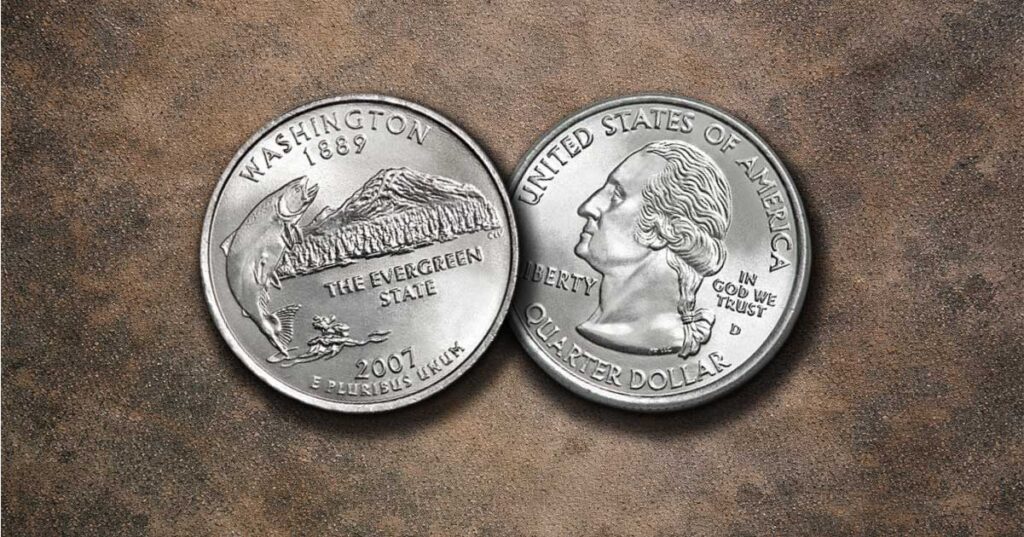
Released in 2007 as part of the U.S. Mint’s 50 State Quarters Program, the Washington state quarter showcases imagery associated with the Pacific Northwest, including a salmon, evergreen forests, and Mount Rainier. While the issue does not feature one standout error comparable to famous state quarter errors, collectors continue to pursue several notable strike and die-related errors found on Washington quarters.
Off-Center Strike
An off-center strike happens when the coin blank is improperly positioned during the striking process. As a result, part of the design fails to transfer onto the coin, leaving a smooth blank area along the edge.
Physical Diagnostics
- Blank Area: A curved empty section appears where the strike missed part of the planchet.
- Missing Design Elements: Portions of the date, lettering, or reverse imagery may be absent.
- Clear Remaining Details: The visible portions of the design should still appear sharp and fully struck.
Frequency
Washington quarters that still display the date and enough of the reverse design to identify the issue typically receive the strongest collector interest.
Missing Clad Layer
Certain Washington quarters were struck on planchets missing one of the outer clad layers, exposing the copper core underneath the surface metal.
Physical Diagnostics
- Copper Toning: One face of the coin may show a strong copper-red color instead of the standard silvery appearance.
- Lower Weight: Coins missing a clad layer weigh less than normal quarters.
- Visible Layer Separation: The edge may show a noticeable division between the clad surface and exposed copper core.
- Well-Defined Strike: Design elements usually remain bold despite the missing outer layer.
Frequency
Although not extremely common, these Washington quarter errors remain popular among collectors.
Die Cracks and Cuds
Die cracks and cuds develop when dies weaken or fracture due to repeated use. Cracks create raised lines across the coin, while cuds form raised lumps near the rim where part of the die breaks away.
Physical Diagnostics
- Raised Die Lines: Die cracks appear as elevated lines extending across the design.
- Rim Blobs: Cuds create thick, raised areas that often connect to the rim.
- Continuous Patterns: Genuine die cracks usually run uninterrupted through letters or devices.
Frequency
Small die cracks appear periodically on Washington quarters, while larger cud errors are considerably scarcer. More dramatic examples are the most likely to receive third-party certification.
Error Quarter Market Value
The value of Washington quarter errors depends on factors such as rarity, condition, eye appeal, and the severity of the mistake. Certified examples in higher grades generally command the largest premiums. Strong off-center strikes, major cud errors, and missing clad layer errors are typically among the most valuable Washington quarter errors.
How to Spot and Authenticate Washington Quarter Errors
Collectors should examine coins from the 50 State Quarters Program carefully with magnification, paying close attention to lettering, rims, and surface texture. Legitimate Mint errors display smooth and consistent characteristics rather than evidence of scratches, cuts, or post-mint alteration. Using a precision scale can also help identify possible clad-layer or planchet-related errors.
When evaluating potentially valuable pieces, collectors often compare them to certified examples from grading services such as PCGS and NGC. Professional authentication is especially important for rare or high-value Washington quarter errors.