
Conder Tokens and the Franklin Connection
The 1794 Franklin Press Token belongs to a group of late 18th century British provincial issues commonly called Conder tokens. These pieces were privately produced during a time when Britain faced an ongoing shortage of small denomination copper coinage needed for routine transactions. In response, merchants and entrepreneurs issued tokens that could pass locally as small change, while also serving other purposes such as advertising, civic promotion, or commemoration. Collecting Conder tokens began early, which helps explain why many survive in high grade. The Franklin Press token in particular is often found in relatively high condition, though preservation varies across the broader Conder token series.
Although struck in Britain, the Franklin Press token attracts U.S. collectors because it carries Benjamin Franklin’s name, a Founding Father closely associated with printing, education, and public life. It is commonly described as an English tradesman’s token, and it appears in U.S. colonial and post-colonial collecting references largely because of the Franklin association.
The wording ties the token to London and a specific issuer, which strongly suggests it was made for use within Britain’s token economy, not for circulation in America. Its precise origin and distribution are unclear. The reverse names a London business, pointing to a home market in Britain rather than in the former colonies. Still, examples crossed the Atlantic over time through travel, trade, and later numismatic demand, and many were saved as Franklin-related curiosities instead of being spent.
Design, Specifications, and Edge Types
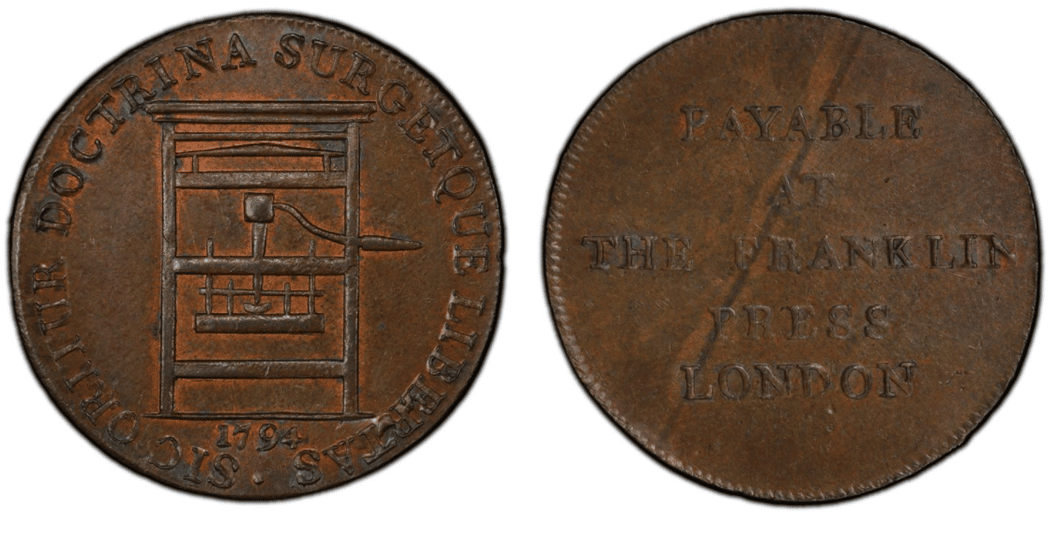
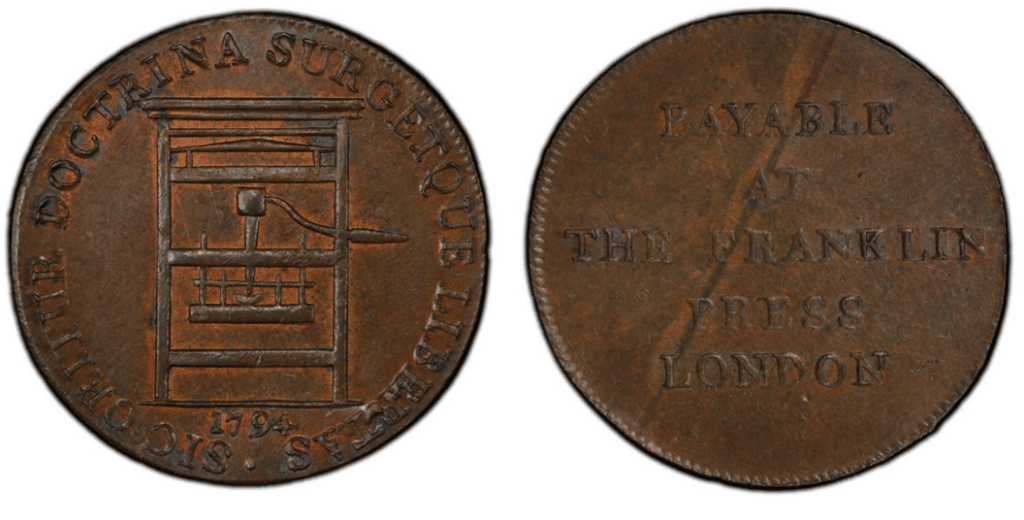
The obverse features a detailed, hand operated printing press with the date 1794 beneath the device. Encircling the scene is the Latin legend “SIC ORITUR DOCTRINA SURGETQUE LIBERTAS”, commonly translated as “THUS LEARNING BEGINS AND LIBERTY ARISES”. The message is direct: the printed word fosters learning, and learning supports liberty, a theme that aligns neatly with Franklin’s identity as a printer and advocate of civic improvement.
The reverse is entirely textual and reads “PAYABLE AT THE FRANKLIN PRESS LONDON”. This is a crucial distinction from official coinage. Rather than declaring a denomination and sovereign authority, the token reads like a promise associated with a named establishment, reinforcing its character as a payable token instead of government issued money.
In standard references, the usual collectible variety is described as a Middlesex Conder Halfpenny and is cataloged in Dalton and Hamer as number 307a for the plain edge type. Typical specifications cited for the token include a diameter of about 28.6 mm and a weight around 7.58 grams.
Edge varieties make the Franklin Press token notable. Most pieces are encountered with a plain edge, and that is the form collectors can realistically pursue. Two other edge types are recorded but are effectively unobtainable: one with the lettered edge “AN ASYLUM FOR THE OPPRESS’D OF ALL NATIONS”, and one with a diagonally reeded edge. Major summaries describe both edge variants as unique, and certification records underscore just how rarely they appear.
Finally, the condition profile of the issue stands out. Many surviving pieces grade About Uncirculated or better, and it is difficult to locate heavily worn examples. That pattern is consistent with a token that circulated lightly, was saved as a keepsake, or was obtained by early collectors, which is behavior commonly seen across the wider Conder token series.