
French Colonial Issues (1670-1722)
Colonial and post-colonial coinage in the Americas created a varied mix of money that circulated alongside wampum, grain, barter, and private tokens. During this period, foreign coins and colonial issues mixed with wampum, grain, barter and privately-minted tokens for a chaotic system of trade that did not standardize until far later.
French Colonial Issue Design
The history of early United States coins embraces a wide variety of money, not just coins minted within the United States itself. Foreign coins circulated in early America, and some foreign gold and silver coins retained legal-tender status in the United States until 1857. Even under British rule, the colonies often faced coin shortages and relied on a mix of foreign coins and substitutes. Spanish American silver was especially important, and British coins appeared in circulation but were not necessarily the dominant everyday coinage in every region. The Spanish eight-reales coin circulated widely in colonial America and later influenced the U.S. dollar. British copper and silver coins also circulated, but availability varied and they were not always the dominant share of coinage.
Foreign coins were not the only circulating currency in the New World. Private issues were also available, and some colonies and later states produced locally authorized coinage. Massachusetts is the best-known early colonial example, beginning in 1652. New Jersey’s state coppers came later after independence, and Maryland-related pieces are often classified as proprietary or private issues rather than straightforward colonial state coinage. There are several major private issues that were created in the Americas and saw varying degrees of circulation. Some coin and token issues were produced under British authority or patent for use in the American colonies, often manufactured in Great Britain and shipped to North America.
The French colonial coins did not have any specific relation to the territories that would become part of the United States. All coins were issued as general New World colonial coins, not tied to a region. Coins were authorized for the French territories in Acadia, New France, Newfoundland and the West Indies in 1670. From 1717 through 1722, coins were authorized for New France, Louisiana, and the West Indies.
In 1670, an edict authorized silver 5 sols and 15 sols and authorized a copper 2 deniers piece, often called a double. The copper piece did not go into regular production and only one example is known, so it is often treated as a trial or non-issued specimen. Large numbers of silver five-sol and fifteen-sol pieces were struck in 1670, although records disagree on how widely they circulated in the colonies.
The 1717 colonial issues included copper 6 deniers and 12 deniers, and the 1720 issues included copper 6 deniers and a silver 20 sols. These issues were produced in limited quantities and are considered scarce today. In 1717, small quantities of copper 6 deniers and 12 deniers were struck, but the coinage was soon aborted due to problems with the alloy and copper quality.
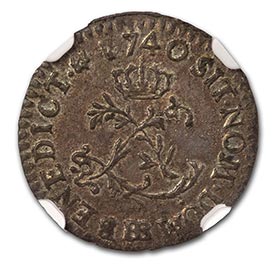
Various coins were struck from the silver alloy billon between 1709 and 1760. These include the 15-denier, 30-denier, half sou and sou marque. Most dates are scarce; the 1740 half-sou is the main exception.
In 1721 and 1722, copper 9 deniers (sou) were struck on planchets imported from Sweden, and large quantities were shipped to New France. Circulation in Canada appears to have been limited, and some accounts describe later redistribution or use in Louisiana under different conditions. Colonists preferred silver, so only limited numbers of the copper pieces reached local circulation.
A later French Colonies sou issue was commonly counterstamped RF for use in the French Caribbean during the Revolutionary era, and many of those counterstamped pieces later circulated in American trade channels, including Louisiana. These pieces were not U.S. federal legal tender, but they did circulate by custom in some places where people accepted a variety of foreign and token coinage at agreed values.
Historical Significance
Most of these coins are rare today, and they are particularly hard to find in the United States. The 1720 issues are sometimes collected in connection with the John Law era and the financial turmoil associated with the Mississippi Company, as well as for their place in early French colonial coinage.
Numismatic Value
High-grade examples are scarce and command strong prices. France had skilled mints, but they still have some individualism between dies. Because of the handmade dies, coins can be collected in types based on the die that was used for the strike. Some of these have very few examples surviving, including the 1670-A Copper double which is unique.